Hyaenodontoidea
Hyaenodontoidea ("hyena teeth") is a superfamily of extinct predatory mammals from extinct order Hyaenodonta. Fossil remains of these mammals are known from early Eocene to early Miocene deposits in North America, Europe and Asia.[2][3]
| Hyaenodontoidea | |
|---|---|
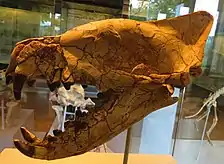 | |
| skull of Hyaenodon horridus | |
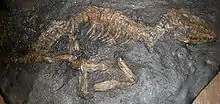 | |
| fossil of Lesmesodon edingeri | |
Scientific classification  | |
| Domain: | Eukaryota |
| Kingdom: | Animalia |
| Phylum: | Chordata |
| Class: | Mammalia |
| Order: | †Hyaenodonta |
| Superfamily: | †Hyaenodontoidea Leidy, 1869[1] |
| Families | |
Classification and phylogeny
Taxonomy
- Superfamily: †Hyaenodontoidea (Leidy, 1869)
- Family: †Hyaenodontidae (Leidy, 1869)
- Family: †Proviverridae (Schlosser, 1886)
Phylogeny
The phylogenetic relationships of superfamily Hyaenodontoidea are shown in the following cladogram:[4][5][6][7][8]
| †Hyaenodonta |
|
|||||||||||||||||||||||||||||||||||||||||||||||||||||||||||||||||||||||||||||||||||||||||||||||||||||||||||||||||||||||||||||||||||||||||||||||||||||||||||||||||||||||||||||||||||||||||||||||||||||||||||||||||||||||||||||||||||||||||||||||||||||||||||||||||||||||
See also
References
- Leidy J. (1869.) "On the extinct Mammalia of Dakota and Nebraska: including an account of some allied forms from other localities, together with a synopsis of the mammalian remains of North America." Journal of the Academy of Natural Sciences Philadelphia 7: 1–472.
- L. Van Valen (1967.) "New Paleocene insectivores and insectivore classification." Bulletin of the American Museum of Natural History 135(5):217-284
- Floréal Solé; Bastien Mennecart (2019). "A large hyaenodont from the Lutetian of Switzerland expands the body mass range of the European mammalian predators during the Eocene". Acta Palaeontologica Polonica. 64 (2): 275–290. doi:10.4202/app.00581.2018.
- Borths, Matthew R.; Stevens, Nancy J. (2017). "Deciduous dentition and dental eruption of Hyainailouroidea (Hyaenodonta, "Creodonta," Placentalia, Mammalia)". Palaeontologia Electronica. 20 (3): 55A. doi:10.26879/776.
- Matthew R. Borths; Nancy J. Stevens (2019). "Simbakubwa kutokaafrika, gen. et sp. nov. (Hyainailourinae, Hyaenodonta, 'Creodonta,' Mammalia), a gigantic carnivore from the earliest Miocene of Kenya". Journal of Vertebrate Paleontology. 39 (1): e1570222. Bibcode:2019JVPal..39E0222B. doi:10.1080/02724634.2019.1570222. S2CID 145972918.
- Floréal Solé; Bernard Marandat; Fabrice Lihoreau (2020). "The hyaenodonts (Mammalia) from the French locality of Aumelas (Hérault), with possible new representatives from the late Ypresian". Geodiversitas. 42 (13): 185–214. doi:10.5252/geodiversitas2020v42a13. S2CID 219585388.
- Solé, F.; Morlo, M.; Schaal, T.; Lehmann, T. (2021). "New hyaenodonts (Mammalia) from the late Ypresian locality of Prémontré (France) support a radiation of the hyaenodonts in Europe already at the end of the early Eocene". Geobios. 66–67: 119–141. Bibcode:2021Geobi..66..119S. doi:10.1016/j.geobios.2021.02.004. S2CID 234848856.
- Averianov, Alexander; Obraztsova, Ekaterina; Danilov, Igor; Jin, Jian-Hua (2023). "A new hypercarnivorous hyaenodont from the Eocene of South China". Frontiers in Ecology and Evolution. 11. doi:10.3389/fevo.2023.1076819. ISSN 2296-701X.