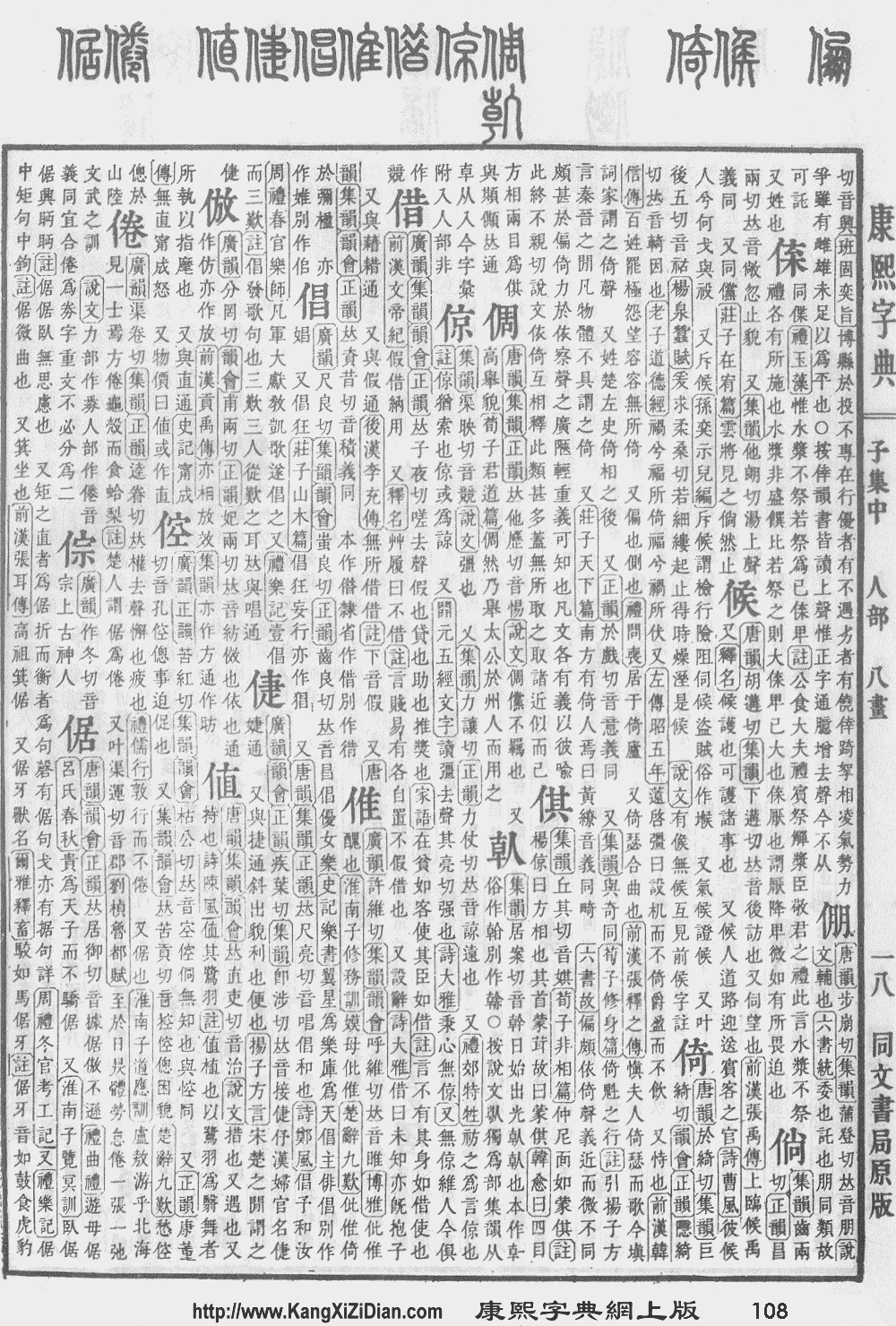
倚

See also: 徛
倚 U+501A, 倚
CJK UNIFIED IDEOGRAPH-501A
← 候
[U+5019]
CJK Unified Ideographs 倛 →
[U+501B]

Translingual

Han character

倚 (Kangxi radical 9, 人+8, 10 strokes, cangjie input 人大一口 (OKMR), four-corner 24221, composition ⿰亻奇)

References

  • KangXi: page 108, character 5
  • Dai Kanwa Jiten: character 776
  • Dae Jaweon: page 230, character 1
  • Hanyu Da Zidian (first edition): volume 1, page 173, character 1
  • Unihan data for U+501A

Chinese

simp. and trad.
倚

Glyph origin

Historical forms of the character 倚


References:

Mostly from Richard Sears' Chinese Etymology site (authorisation),
which in turn draws data from various collections of ancient forms of Chinese characters, including:

  • Shuowen Jiezi (small seal),
  • Jinwen Bian (bronze inscriptions),
  • Liushutong (Liushutong characters) and
  • Yinxu Jiaguwen Bian (oracle bone script).

Pronunciation


Note:
  • óa - vernacular;
  • í - literary.

Rime
Character 倚 倚
Reading # 1/2 2/2
Initial (聲) 影 (34) 影 (34)
Final (韻) 支 (13) 支 (13)
Tone (調) Rising (X) Departing (H)
Openness (開合) Open Open
Division (等) III III
Fanqie 於綺切 於義切
Reconstructions
Zhengzhang
Shangfang
/ʔˠiᴇX/ /ʔˠiᴇH/
Pan
Wuyun
/ʔᵚiɛX/ /ʔᵚiɛH/
Shao
Rongfen
/ʔiɛX/ /ʔiɛH/
Edwin
Pulleyblank
/ʔjiə̆X/ /ʔjiə̆H/
Li
Rong
/ʔjeX/ /ʔjeH/
Wang
Li
/ǐeX/ /ǐeH/
Bernard
Karlgren
/ʔie̯X/ /ʔie̯H/
Expected
Mandarin
Reflex
yǐ yì
Expected
Cantonese
Reflex
ji2 ji3
Baxter–Sagart system 1.1 (2014)
Character 倚
Reading # 1/1
Modern
Beijing
(Pinyin)
yǐ
Middle
Chinese
‹ ʔjeX ›
Old
Chinese
/*Cə.q(r)ajʔ/
English lean on

Notes for Old Chinese notations in the Baxter–Sagart system:

* Parentheses "()" indicate uncertain presence;
* Square brackets "[]" indicate uncertain identity, e.g. *[t] as coda may in fact be *-t or *-p;
* Angle brackets "<>" indicate infix;
* Hyphen "-" indicates morpheme boundary;

* Period "." indicates syllable boundary.
Zhengzhang system (2003)
Character 倚 倚
Reading # 1/2 2/2
No. 10018 10022
Phonetic
component
奇 奇
Rime
group
歌 歌
Rime
subdivision
1 1
Corresponding
MC rime
倚 倚
Old
Chinese
/*qralʔ/ /*qrals/

Definitions

倚

  1. to lean on; to lean against
  2. to rely on; to depend on; to lean on
  3. to be partial toward; to lean toward

Compounds

  • 不偏不倚 (bùpiānbùyǐ)
  • 中立不倚
  • 倚仗 (yǐzhàng)
  • 倚伏
  • 倚傍
  • 倚天
  • 倚恃 (yǐshì)
  • 倚扉而望
  • 倚托
  • 倚杖
  • 倚歌
  • 倚玉偎香
  • 倚瑟
  • 倚翠
  • 倚草附木
  • 倚薄
  • 倚重 (yǐzhòng)
  • 倚靠 (yǐkào)
  • 偎倚 (wēiyǐ)
  • 偎香倚玉
  • 偏倚 (piānyǐ)
  • 徙倚
  • 拔地倚天
  • 毗倚
  • 泰山可倚
  • 蒹葭倚玉
  • 跛倚
  • 倚兒不當/倚儿不当
  • 倚勢/倚势 (yǐshì)
  • 倚勢挾權/倚势挟权
  • 倚多為勝/倚多为胜
  • 倚官仗勢/倚官仗势
  • 倚官託勢/倚官托势
  • 倚富欺貧/倚富欺贫
  • 倚廬/倚庐
  • 倚強凌弱/倚强凌弱
  • 倚強欺弱/倚强欺弱 (yǐqiáng qī ruò)
  • 倚翠偎紅/倚翠偎红
  • 倚老賣老/倚老卖老 (yǐlǎomàilǎo)
  • 倚聲/倚声
  • 倚負/倚负
  • 倚財仗勢/倚财仗势
  • 倚賴/倚赖 (yǐlài)
  • 倚賴性/倚赖性
  • 倚郭縣/倚郭县
  • 倚門/倚门
  • 倚門之娼/倚门之娼
  • 倚門佇望/倚门伫望
  • 倚門倚閭/倚门倚闾
  • 倚門傍戶/倚门傍户
  • 倚門賣俏/倚门卖俏
  • 倚門賣笑/倚门卖笑
  • 倚閭/倚闾
  • 倚閭之望/倚闾之望
  • 倚馬千言/倚马千言
  • 倚馬可待/倚马可待 (yǐmǎkědài)
  • 偎紅倚翠/偎红倚翠
  • 憑倚/凭倚
  • 挾權倚勢/挟权倚势
  • 挾貴倚勢/挟贵倚势
  • 松蘿共倚/松萝共倚
  • 無偏無倚/无偏无倚
  • 狼狽相倚/狼狈相倚
  • 相倚為命/相倚为命
  • 相倚為彊/相倚为强
  • 禍福倚伏/祸福倚伏
  • 禍福相倚/祸福相倚

Japanese

Kanji

倚

(uncommon “Hyōgai” kanji)

  1. to lean on; to lean against
    Synonym: 寄
  2. to rely on; to depend on
  3. Alternative form of 椅: chair
  4. Alternative form of 踦, 畸: lame, crippled; unbalanced

Readings

From Middle Chinese 倚 (MC ʔˠiᴇX); compare Mandarin 倚 (yǐ):

From Middle Chinese 倚 (MC kˠiᴇ); compare Mandarin 倚 (jī):

From native Japanese roots:

Compounds

Korean

Hanja

倚 • (ui, gi) (hangeul 의, 기, revised ui, gi, McCune–Reischauer ŭi, ki)

  1. This term needs a translation to English. Please help out and add a translation, then remove the text {{rfdef}}.

Vietnamese

Han character

倚: Hán Nôm readings: ỷ, ấy

  1. This term needs a translation to English. Please help out and add a translation, then remove the text {{rfdef}}.
This article is issued from Wiktionary. The text is licensed under Creative Commons - Attribution - Sharealike. Additional terms may apply for the media files.