奪

See also: 夺
奪 U+596A, 奪
CJK UNIFIED IDEOGRAPH-596A
← 奩
[U+5969]
CJK Unified Ideographs 奫 →
[U+596B]

Translingual

Han character

奪 (Kangxi radical 37, 大+11, 14 strokes, cangjie input 大人土戈 (KOGI), four-corner 40341, composition ⿳大隹寸)

Derived characters

  • 𡁯, 𡚞

Descendants

References

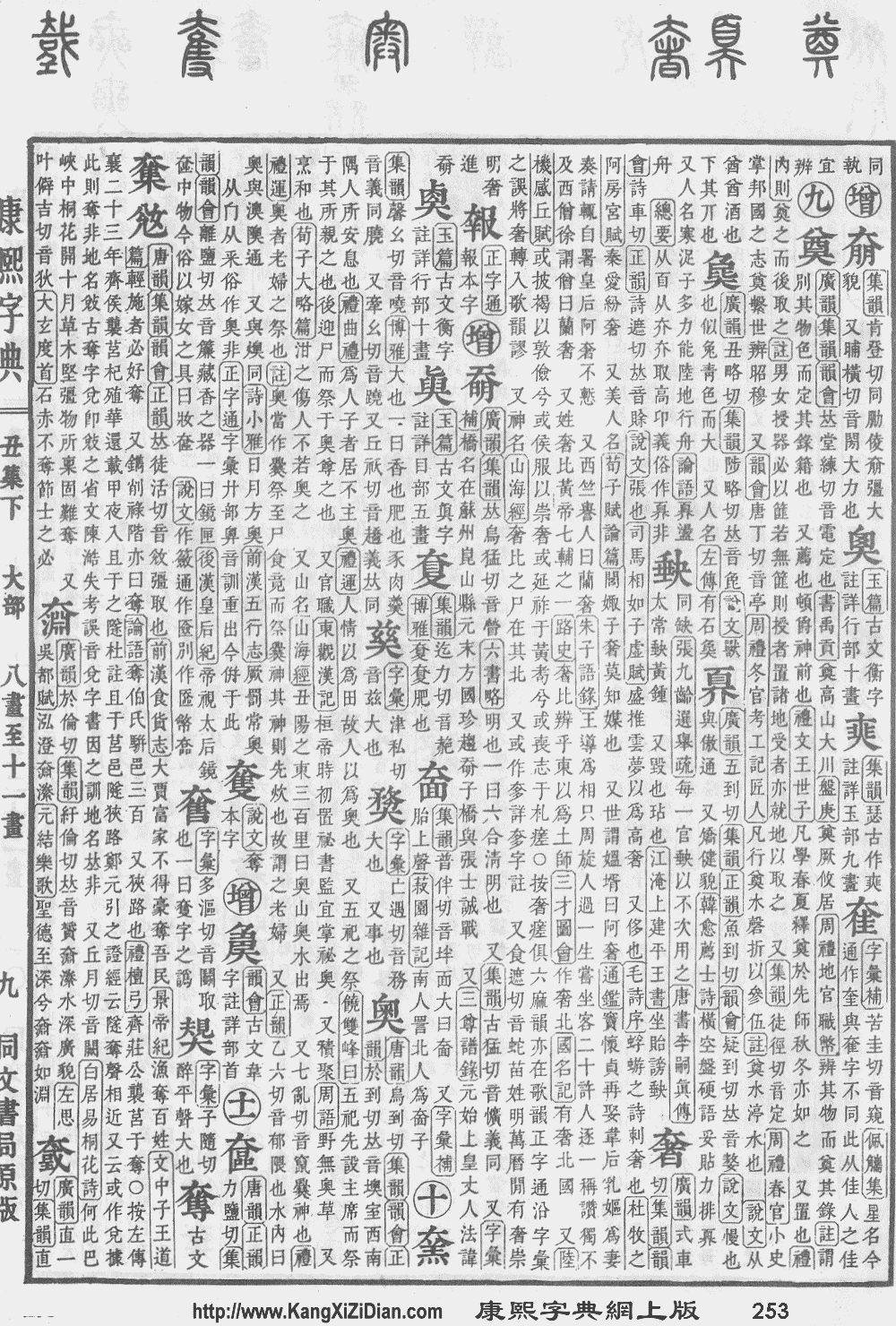
  • KangXi: page 253, character 25
  • Dai Kanwa Jiten: character 5994
  • Dae Jaweon: page 515, character 21
  • Hanyu Da Zidian (first edition): volume 1, page 547, character 14
  • Unihan data for U+596A

Chinese

trad. 奪
simp. 夺
alternative forms 𡙜
敓
𡜎
𡙸
𠔟

Glyph origin

Historical forms of the character 奪
Western Zhou Shuowen Jiezi (compiled in Han) Liushutong (compiled in Ming)
Bronze inscriptions Small seal script Transcribed ancient scripts

Ideogrammic compound (會意) : 衣 (“clothing”) + 雀 (“bird”) + 又 (“hand”) – a hand seizing a bird from someone.

Pronunciation 1


Note:
  • duăk - literary;
  • dŏk - vernacular.
Note:
  • toa̍t - literary;
  • toa̍h - vernacular.

Rime
Character 奪
Reading # 1/1
Initial (聲) 定 (7)
Final (韻) 桓 (64)
Tone (調) Checked (Ø)
Openness (開合) Closed
Division (等) I
Fanqie 徒活切
Baxter dwat
Reconstructions
Zhengzhang
Shangfang
/duɑt̚/
Pan
Wuyun
/dʷɑt̚/
Shao
Rongfen
/duɑt̚/
Edwin
Pulleyblank
/dwat̚/
Li
Rong
/duɑt̚/
Wang
Li
/duɑt̚/
Bernard
Karlgren
/dʱuɑt̚/
Expected
Mandarin
Reflex
duó
Expected
Cantonese
Reflex
dyut6
Baxter–Sagart system 1.1 (2014)
Character 奪
Reading # 1/1
Modern
Beijing
(Pinyin)
duó
Middle
Chinese
‹ dwat ›
Old
Chinese
/*Cə.lˁot/
English seize

Notes for Old Chinese notations in the Baxter–Sagart system:

* Parentheses "()" indicate uncertain presence;
* Square brackets "[]" indicate uncertain identity, e.g. *[t] as coda may in fact be *-t or *-p;
* Angle brackets "<>" indicate infix;
* Hyphen "-" indicates morpheme boundary;

* Period "." indicates syllable boundary.

Definitions

奪

  1. † to lose
  2. to seize; to take by force
    奪取/夺取  ―  duóqǔ  ―  to seize
  3. to compete for and obtain
    奪得金牌/夺得金牌  ―  duó dé jīnpái  ―  to carry off a gold medal
  4. to prevail over
    先聲奪人/先声夺人  ―  xiānshēngduórén  ―  to overawe one's opponent first by a show of strength
  5. to deprive; to cause to lose
    剝奪/剥夺  ―  bōduó  ―  to deprive; to strip
  6. (literary) to decide
    定奪/定夺  ―  dìngduó  ―  to make a decision

Compounds

Pronunciation 2


Definitions

奪

  1. † name of an ancient place

Japanese

Kanji

奪

(common “Jōyō” kanji)

  1. to rob; to snatch

Readings

Korean

Hanja

奪 • (tal) (hangeul 탈, revised tal, McCune–Reischauer t'al)

  1. This term needs a translation to English. Please help out and add a translation, then remove the text {{rfdef}}.

Vietnamese

Han character

奪: Hán Nôm readings: đoạt, sáo, xạo

  1. This term needs a translation to English. Please help out and add a translation, then remove the text {{rfdef}}.
This article is issued from Wiktionary. The text is licensed under Creative Commons - Attribution - Sharealike. Additional terms may apply for the media files.