惟

惟 U+60DF, 惟
CJK UNIFIED IDEOGRAPH-60DF
← 惞
[U+60DE]
CJK Unified Ideographs 惠 →
[U+60E0]

Translingual

Han character

惟 (Kangxi radical 61, 心+8, 11 strokes, cangjie input 心人土 (POG), four-corner 90014, composition ⿰忄隹)

References

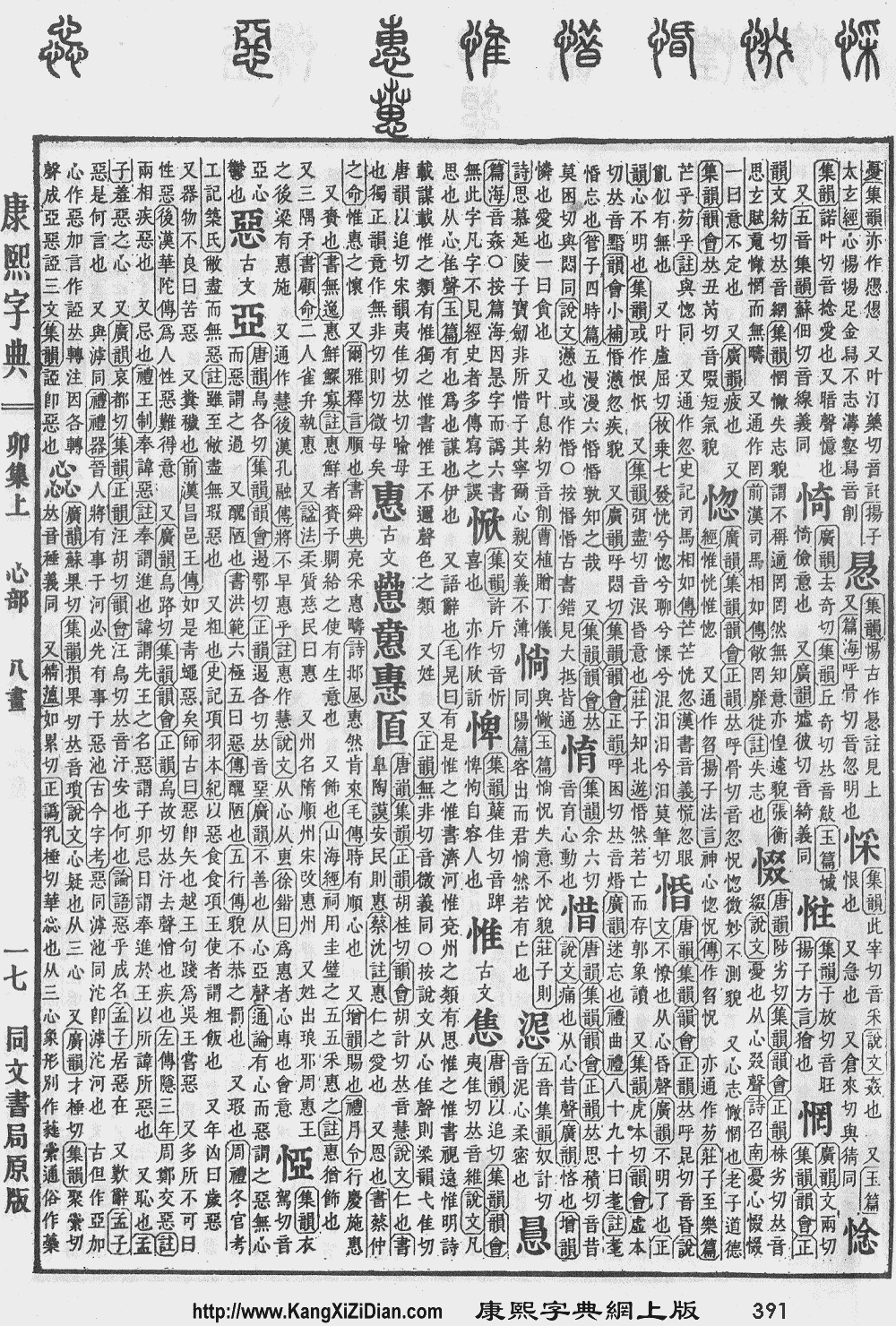
  • KangXi: page 391, character 17
  • Dai Kanwa Jiten: character 10820
  • Dae Jaweon: page 726, character 3
  • Hanyu Da Zidian (first edition): volume 4, page 2316, character 3
  • Unihan data for U+60DF

Chinese

simp. and trad.
惟

Glyph origin

Pronunciation


  • Dialectal data
Variety Location 惟
Mandarin Beijing /uei³⁵/
Harbin /uei⁴⁴/
Tianjin /vei⁴⁵/
Jinan /vei⁵⁵/
Qingdao /ve⁵⁵/
Zhengzhou /uei⁵³/
Xi'an /vi²⁴/
Xining /uɨ²⁴/
Yinchuan /vei⁵³/
Lanzhou /vei⁵³/
Ürümqi /vei⁴⁴/
Wuhan /uei²¹³/
Chengdu /uei³¹/
Guiyang /uei²¹/
Kunming /uei³¹/
Nanjing /uəi²⁴/
Hefei /ue⁵⁵/
Jin Taiyuan /uei¹¹/
Pingyao /uei¹³/
Hohhot /vei³¹/
Wu Shanghai /vi²³/
Suzhou /vi¹³/
Hangzhou /ɦui²¹³/
Wenzhou /vu³¹/
Hui Shexian /ue⁴⁴/
Tunxi /ue⁴⁴/
Xiang Changsha /uei¹³/
Xiangtan /uəi¹²/
Gan Nanchang /ui⁴⁵/
Hakka Meixian /vi¹¹/
Taoyuan /vui¹¹/
Cantonese Guangzhou /wɐi²¹/
Nanning /wɐi²¹/
Hong Kong /wɐi²¹/
Min Xiamen (Min Nan) /ui³⁵/
Fuzhou (Min Dong) /mi⁵³/
Jian'ou (Min Bei) /y²¹/
Shantou (Min Nan) /zui⁵⁵/
Haikou (Min Nan) /vui³¹/

Rime
Character 惟
Reading # 1/1
Initial (聲) 以 (36)
Final (韻) 脂 (16)
Tone (調) Level (Ø)
Openness (開合) Closed
Division (等) III
Fanqie 以追切
Reconstructions
Zhengzhang
Shangfang
/jiuɪ/
Pan
Wuyun
/jʷi/
Shao
Rongfen
/juɪ/
Edwin
Pulleyblank
/jwi/
Li
Rong
/ui/
Wang
Li
/jwi/
Bernard
Karlgren
/wi/
Expected
Mandarin
Reflex
wéi
Expected
Cantonese
Reflex
wai4
Baxter–Sagart system 1.1 (2014)
Character 惟
Reading # 1/1
Modern
Beijing
(Pinyin)
wéi
Middle
Chinese
‹ ywij ›
Old
Chinese
/*ɢʷij/
English (copula); namely

Notes for Old Chinese notations in the Baxter–Sagart system:

* Parentheses "()" indicate uncertain presence;
* Square brackets "[]" indicate uncertain identity, e.g. *[t] as coda may in fact be *-t or *-p;
* Angle brackets "<>" indicate infix;
* Hyphen "-" indicates morpheme boundary;

* Period "." indicates syllable boundary.
Zhengzhang system (2003)
Character 惟
Reading # 1/1
No. 12853
Phonetic
component
唯
Rime
group
脂
Rime
subdivision
2
Corresponding
MC rime
惟
Old
Chinese
/*ɢʷi/

Definitions

惟

  1. but; however; nevertheless
  2. only
  3. to think; to contemplate
  4. † Alternative form of 唯 (wéi, “to be”).
  5. † (alt. form 維/维, 唯) meaningless sentence-initial particle

Compounds

  • 不惟 (bùwéi)
  • 人心惟危
  • 令出惟行
  • 伏惟 (fúwéi)
  • 匪惟
  • 思惟
  • 惟利是逐
  • 惟天可表
  • 惟妙惟肖 (wéimiàowéixiào)
  • 惟恐
  • 惟精惟一
  • 明德惟馨
  • 正思惟
  • 民惟邦本
  • 洪惟
  • 非惟

Japanese

Kanji

惟

(“Jinmeiyō” kanji used for names)

  1. consider
  2. reflect
  3. think

Readings

Definitions

Kanji in this term
惟
これ
Jinmeiyō
kun’yomi
For pronunciation and definitions of 惟 – see the following entry.
【これ】
[pronoun] this
[pronoun] (deictically) this one (near the speaker)
[pronoun] (anaphorically) this one I am talking about (only the speaker knows)
[pronoun] (archaic) I; me
[pronoun] (archaic) you
[pronoun] (literary, calque of Literary Chinese 是, 之, 惟, etc.) Repeat the topic with a correct case marker to avoid any misunderstanding if it is not a subject.
Alternative spellings
此れ, 是, 之, 維, 惟
(This term, 惟, is an alternative spelling of the above term.)

Korean

Hanja

惟 • (yu) (hangeul 유, revised yu, McCune–Reischauer yu, Yale yu)

  1. This term needs a translation to English. Please help out and add a translation, then remove the text {{rfdef}}.

Vietnamese

Han character

惟: Hán Nôm readings: duy

  1. This term needs a translation to English. Please help out and add a translation, then remove the text {{rfdef}}.
This article is issued from Wiktionary. The text is licensed under Creative Commons - Attribution - Sharealike. Additional terms may apply for the media files.