斑

斑 U+6591, 斑
CJK UNIFIED IDEOGRAPH-6591
← 斐
[U+6590]
CJK Unified Ideographs 斒 →
[U+6592]

Translingual

Han character

斑 (Kangxi radical 67, 文+8, 12 strokes, cangjie input 一土卜大土 (MGYKG), four-corner 11114, composition ⿴玨文)

References

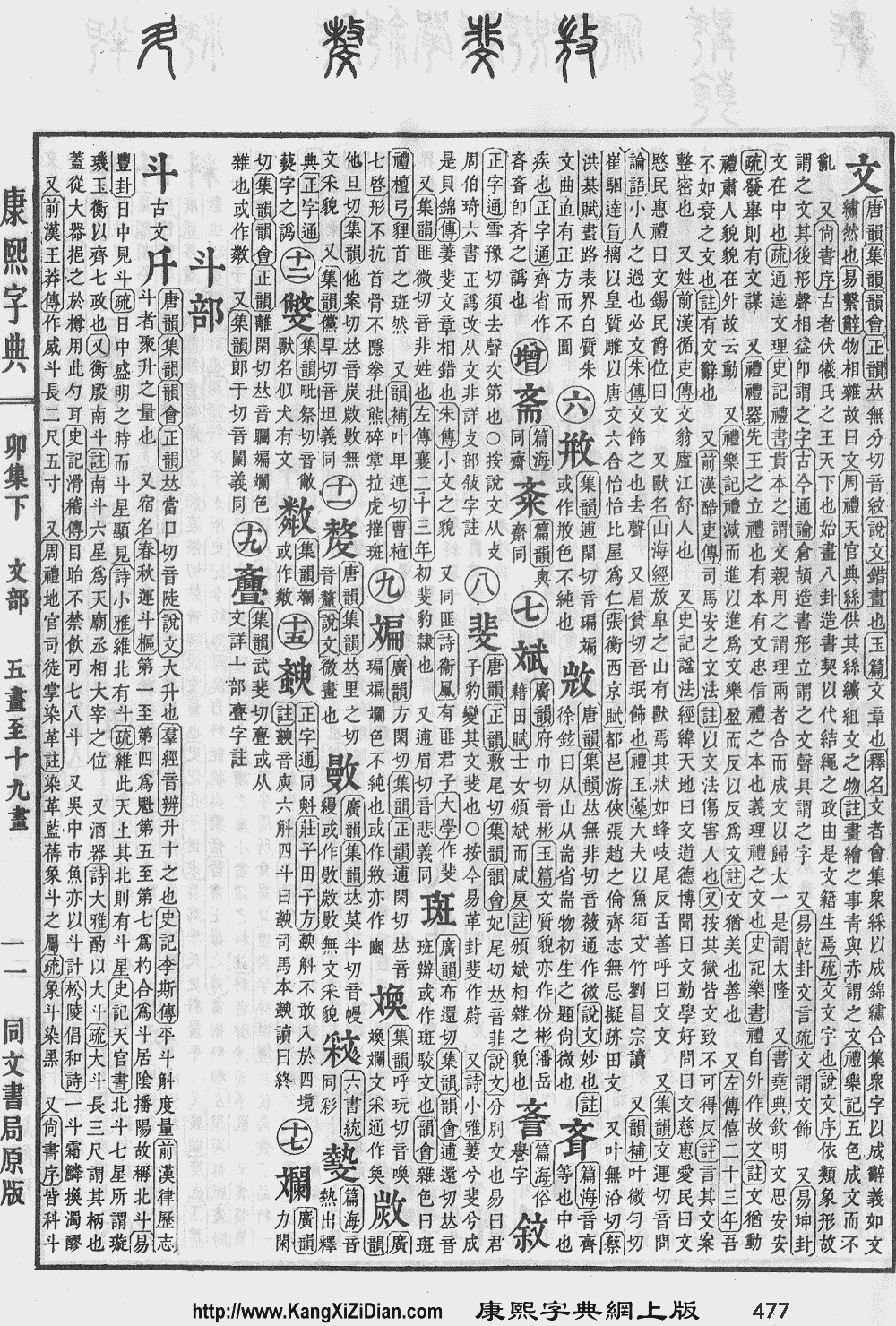
  • KangXi: page 477, character 11
  • Dai Kanwa Jiten: character 13470
  • Dae Jaweon: page 835, character 11
  • Hanyu Da Zidian (first edition): volume 2, page 1123, character 4
  • Unihan data for U+6591

Chinese

simp. and trad.
斑
alternative forms 辬
班
䃑

Glyph origin

Ideogrammic compound (會意) : 玨 (“jade”) + 文 (“stripe”).

Etymology 1

Either the same etymon as 班 (OC *praːn) or related to 駁 (OC *praːwɢ).

Pronunciation


Note:
  • bang1 - literary;
  • boin1 - vernacular.

Rime
Character 斑
Reading # 1/1
Initial (聲) 幫 (1)
Final (韻) 刪 (69)
Tone (調) Level (Ø)
Openness (開合) Open
Division (等) II
Fanqie 布還切
Reconstructions
Zhengzhang
Shangfang
/pˠan/
Pan
Wuyun
/pᵚan/
Shao
Rongfen
/pɐn/
Edwin
Pulleyblank
/paɨn/
Li
Rong
/pan/
Wang
Li
/pan/
Bernard
Karlgren
/pan/
Expected
Mandarin
Reflex
bān
Expected
Cantonese
Reflex
baan1
Baxter–Sagart system 1.1 (2014)
Character 斑
Reading # 1/1
Modern
Beijing
(Pinyin)
bān
Middle
Chinese
‹ pæn ›
Old
Chinese
/*pˁran/
English variegated

Notes for Old Chinese notations in the Baxter–Sagart system:

* Parentheses "()" indicate uncertain presence;
* Square brackets "[]" indicate uncertain identity, e.g. *[t] as coda may in fact be *-t or *-p;
* Angle brackets "<>" indicate infix;
* Hyphen "-" indicates morpheme boundary;

* Period "." indicates syllable boundary.
Zhengzhang system (2003)
Character 斑
Reading # 1/1
No. 225
Phonetic
component
班
Rime
group
元
Rime
subdivision
1
Corresponding
MC rime
班
Old
Chinese
/*praːn/

Definitions

斑

  1. spot; stripe
  2. spotted; striped; mottled
  3. resplendent
  4. to cut; to split
  5. a surname

Compounds

Etymology 2

For pronunciation and definitions of 斑 – see 癍 (“abnormal pigmentary deposits on the skin; flecks”).
(This character, 斑, is the second-round simplified form of 癍.)
Notes:

References

Japanese

Kanji

斑

(common “Jōyō” kanji)

  1. spot
  2. blemish
  3. speck
  4. patches

Readings

Etymology 1

Kanji in this term
斑
まだら
Grade: S
kun’yomi
For pronunciation and definitions of 斑 – see the following entry.
【まだら】
[adjective] variegated
[noun] being variegated
Alternative spellings
斑, 駁, 駮
(This term, 斑, is an alternative spelling of the above term.)

Etymology 2

Kanji in this term
斑
むら
Grade: S
kun’yomi
For pronunciation and definitions of 斑 – see the following entry.
【むらムラ】
[noun] a design like marble or spots
[noun] (by extension) having variation or fluctuation
Alternative spellings
斑, むら
(This term, 斑, is an alternative spelling of the above term.)

Etymology 3

Kanji in this term
斑
ふ
Grade: S
kun’yomi
For pronunciation and definitions of 斑 – see ふ.
(This term, 斑, is an alternative spelling of the above terms.)

(The following entry is uncreated: ふ.)

Korean

Hanja

斑 • (ban) (hangeul 반, revised ban, McCune–Reischauer pan, Yale pan)

  1. This term needs a translation to English. Please help out and add a translation, then remove the text {{rfdef}}.

Vietnamese

Han character

斑: Hán Nôm readings: ban

  1. This term needs a translation to English. Please help out and add a translation, then remove the text {{rfdef}}.
This article is issued from Wiktionary. The text is licensed under Creative Commons - Attribution - Sharealike. Additional terms may apply for the media files.