碎
See also: 砕
| ||||||||
Translingual
| Stroke order | |||
|---|---|---|---|
| File:碎-order.gif | |||
Han character
碎 (Kangxi radical 112, 石+8, 13 strokes, cangjie input 一口卜人十 (MRYOJ), four-corner 10648, composition ⿰石卒)
Derived characters
- 𡀬 𢣃 𣩸 𡳥 𤻒
Descendants
References
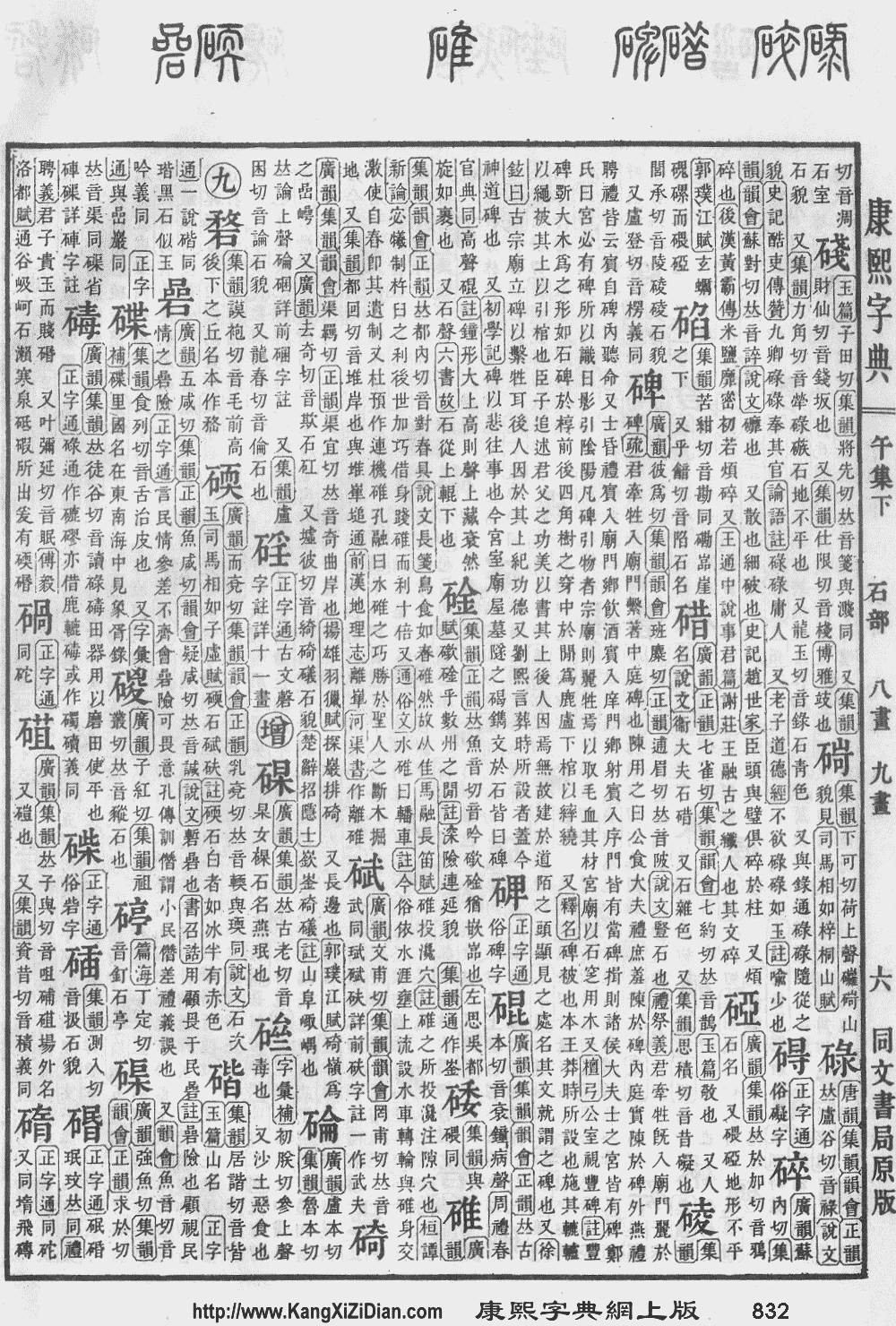
- KangXi: page 832, character 5
- Dai Kanwa Jiten: character 24284
- Dae Jaweon: page 1248, character 23
- Hanyu Da Zidian (first edition): volume 4, page 2439, character 9
- Unihan data for U+788E
Chinese
| simp. and trad. |
碎 | |
|---|---|---|
| 2nd round simp. | 砕 | |
| alternative forms | 砕 | |
Glyph origin
| Historical forms of the character 碎 |
|---|
| Shuowen Jiezi (compiled in Han) |
| Small seal script |
 |
Characters in the same phonetic series (卒) (Zhengzhang, 2003)
| Old Chinese | |
|---|---|
| 晬 | *ʔsuːds |
| 祽 | *ʔsuːds |
| 綷 | *ʔsuːds |
| 淬 | *sʰuːds |
| 啐 | *sʰuːds, *suːds, *sʰroːds, *ʔsud |
| 倅 | *sʰuːds, *ʔsuːd |
| 焠 | *sʰuːds |
| 碎 | *suːds |
| 誶 | *suːds, *suds, *zud |
| 濢 | *ʔslulʔ, *sʰluds |
| 噿 | *ʔslulʔ |
| 臎 | *ʔslulʔ, *sʰluds |
| 醉 | *ʔsuds |
| 翠 | *sʰuds |
| 悴 | *zuds |
| 萃 | *zuds |
| 瘁 | *zuds |
| 顇 | *zuds |
| 粹 | *suds |
| 睟 | *suds |
| 賥 | *suds |
| 卒 | *ʔsuːd, *sʰuːd, *ʔsud |
| 稡 | *ʔsuːd |
| 猝 | *sʰuːd |
| 椊 | *zuːd |
| 捽 | *zuːd, *zud |
| 崪 | *zuːd |
| 窣 | *suːd |
| 崒 | *zud |
| 踤 | *zud |
| 錊 | *ʔsuːɡ |
Pronunciation
Definitions
碎
Synonyms
- (fragmented): 零星 (língxīng)
Compounds
Derived terms from 碎
Japanese
| 砕 | |
| 碎 |
Kanji
碎
(“Jinmeiyō” kanji used for names, kyūjitai kanji, shinjitai form 砕)
- This term needs a translation to English. Please help out and add a translation, then remove the text
{{rfdef}}.
Korean
Etymology
From Middle Chinese 碎 (MC suʌiH).
Compounds
- 분쇄 (粉碎, bunswae, “shattering”)
- 파쇄 (破碎, paswae, “crushing”)
- 쇄빙선 (碎氷船, swaebingseon, “icebreaker”)
Vietnamese
Pronoun
碎 • (tôi)
- (formal in all dialects) I/me (used in formal contexts, regardless of the difference in status between the speakers)
Notes
This character is also used for the alternative pronunciation, tui
This article is issued from Wiktionary. The text is licensed under Creative Commons - Attribution - Sharealike. Additional terms may apply for the media files.