秀
| ||||||||
Translingual
Han character
秀 (Kangxi radical 115, 禾+2, 7 strokes, cangjie input 竹木弓竹尸 (HDNHS), four-corner 20227, composition ⿱禾乃)
References
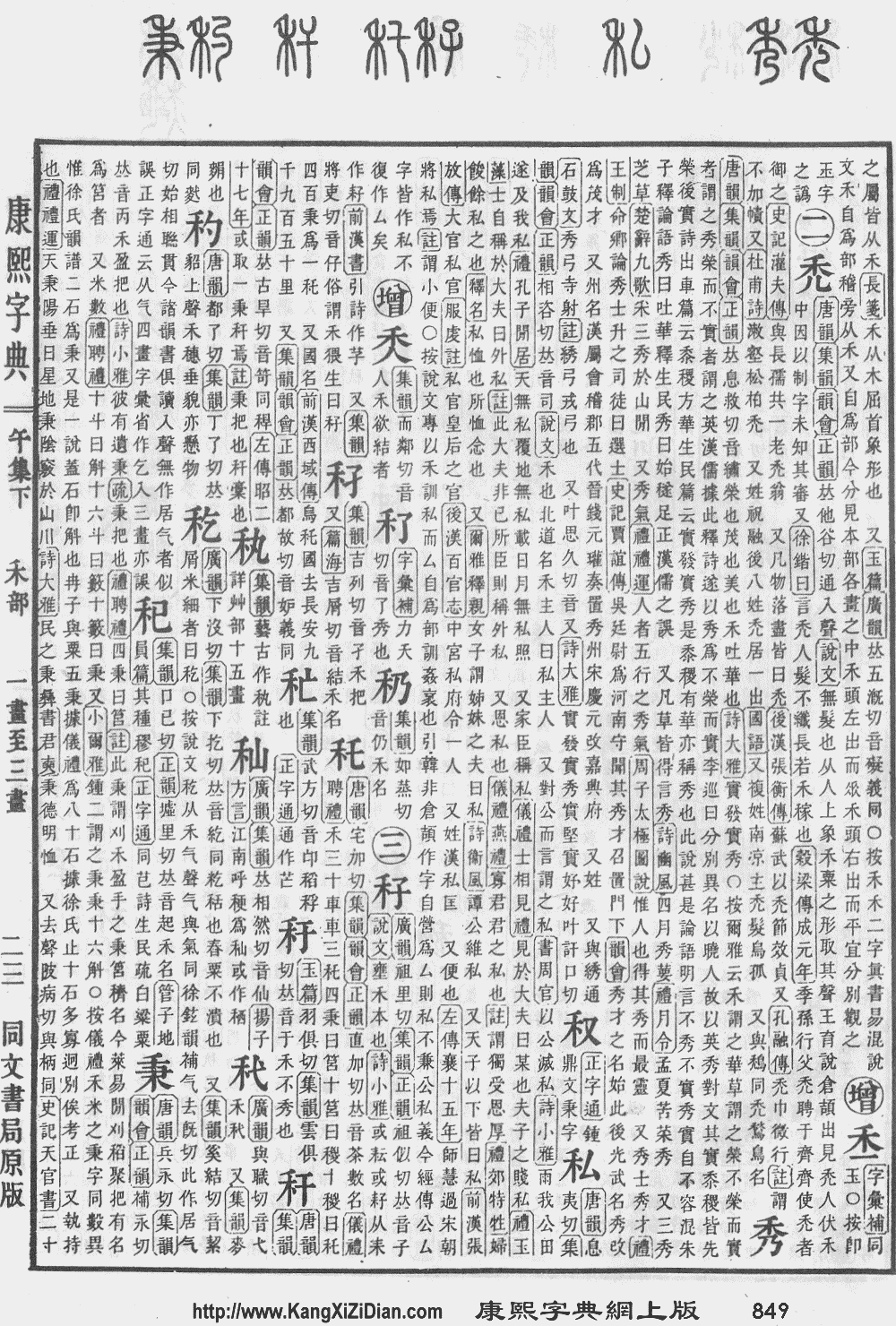
- KangXi: page 849, character 3
- Dai Kanwa Jiten: character 24911
- Dae Jaweon: page 1270, character 16
- Hanyu Da Zidian (first edition): volume 4, page 2589, character 4
- Unihan data for U+79C0
Chinese
| trad. | 秀 | |
|---|---|---|
| simp. # | 秀 | |
| alternative forms | 𥝙 𥝠 | |

Glyph origin
| Historical forms of the character 秀 | ||
|---|---|---|
| Warring States | Shuowen Jiezi (compiled in Han) | Liushutong (compiled in Ming) |
| Chu slip and silk script | Small seal script | Transcribed ancient scripts |
 |
 |
 |
From an earlier form 𥝙, attested in the stone drum inscriptions (石鼓文 (shígǔwén)) from the Warring States period.
According to Chi (2010), the character is an ideogrammic compound (會意) : 禾 (“rice plant”) + 引 (“to draw out flowers”) — blooming of a rice plant. The Shuihudi Qin bamboo texts (睡簡) recorded this character as ⿱禾引. The bottom component 弓 found in the stone drum inscriptions is likely a reduction of 引.
Xu Kai (徐鍇), the author of 《說文解字繫傳》 (10th century AD) gave the following explanation: Pictogram (象形) : 禾 (“plant”) + 乃, resembling a fruit/an ear hanging off a plant.
Shuowen states that this character was tabooed at that time (2nd century AD) and so did not elaborate on its origin, due to it being the birth name of Emperor Guangwu of Han.
Etymology 1
May be a causative of 褎 (OC *lɯws, “growth of seedlings”). Compare Proto-Vietic *m-loh (“to blossom”) (whence Vietnamese trổ (“to burst, to open, to display”), lổ (“naked”)), and Khmer លាស់ (lŏəh, “to grow, to blossom, to prosper”).
Pronunciation
Definitions
秀
- † (of plants, especially of crops) to shoot out into ears; earing; ear
- 秀而不實/秀而不实 ― xiù'érbùshí ― to put forth flowers but bear no fruit
- 實種實褎,實發實秀。 [Classical Chinese, trad.]
- From: The Classic of Poetry, c. 11th – 7th centuries BCE, translated based on James Legge's version
- Shí zhòng shí yòu, shí fā shí xiù. [Pinyin]
- Then he used it as seed, and it sprang up; It grew and came into ear.
实种实褎,实发实秀。 [Classical Chinese, simp.]
- † (of plants) to bear fruit
- † (of plants) to blossom
- beautiful; elegant; graceful
- (especially of a person) outstanding; prominent; extraordinary
Compounds
|
|
Descendants
Pronunciation
Definitions
秀
Japanese
Readings
| Kanji in this term |
|---|
| 秀 |
| しゅう Grade: S |
| on’yomi |