臍
| ||||||||
Translingual
| Traditional | 臍 |
|---|---|
| Shinjitai (extended) |
𦜝 |
| Simplified | 脐 |
Han character
臍 (Kangxi radical 130, 肉+14, 18 strokes, cangjie input 月卜X (BYX), four-corner 70223, composition ⿰⺼齊)
References
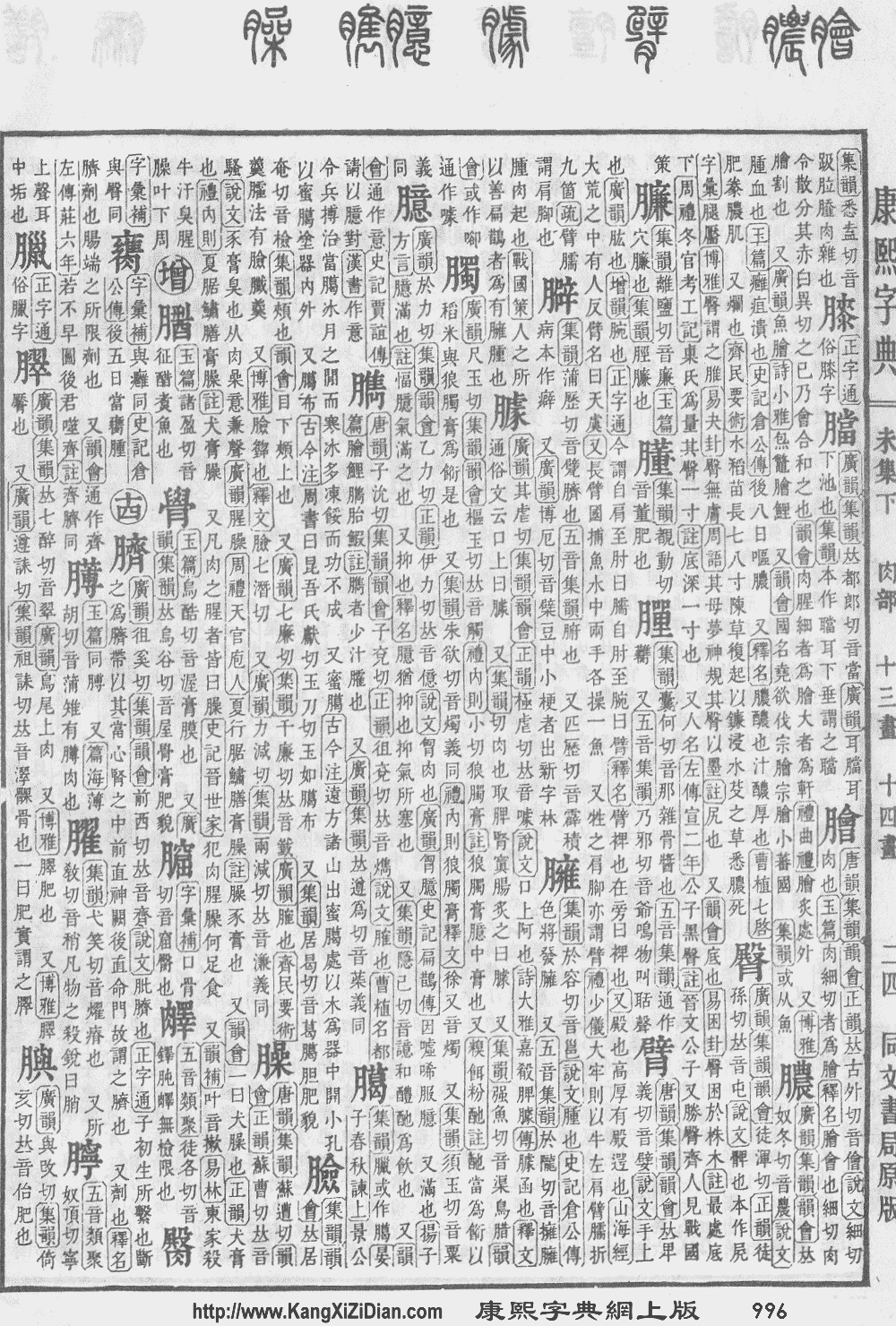
- KangXi: page 996, character 25
- Dai Kanwa Jiten: character 29967
- Hanyu Da Zidian (first edition): volume 3, page 2121, character 5
- Unihan data for U+81CD
Chinese
| trad. | 臍 | |
|---|---|---|
| simp. | 脐 | |
Glyph origin
| Old Chinese | |
|---|---|
| 儕 | *zriːl |
| 麡 | *zriːl, *ʔsliːl, *zliːl |
| 齋 | *ʔsriːl |
| 穧 | *ʔsleds, *ʔsliːls, *zliːls |
| 擠 | *ʔsliːl, *ʔsliːls |
| 躋 | *ʔsliːl, *ʔsliːls |
| 齏 | *ʔsliːl |
| 齎 | *ʔsliːl, *ʔslil |
| 櫅 | *ʔsliːl |
| 齌 | *ʔsliːl, *sʰliːl, *zliːls |
| 隮 | *ʔsliːl, *ʔsliːls |
| 賷 | *ʔsliːl |
| 虀 | *ʔsliːl |
| 濟 | *ʔsliːlʔ, *ʔsliːls |
| 癠 | *ʔsliːlʔ, *zliːl, *zliːlʔ, *zliːls |
| 霽 | *ʔsliːls |
| 齊 | *zliːl, *zliːls |
| 臍 | *zliːl |
| 蠐 | *zliːl, *zlil |
| 懠 | *zliːl, *zliːls |
| 薺 | *zliːlʔ, *zlil |
| 鱭 | *zliːlʔ |
| 嚌 | *zliːls |
| 劑 | *zliːls, *ʔslel |
| 齍 | *ʔslil |
Phono-semantic compound (形聲, OC *zliːl) : semantic 肉 (“meat; flesh”) + phonetic 齊 (OC *zliːl, *zliːls).
Etymology
Probably from Proto-Sino-Tibetan *s-taj (“navel; abdomen; centre; self”) (Weidert, 1987; Schuessler, 2007). Cognate with Tibetan ལྟེ (lte, “navel”), Chepang तोय् (“navel”).
Pronunciation
Synonyms
Japanese
| 𦜝 | |
| 臍 |
Kanji
(uncommon “Hyōgai” kanji, kyūjitai kanji, shinjitai form 𦜝)
- This term needs a translation to English. Please help out and add a translation, then remove the text
{{rfdef}}.
Compounds
- 膃肭臍 (ottosei, “fur seal”)
- 観念の臍を固める (kannen no hozo o katameru)
- 臍炎 (saien)
- 臍下 (saika)
- 臍窩 (saika)
- 臍下丹田 (saikatanden)
- 臍疝痛 (saisentsū)
- 臍帯 (saitai)
- 臍帯血 (saitaiketsu)
- 臍帯血移植 (saitaiketsuishoku)
- 臍囊 (sainō)
- 臍ヘルニア (saiherunia)
- 麝香の臍 (jakō no hozo)
- 臍下 (seika)
- 臍下丹田 (seikatanden)
- 噬臍 (zeisei)
- 臍帯 (seitai)
- 出臍 (debeso)
- 臍猪 (hesoinoshishi, “peccary”)
- 臍が宿替えする (heso ga yadogae suru)
- 臍土器 (hesokawarake)
- 臍柑 (hesokan)
- 臍繰り (hesokuri)
- 臍繰り金 (hesokurigane)
- 臍繰る (hesokuru)
- 臍茶 (hesocha)
- 臍で茶を沸かす (heso de cha o wakasu)
- 臍の緒 (heso no o)
- 臍の緒を切ってから (heso no o o kitte kara)
- 臍の下 (heso no shita)
- 臍曲がり (hesomagari)
- 臍を曲げる (heso o mageru)
- 臍落ち (hozōchi)
- 臍繰り金 (hozokurigane)
- 臍落 (hozochi)
- 臍の緒 (hozo no o)
- 臍を固める (hozo o katameru)
- 臍を噬む (hozo o kamu)
- 櫓臍 (robeso)
Etymology 1
| Kanji in this term |
|---|
| 臍 |
| へそ Hyōgaiji |
| kun’yomi |
Might be a shift from, or cognate with 臍 (hozo, “navel”). (Can this(+) etymology be sourced?)
First cited to a text from 810 CE, around the Heian period.[1]
Etymology 2
| Kanji in this term |
|---|
| 臍 |
| ほぞ Hyōgaiji |
| kun’yomi |
From Old Japanese 臍 (poso).[2][4][5][6] First attested in the Nihon Shoki of 720 CE.[5] Ultimately from Proto-Japonic *pəsə. Cognate with Kikai 臍 (pusu, husu), Kunigami 臍 (husu, pusū), Miyako 臍 (pusu, pisu), Northern Amami-Oshima 臍 (husu), Okinawan 臍 (husu), Oki-No-Erabu 臍 (husu), Southern Amami-Oshima 臍 (husu), Toku-No-Shima 臍 (husyu), Yaeyama 臍 (pusu, puchu), Yonaguni 臍 (husu), and Yoron 臍 (pusu).
Might be cognate with 細い (hosoi, “slender, thin”), in reference to the thin size of a navel. Might also be cognate with Proto-Malayo-Polynesian *pusəj (“navel”) and Middle Korean ᄇᆡᆺ복 (poyspwok, “navel”, Korean 배꼽 (baekkop, “navel”)).
Pronunciation
References
- “臍”, in 日本国語大辞典 (Nihon Kokugo Daijiten, “Nihon Kokugo Daijiten”) (in Japanese), 2nd edition, Tōkyō: Shogakukan, 2000, →ISBN
- 2006, 大辞林 (Daijirin), Third Edition (in Japanese), Tōkyō: Sanseidō, →ISBN
- 1998, NHK日本語発音アクセント辞典 (NHK Japanese Pronunciation Accent Dictionary) (in Japanese), Tōkyō: NHK, →ISBN
- 1988, 国語大辞典(新装版) (Kokugo Dai Jiten, Revised Edition) (in Japanese), Tōkyō: Shogakukan
- “臍・蔕・枘”, in 日本国語大辞典 (Nihon Kokugo Daijiten, “Nihon Kokugo Daijiten”) (in Japanese), 2nd edition, Tōkyō: Shogakukan, 2000, →ISBN
- “臍”, in デジタル大辞泉 (Dejitaru Daijisen) (in Japanese), Tōkyō: Shogakukan, updated roughly every four months
Korean
Etymology
From Middle Chinese 臍 (MC d͡zei).
Recorded as Middle Korean 쪵 (Yale: ccyey) in Dongguk Jeongun (東國正韻 / 동국정운), 1448.
Recorded as Middle Korean 졔 (cyey) (Yale: cyey) in Hunmong Jahoe (訓蒙字會 / 훈몽자회), 1527.