舌
| ||||||||
| ||||||||
Translingual
| Stroke order | |||
|---|---|---|---|
 | |||
| Stroke order | |||
|---|---|---|---|
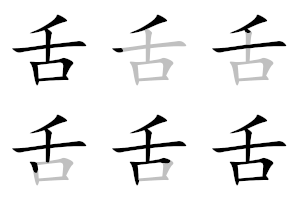 | |||
Alternative forms
- In Traditional Chinese (Taiwan, Hong Kong and Macao), this character is written with 干 as the upper component, which is also the historical form found in the Kangxi dictionary.
- In Simplified Chinese, (mainland China and Singapore), Japanese Kanji, Korean Hanja and Vietnamese Nom script, this character is written with 千 as the upper component.
Han character
舌 (Kangxi radical 135, 舌+0, 6 strokes, cangjie input 竹十口 (HJR), four-corner 20604, composition ⿱千口(GJKV) or ⿱干口(HT))
- Kangxi radical #135, ⾆.
- Shuowen Jiezi radical №46
Derived characters
- Appendix:Chinese radical/舌
- 佸, 㓉, 咶, 姡, 𡯢, 恬, 括, 活, 狧, 𭥹, 栝, 𣭪, 𤈏, 䏦, 䄆, 𤫵, 甛, 䀨, 秳, 𥚇, 絬, 聒, 𬛥, 𦨯, 蛞, 話(话), 𧵳(䞌), 趏, 䟯, 𨈸, 𮝐, 䣶, 銛(铦), 𬺄, 𩈙, 颳, 餂, 𣽰, 䯏, 𬵏, 𪌩, 𧱳, 𪎾, 𪗽
- 刮, 㔚, 𢼤, 𣁳, 𣢯, 𤭇, 甜, 𬚸, 𫕛, 𫫞, 𮧺, 頢(𬱠), 𫬎, 鴰(鸹), 𭓯, 䒷, 筈, 髺, 䦚, 𡇜, 憩
- 适, 敌 (Simplified from the component 啇)
- 乱, 辞, 𦯠 (Simplified from the component 𤔔)
References
- KangXi: page 1006, character 22
- Dai Kanwa Jiten: character 30277
- Dae Jaweon: page 1463, character 12
- Hanyu Da Zidian (first edition): volume 5, page 2941, character 1
- Unihan data for U+820C

Chinese
| trad. | 舌 | |
|---|---|---|
| simp. # | 舌 | |
Glyph origin
| Historical forms of the character 舌 | ||
|---|---|---|
| Shang | Shuowen Jiezi (compiled in Han) | Liushutong (compiled in Ming) |
| Oracle bone script | Small seal script | Transcribed ancient scripts |
 |
 |
 |
Pictogram (象形) – a forked tongue emerging upwards from a mouth (口).
Etymology 1
From 舐 (OC *ɦljeʔ, “to lick”) + *-t (“nominal suffix for natural objects”), literally “licker” (Schuessler, 2007).
Pronunciation
Synonyms
Dialectal synonyms of 舌頭 (“tongue”) [map]
Compounds
Derived terms from 舌
|
|
|
Glyph origin
Characters in the same phonetic series (桰) (Zhengzhang, 2003)
| Old Chinese | |
|---|---|
| 咶 | *qʰroːds, *qʰroːds, *ɡroːd |
| 話 | *ɡroːds |
| 刮 | *kroːd |
| 鴰 | *kroːd, *koːd |
| 趏 | *kroːd, *kʰroːd |
| 舌 | *ɡroːd, *ɦbljed |
| 姡 | *ɡroːd, *ɡoːd |
| 頢 | *ɡroːd, *koːd |
| 括 | *koːd |
| 活 | *koːd, *ɡoːd |
| 适 | *koːd, *kʰoːd |
| 栝 | *koːd, *l̥ʰeːmʔ |
| 佸 | *koːd, *ɡoːd |
| 髺 | *koːd |
| 聒 | *koːd |
| 銛 | *koːd, *slem, *l̥ʰeːmʔ |
| 葀 | *koːd |
| 懖 | *koːd |
| 筈 | *koːd, *kʰoːd |
| 萿 | *koːd |
| 蛞 | *kʰoːd |
| 闊 | *kʰoːd |
| 秳 | *ɡoːd |
Japanese
Etymology
From Old Japanese, from Proto-Japonic *sita.
Korean
Etymology
From Middle Chinese 舌 (MC ʑiᴇt̚).
Recorded as Middle Korean 쎠ᇙ〮 (Yale: ssyelq) in Dongguk Jeongun (東國正韻 / 동국정운), 1448.
Recorded as Middle Korean 설 (sel) (Yale: sel) in Hunmong Jahoe (訓蒙字會 / 훈몽자회), 1527.
Compounds
Kunigami
Pronunciation
- IPA(key): /ɕit͡ɕaː/
Miyako
Pronunciation
- IPA(key): /ss̩da/
Okinawan
Pronunciation
- IPA(key): /ɕit͡ɕa/
Vietnamese
Yaeyama
Pronunciation
- IPA(key): /sɨta/
Yonaguni
Pronunciation
- IPA(key): /tˀa/
This article is issued from Wiktionary. The text is licensed under Creative Commons - Attribution - Sharealike. Additional terms may apply for the media files.