鞄
| ||||||||
Translingual
| Stroke order | |||
|---|---|---|---|
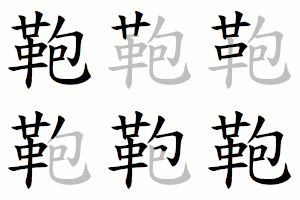 | |||
Han character
鞄 (Kangxi radical 177, 革+5, 14 strokes, cangjie input 廿十心口山 (TJPRU), four-corner 47512, composition ⿰革包)
References
- KangXi: page 1386, character 38
- Dai Kanwa Jiten: character 42781
- Dae Jaweon: page 1901, character 14
- Hanyu Da Zidian (first edition): volume 7, page 4331, character 12
- Unihan data for U+9784

Chinese
| simp. and trad. |
鞄 | |
|---|---|---|
Glyph origin
| Historical forms of the character 鞄 | |
|---|---|
| Spring and Autumn | Shuowen Jiezi (compiled in Han) |
| Bronze inscriptions | Small seal script |
 |
 |
Characters in the same phonetic series (勹) (Zhengzhang, 2003)
| Old Chinese | |
|---|---|
| 袍 | *buː |
| 袌 | *buː, *buːs |
| 軳 | *buː |
| 抱 | *buːʔ |
| 勽 | *buːs, *mɯnʔ |
| 菢 | *buːs |
| 勹 | *pruː |
| 包 | *pruː |
| 胞 | *pruː, *pʰruː |
| 苞 | *pruː |
| 枹 | *pruː, *bu, *bu |
| 飽 | *pruːʔ |
| 泡 | *pʰruː, *m̥ʰruːs, *bruː |
| 炮 | *pʰruːs, *bruː |
| 皰 | *pʰruːs, *bruːs |
| 疱 | *pʰruːs, *bruːs |
| 跑 | *bruː, *bruːɡ |
| 咆 | *bruː |
| 庖 | *bruː |
| 匏 | *bruː |
| 刨 | *bruː |
| 狍 | *bruː |
| 炰 | *bruː |
| 鉋 | *bruː, *bruːs |
| 瓟 | *bruː, *bruːɡ |
| 颮 | *bruː, *pʰruːɡ |
| 鞄 | *bruː, *bruːʔ, *bruːs, *pʰruːɡ |
| 鮑 | *bruːʔ |
| 骲 | *bruːʔ, *bruːs, *bruːɡ, *pʰoːɡ |
| 玸 | *bu |
| 雹 | *bruːɡ |
| 窇 | *bruːɡ |
Pronunciation
Definitions
鞄
- to work hides
- leather bag
Japanese
Readings
- Go-on: びょう (byō)←べう (beu, historical)
- Kan-on: ほう (hō)←はう (fau, historical)
- Kun: かばん (kaban, 鞄)
Etymology
| Kanji in this term |
|---|
| 鞄 |
| かばん Jinmeiyō |
| kun’yomi |
Possibly derived from Chinese 夾板/夹板 (jiābǎn) or 夾槾/夹槾 (“boards for pressing or holding things together”),[1][2] modern Min Nan reading kiap-pán.
The original meaning of the kanji 鞄 referred to tanned leather or a tanner who produces such material. The kun'yomi kaban only appears from the Meiji period (1868–1912).[2]
First attested with the reading kaban to a work from 1877.[2] Over the period of roughly 1877–1887, this word kaban grew in popularity and displaced the previous term 胴乱 (dōran, “satchel”).[2][3]
Noun
鞄 • (kaban)
Derived terms
Derived terms
- 折り鞄 (orikaban, “briefcase, portfolio”)
- 鞄語 (kabango, “(linguistics) portmanteau word”)
- 鞄持ち (kabanmochi, “luggage carrier; private secretary”)
- 提げ鞄 (sagekaban, “handbag, purse”)
- 支那鞄 (shinakaban, “Chinese chest”)
- 通学鞄 (tsūgakukaban, “schoolbag”)
- 手鞄 (tekaban, “handbag, purse”)
- 手提げ鞄 (tesagekaban, “handbag, purse”)
References
- 2006, 大辞林 (Daijirin), Third Edition (in Japanese), Tōkyō: Sanseidō, →ISBN
- 1988, 国語大辞典(新装版) (Kokugo Dai Jiten, Revised Edition) (in Japanese), Tōkyō: Shogakukan
- “鞄”, in 日本大百科全書:ニッポニカ (Nippon Dai Hyakka Zensho: Nipponica, “Encyclopedia Nipponica”) (in Japanese), Tōkyō: Shogakukan, 1984
- 1998, NHK日本語発音アクセント辞典 (NHK Japanese Pronunciation Accent Dictionary) (in Japanese), Tōkyō: NHK, →ISBN
Korean
Hanja
鞄 (eum 포 (po))
- This term needs a translation to English. Please help out and add a translation, then remove the text
{{rfdef}}.
Vietnamese
This article is issued from Wiktionary. The text is licensed under Creative Commons - Attribution - Sharealike. Additional terms may apply for the media files.