薄
| ||||||||
Translingual
| Stroke order | |||
Mainland China and Japan | |||
Han character
薄 (Kangxi radical 140, 艸+13, 16 (Japan, Mainland), 17 (Hong Kong, Taiwan) strokes, cangjie input 廿水戈戈 (TEII), four-corner 44146, composition ⿱艹溥)
References
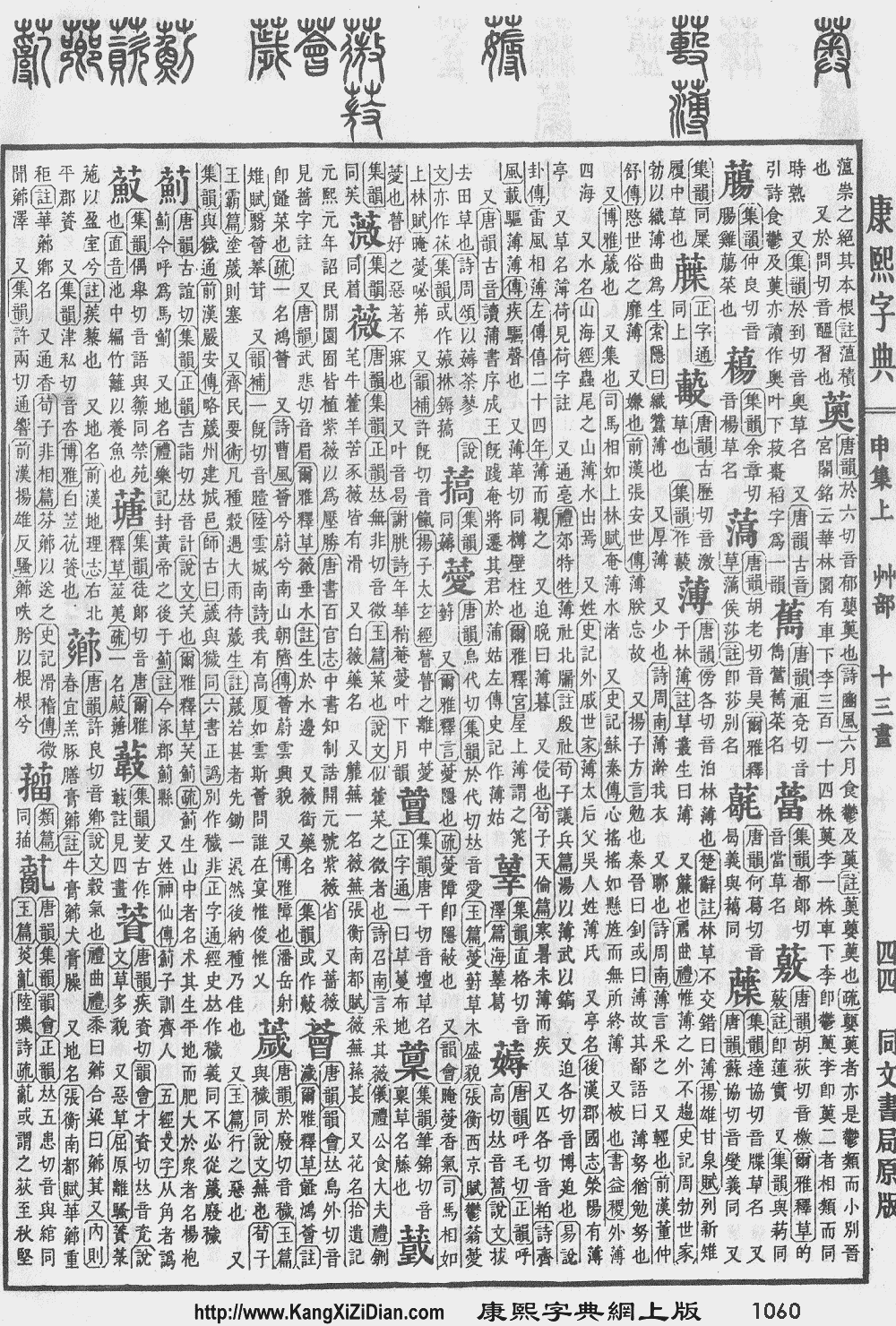
- KangXi: page 1060, character 12
- Dai Kanwa Jiten: character 32083
- Dae Jaweon: page 1523, character 40
- Hanyu Da Zidian (first edition): volume 5, page 3307, character 3
- Unihan data for U+8584
Chinese
| trad. | 薄 | |
|---|---|---|
| simp. # | 薄 | |
Glyph origin
Characters in the same phonetic series (甫) (Zhengzhang, 2003)
| Old Chinese | |
|---|---|
| 豧 | *pʰoːs, *pʰa, *pʰas |
| 縛 | *baːɡs, *baɡ |
| 逋 | *paː |
| 餔 | *paː, *baːs |
| 晡 | *paː |
| 庯 | *paː |
| 陠 | *paː, *pʰaː |
| 鵏 | *paː, *baːs |
| 峬 | *paː |
| 誧 | *paː, *pʰaː, *pʰaːʔ, *pʰaːs |
| 秿 | *paː, *pʰa, *baʔ |
| 鯆 | *paː, *pʰaː, *paʔ |
| 補 | *paːʔ |
| 圃 | *paːʔ, *paːs |
| 鋪 | *pʰaː, *pʰaːs, *pʰa |
| 痡 | *pʰaː, *pʰa |
| 浦 | *pʰaːʔ |
| 烳 | *pʰaːʔ |
| 溥 | *pʰaːʔ, *paːɡ |
| 悑 | *pʰaːs |
| 酺 | *baː |
| 匍 | *baː |
| 蜅 | *baː, *paʔ |
| 脯 | *baː, *paʔ |
| 葡 | *baː |
| 蒱 | *baː |
| 蒲 | *baː |
| 簿 | *baːʔ, *baːɡ |
| 捕 | *baːs |
| 哺 | *baːs |
| 簠 | *pa, *paʔ, *pʰas |
| 甫 | *paʔ |
| 黼 | *paʔ |
| 莆 | *paʔ |
| 俌 | *paʔ, *pʰaʔ |
| 郙 | *paʔ, *pʰa |
| 傅 | *paɡs |
| 搏 | *paɡs, *paːɡ, *pʰaːɡ |
| 麱 | *pʰa |
| 尃 | *pʰa |
| 榑 | *ba |
| 輔 | *baʔ |
| 鬴 | *baʔ |
| 賻 | *baɡs |
| 博 | *paːɡ |
| 髆 | *paːɡ |
| 鎛 | *paːɡ |
| 猼 | *paːɡ |
| 餺 | *paːɡ |
| 簙 | *paːɡ |
| 鑮 | *paːɡ, *baːɡ |
| 欂 | *paːɡ, *baɡ, *breːɡ |
| 蒪 | *pʰaːɡ |
| 膊 | *pʰaːɡ |
| 薄 | *baːɡ |
| 礡 | *baːɡ |
Phono-semantic compound (形聲, OC *baːɡ) : semantic 艹 + phonetic 溥 (OC *pʰaːʔ, *paːɡ).
Etymology
From Proto-Sino-Tibetan *ba (“thin; flat”) (STEDT). Cognate with Burmese ပါး (pa:, “thin”), Jingpho pha (pha³¹, “thin”).
Pronunciation 1
Definitions
薄
- thin (not thick); flimsy
- slight; meagre; small
- 薄酬 ― bóchóu ― small reward
- 德薄而位尊,知小而謀大,力小而任重,鮮不及矣。 [Pre-Classical Chinese, trad.]
- From: I Ching, 11th – 8th century BCE
- Dé bó ér wèi zūn, zhī xiǎo ér móu dà, lì xiǎo ér rèn zhòng, xiān bùjí yǐ. [Pinyin]
- Virtue small and office high; wisdom small and plans great; strength small and burden heavy: - where such conditions exist, it is seldom that they do not end (in evil).
德薄而位尊,知小而谋大,力小而任重,鲜不及矣。 [Pre-Classical Chinese, simp.]
- poor; infertile
- cold in manner; indifferent
- ungenerous; unkind; mean
- 刻薄 ― kèbó ― mean; unkind
- (of taste) weak; light; not strong
- 脣竭則齒寒,魯酒薄而邯鄲圍,聖人生而大盜起。 [Classical Chinese, trad.]
- From: Zhuangzi, circa 3rd – 2nd centuries BCE
- Chún jié zé chǐ hán, Lǔ jiǔ bó ér Hándān wéi, shèngrén shēng ér dàdào qǐ. [Pinyin]
- 'When the lips are gone the teeth are cold;' 'The poor wine of Lu gave occasion to the siege of Han-dan;' 'When sages are born great robbers arise.'
唇竭则齿寒,鲁酒薄而邯郸围,圣人生而大盗起。 [Classical Chinese, simp.]
- to belittle; to despise
- 厚此薄彼 ― hòucǐbóbǐ ― to favour one and slight the other
- Alternative form of 亳 (Bó, “capital of Yin”).
- to reduce
- 王如施仁政於民,省刑罰,薄稅斂,深耕易耨,…… [Classical Chinese, trad.]
- From: Mencius, c. 4th century BCE
- wáng rú shī rénzhèng yú mín, xǐng xíngfá, bó shuìliǎn, shēngēngyìnòu,...... [Pinyin]
- If Your Majesty will indeed dispense a benevolent government to the people, being sparing in the use of punishments and fines, and making the taxes and levies light, so causing that the fields shall be ploughed deep, and the weeding of them be carefully attended to…
王如施仁政于民,省刑罚,薄税敛,深耕易耨,…… [Classical Chinese, simp.]
- (literary) to approach
- 日薄西山 ― rìbóxīshān ― to approach death
- 薄暮雷電,歸何憂? [Classical Chinese, trad.]
- From: The Verses of Chu, 4th century BCE – 2nd century CE
- Bómù léidiàn, guī hé yōu? [Pinyin]
- (please add an English translation of this example)
薄暮雷电,归何忧? [Classical Chinese, simp.]
- a surname
Synonyms
- (Southwestern Mandarin, Jianghuai Mandarin) 𣻏 (jiāo, “thin”)
Antonyms
- 厚 (hòu, “thick”)
See also
- 扁 (biǎn)
Compounds
Derived terms from 薄
|
|
|
Pronunciation 2
Pronunciation 3
Definitions
薄
- ‡ Only used in 蓾薄.
References
- “Entry #12335”, in 臺灣閩南語常用詞辭典 [Dictionary of Frequently-Used Taiwan Minnan] (in Chinese and Min Nan), Ministry of Education, R.O.C., 2011.
Japanese
| Shinjitai | 薄 | |
| Kyūjitai [1] |
薄󠄃 薄+ 󠄃?(Hanyo-Denshi) (Moji_Joho) |
 |
| The displayed kanji may be different from the image due to your environment. See here for details. | ||
Readings
Etymology
| Kanji in this term |
|---|
| 薄 |
| すすき Grade: S |
| kun’yomi |
| For pronunciation and definitions of 薄 – see the following entry. | ||
| ||
| (This term, 薄, is an alternative spelling of the above term.) |
Korean
Vietnamese
This article is issued from Wiktionary. The text is licensed under Creative Commons - Attribution - Sharealike. Additional terms may apply for the media files.