仇

See also: 讐
仇 U+4EC7, 仇
CJK UNIFIED IDEOGRAPH-4EC7
← 仆
[U+4EC6]
CJK Unified Ideographs 仈 →
[U+4EC8]

Translingual

Han character

仇 (Kangxi radical 9, 人+2, 4 strokes, cangjie input 人大弓 (OKN), four-corner 24217, composition ⿰亻九)

References

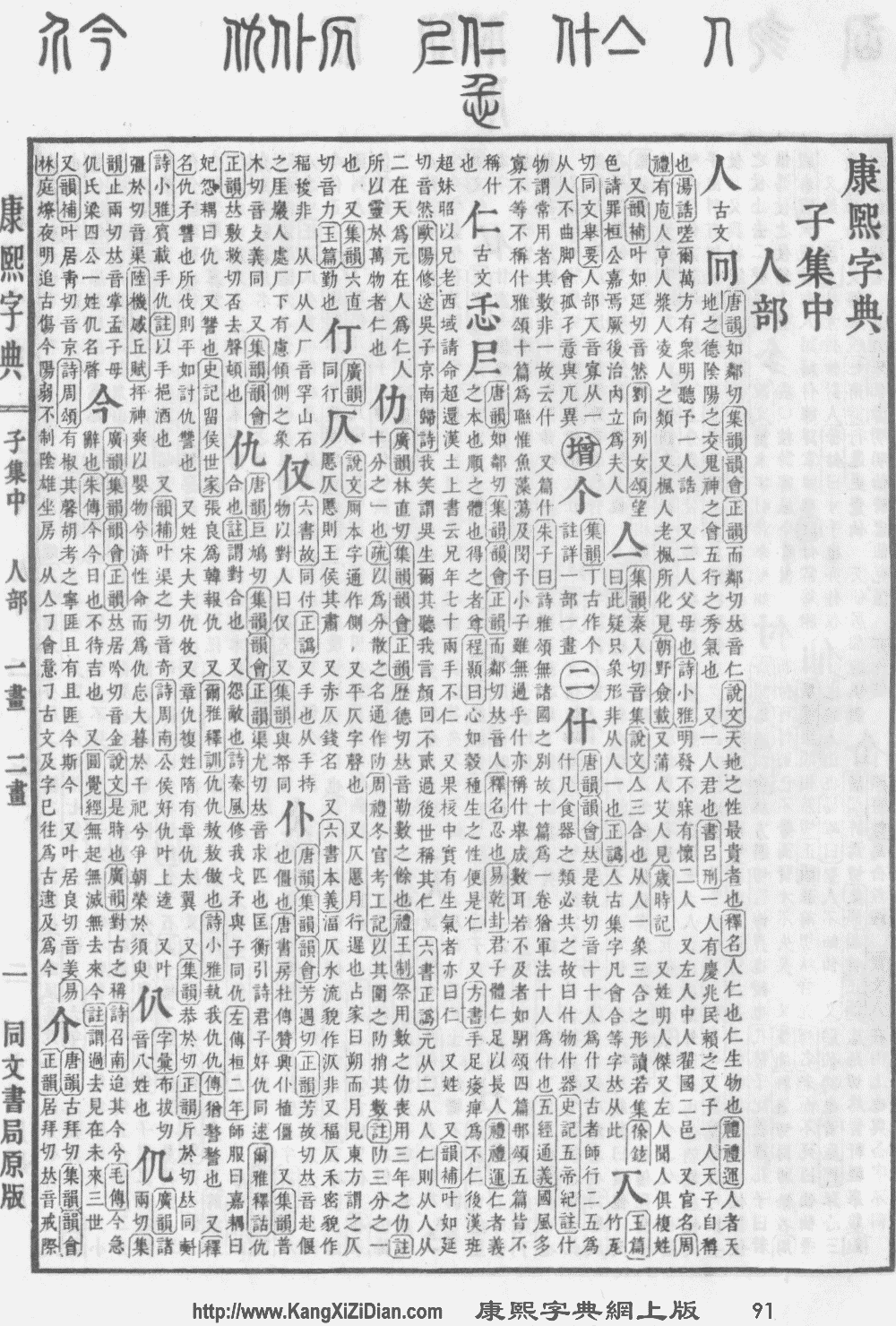
  • KangXi: page 91, character 15
  • Dai Kanwa Jiten: character 355
  • Dae Jaweon: page 193, character 7
  • Hanyu Da Zidian (first edition): volume 1, page 109, character 3
  • Unihan data for U+4EC7

Chinese

simp. and trad.
仇
alternative forms 讎/雠 “resentment”
㐜

Glyph origin

Historical forms of the character 仇
Shuowen Jiezi (compiled in Han) Liushutong (compiled in Ming)
Small seal script Transcribed ancient scripts


References:

Mostly from Richard Sears' Chinese Etymology site (authorisation),
which in turn draws data from various collections of ancient forms of Chinese characters, including:

  • Shuowen Jiezi (small seal),
  • Jinwen Bian (bronze inscriptions),
  • Liushutong (Liushutong characters) and
  • Yinxu Jiaguwen Bian (oracle bone script).

Phono-semantic compound (形聲, OC *ɡu) : semantic 亻 (“person”) + phonetic 九 (OC *kuʔ) – spouse.

Pronunciation 1


  • Dialectal data
Variety Location 仇
Mandarin Beijing /ʈ͡ʂʰou³⁵/
Harbin /ʈ͡ʂʰou²⁴/
Tianjin /ʈ͡ʂʰou⁴⁵/
/t͡sʰou⁴⁵/
Jinan /ʈ͡ʂʰou⁴²/
Qingdao /tʃʰou⁴²/
Zhengzhou /ʈ͡ʂʰou⁴²/
Xi'an /ʈ͡ʂʰou²⁴/
Xining /ʈ͡ʂʰɯ²⁴/
Yinchuan /ʈ͡ʂʰəu⁵³/
Lanzhou /ʈ͡ʂʰou⁵³/
Ürümqi /ʈ͡ʂʰɤu⁵¹/
Wuhan /t͡sʰəu²¹³/
Chengdu /t͡sʰəu³¹/
Guiyang /t͡sʰəu²¹/ ~恨
/t͡ɕʰiəu²¹/ 姓
Kunming /ʈ͡ʂʰəu³¹/
Nanjing /ʈ͡ʂʰəɯ²⁴/
Hefei /ʈ͡ʂʰɯ⁵⁵/
Jin Taiyuan /t͡sʰəu¹¹/
Pingyao /t͡sʰəu¹³/
Hohhot /t͡sʰəu³¹/
Wu Shanghai /zɤ²³/
Suzhou /zɤ¹³/
Hangzhou /d͡zei²¹³/
Wenzhou /d͡ʑɤu³¹/
Hui Shexian /t͡ɕʰiu⁴⁴/
Tunxi /t͡ɕʰiu⁴⁴/
Xiang Changsha /ʈ͡ʂəu¹³/
Xiangtan /ɖ͡ʐəɯ¹²/
Gan Nanchang /t͡sʰɨu²⁴/
Hakka Meixian /su¹¹/
Taoyuan /ʃu¹¹/
Cantonese Guangzhou /sɐu²¹/
Nanning /t͡sʰɐu²¹/
Hong Kong /sɐu²¹/
/t͡sʰɐu²¹/
Min Xiamen (Min Nan) /siu³⁵/
Fuzhou (Min Dong) /sieu⁵³/
Jian'ou (Min Bei) /t͡sʰiu²¹/
Shantou (Min Nan) /t͡sʰiu⁵⁵/
Haikou (Min Nan) /siu³¹/
/sɔu³¹/

Rime
Character 仇
Reading # 1/1
Initial (聲) 群 (30)
Final (韻) 尤 (136)
Tone (調) Level (Ø)
Openness (開合) Open
Division (等) III
Fanqie 巨鳩切
Reconstructions
Zhengzhang
Shangfang
/ɡɨu/
Pan
Wuyun
/ɡiu/
Shao
Rongfen
/ɡiəu/
Edwin
Pulleyblank
/guw/
Li
Rong
/ɡiu/
Wang
Li
/ɡĭəu/
Bernard
Karlgren
/gi̯ə̯u/
Expected
Mandarin
Reflex
qiú
Expected
Cantonese
Reflex
kau4
Baxter–Sagart system 1.1 (2014)
Character 仇
Reading # 1/1
Modern
Beijing
(Pinyin)
qiú
Middle
Chinese
‹ gjuw ›
Old
Chinese
/*[ɡ](r)u/
English mate (*n.)

Notes for Old Chinese notations in the Baxter–Sagart system:

* Parentheses "()" indicate uncertain presence;
* Square brackets "[]" indicate uncertain identity, e.g. *[t] as coda may in fact be *-t or *-p;
* Angle brackets "<>" indicate infix;
* Hyphen "-" indicates morpheme boundary;

* Period "." indicates syllable boundary.
Zhengzhang system (2003)
Character 仇
Reading # 1/1
No. 6944
Phonetic
component
九
Rime
group
幽
Rime
subdivision
1
Corresponding
MC rime
𧚍
Old
Chinese
/*ɡu/

Definitions

仇

  1. hatred; enmity; resentment
  2. enemy; foe; adversary
  3. to make reprisals; to retaliate
  4. to proofread; to check against the original

Compounds

Pronunciation 2


Rime
Character 仇
Reading # 1/1
Initial (聲) 群 (30)
Final (韻) 尤 (136)
Tone (調) Level (Ø)
Openness (開合) Open
Division (等) III
Fanqie 巨鳩切
Reconstructions
Zhengzhang
Shangfang
/ɡɨu/
Pan
Wuyun
/ɡiu/
Shao
Rongfen
/ɡiəu/
Edwin
Pulleyblank
/guw/
Li
Rong
/ɡiu/
Wang
Li
/ɡĭəu/
Bernard
Karlgren
/gi̯ə̯u/
Expected
Mandarin
Reflex
qiú
Expected
Cantonese
Reflex
kau4
Baxter–Sagart system 1.1 (2014)
Character 仇
Reading # 1/1
Modern
Beijing
(Pinyin)
qiú
Middle
Chinese
‹ gjuw ›
Old
Chinese
/*[ɡ](r)u/
English mate (*n.)

Notes for Old Chinese notations in the Baxter–Sagart system:

* Parentheses "()" indicate uncertain presence;
* Square brackets "[]" indicate uncertain identity, e.g. *[t] as coda may in fact be *-t or *-p;
* Angle brackets "<>" indicate infix;
* Hyphen "-" indicates morpheme boundary;

* Period "." indicates syllable boundary.
Zhengzhang system (2003)
Character 仇
Reading # 1/1
No. 6944
Phonetic
component
九
Rime
group
幽
Rime
subdivision
1
Corresponding
MC rime
𧚍
Old
Chinese
/*ɡu/

Definitions

仇

  1. companion; peer
  2. spouse; mate
  3. a surname

Compounds

  • 仇仇
  • 仇偶

Japanese

Kanji

仇

(uncommon “Hyōgai” kanji)

Readings

Etymology 1

Kanji in this term
仇
あだ
Hyōgaiji
kun’yomi

Pronunciation

  • (Tokyo) あだ​ [àdáꜜ] (Odaka – [2])[1]
  • IPA(key): [a̠da̠]

Noun

仇(あだ) • (ada) 

  1. foe, enemy

Noun

仇(かたき) • (kataki) 

  1. Alternative form of 敵

References

  1. 2006, 大辞林 (Daijirin), Third Edition (in Japanese), Tōkyō: Sanseidō, →ISBN

Korean

Hanja

仇 (eum 구 (gu))

  1. enemy
  2. hate, hatred
  3. enmity

Vietnamese

Han character

仇: Hán Nôm readings: cừu

  1. This term needs a translation to English. Please help out and add a translation, then remove the text {{rfdef}}.
This article is issued from Wiktionary. The text is licensed under Creative Commons - Attribution - Sharealike. Additional terms may apply for the media files.