右
| ||||||||
Translingual
| Stroke order | |||
|---|---|---|---|
 | |||
| Stroke order (Japan) | |||
|---|---|---|---|
 | |||
Han character
右 (Kangxi radical 30, 口+2, 5 strokes, cangjie input 大口 (KR), four-corner 40600, composition ⿸𠂇口)
References
- KangXi: page 173, character 5
- Dai Kanwa Jiten: character 3250
- Dae Jaweon: page 385, character 1
- Hanyu Da Zidian (first edition): volume 1, page 569, character 1
- Unihan data for U+53F3
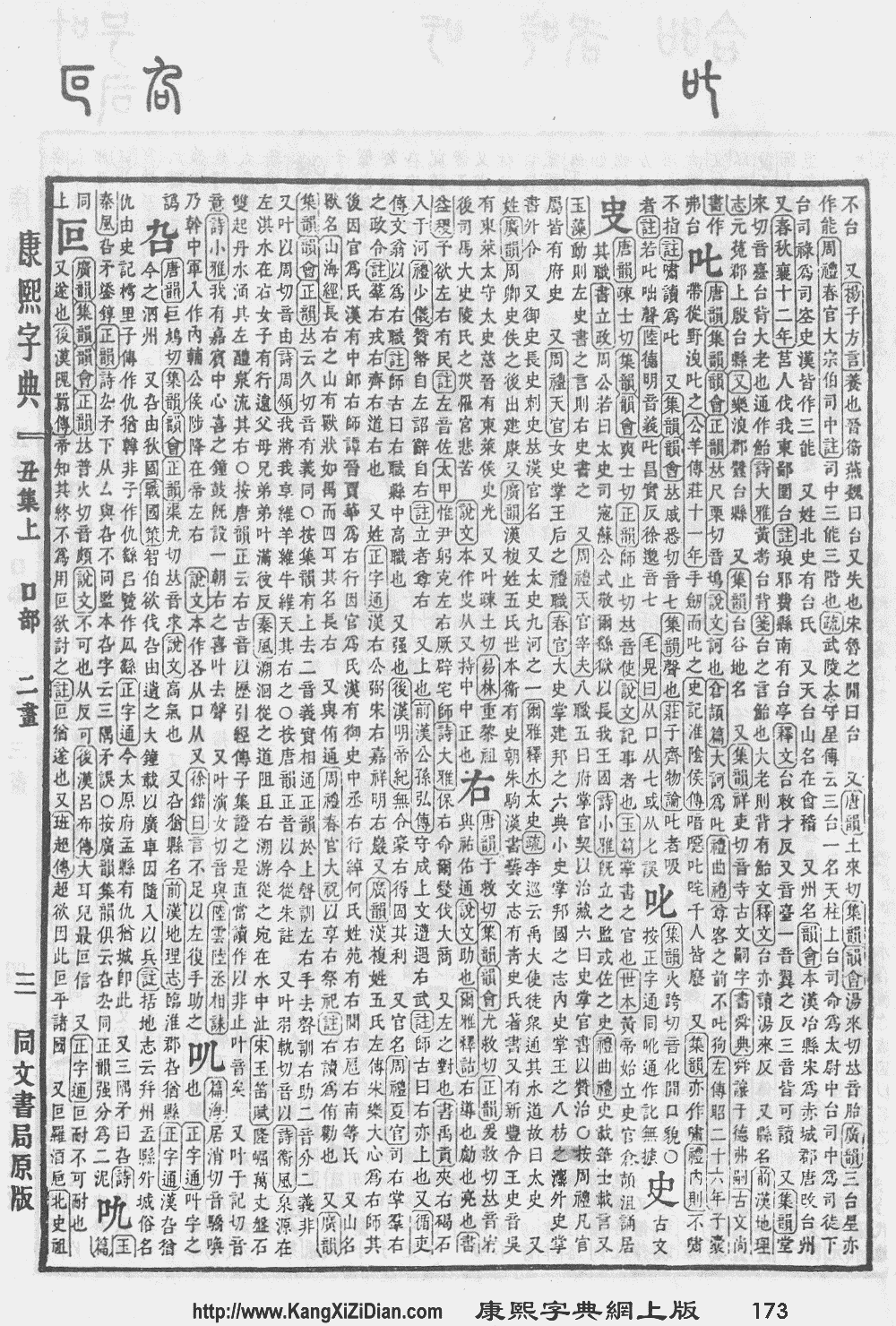
Chinese
| simp. and trad. |
右 | |
|---|---|---|
| alternative forms | 又 厷 | |
Glyph origin
| Historical forms of the character 右 | ||||
|---|---|---|---|---|
| Shang | Western Zhou | Warring States | Shuowen Jiezi (compiled in Han) | Liushutong (compiled in Ming) |
| Oracle bone script | Bronze inscriptions | Chu slip and silk script | Small seal script | Transcribed ancient scripts |
 |
 |
 |
 |
 |
Originally 又 (OC *ɢʷɯs, “right hand”) in the oracle bone script.
In bronze inscriptions, a 口 (“mouth; speech”) component was added, perhaps with the intention of indicating the use of 又 (OC *ɢʷɯs, “again”) is a phonetic loan. In other words, the current form is a phono-semantic compound (形聲, OC *ɢʷɯʔ, *ɢʷɯs) and ideogrammic compound (會意) : phonetic 又 (OC *ɢʷɯs, “right hand”) + semantic 口.
Etymology
From Proto-Sino-Tibetan *g-(j/r)a (“right (hand)”) (STEDT). Cognate with Tibetan གཡས (g.yas, “right”), Jingpho hkra (khʒa⁵⁵, “right”), Burmese ယာ (ya), ညာ (nya).
友 (OC *ɢʷɯʔ, “be friendly; friend”) is the endoactive derivation of 右 (OC *ɢʷɯʔ) (Schuessler, 2007).
佑 (OC *ɢʷɯs, “to aid”), 祐 (OC *ɢʷɯs, “(of divinity) to assist; to bless”), 宥 (OC *ɢʷɯs, “to pardon; magnanimous”) are exoactive derivations of 右 (OC *ɢʷɯʔ) (ibid.).
Pronunciation 1
Definitions
右
Synonyms
Antonyms
- 左 (zuǒ, “left”)
Pronunciation 2
Definitions
右
Compounds
|
Descendants
Others:
References
- “右”, in 漢語多功能字庫 (Multi-function Chinese Character Database), 香港中文大學 (the Chinese University of Hong Kong), 2014–
- Dictionary of Chinese Character Variants (教育部異體字字典), A00483
Japanese
Kanji
Readings
Compounds
Etymology 1
| Kanji in this term |
|---|
| 右 |
| みぎ Grade: 1 |
| kun’yomi |
(This etymology is missing or incomplete. Please add to it, or discuss it at the Etymology scriptorium.)
Pronunciation
Noun
右 • (migi)
- right (direction)
- 1999 July 22, “封印されし者の右足 [Right Leg of the Sealed One]”, in Vol.4, Konami:
- 封印された右足。封印を解くと、無限の力を得られる。
- Fūinsareta migiashi. Fūin o toku to, mugen no chikara o erareru.
- A sealed right leg. Whosoever breaks the seal shall earn infinite power.
- 封印された右足。封印を解くと、無限の力を得られる。
- 私は右の目が見えない。
- Watashi wa migi no me ga mienai.
- I can't see with my right eye.
-
- (in vertical writing of Japanese, with columns running right to left) the above statement, foregoing
- (politics) the right wing, a rightist
- (historical) a superior during in the Chinese Warring States period
- Synonym: 上位 (jōi)
Antonyms
- (right, rightist): 左 (hidari, “left”)
Derived terms
- 右する (migi suru)
- 右上り, 右上がり (migiagari)
- 右上 (migiue)
- 右腕 (migiude)
- 右側 (migigawa)
- 右利き (migikiki)
- 右下 (migishita)
- 右手 (migite)
- 右と言えば左 (migi to ieba hidari)
- 右に同じ (migi ni onaji, “ditto”)
- 右に出る (migi ni deru)
- 右大臣 (Migi no Ōimōchigimi)
- 右大臣 (Migi no Otodo)
- 右左 (migihidari)
- 右巻, 右巻き (migimaki)
- 右も左も分からない (migi mo hidari mo wakaranai)
- 右様 (migiyō)
- 右四つ (migiyotsu)
- 回れ右 (mawaremigi)
Proverbs
- 右の耳から左の耳 (migi no mimi kara hidari no mimi)
- 右を見ても左を見ても (migi o mite mo hidari o mite mo)
- 左平目に右鰈 (hidari hirame ni migi karei)
Etymology 2
| Kanji in this term |
|---|
| 右 |
| みぎり Grade: 1 |
| irregular |
The final り (ri) is likely by analogy with its antonym 左 (hidari, “left”).[3]
Noun
右 • (migiri)
- (archaic) Same as みぎ (migi) above
Etymology 3
| Kanji in this term |
|---|
| 右 |
| ゆう Grade: 1 |
| kan’on |
The “right (direction)” and “respect, esteem, value” senses are from Middle Chinese 右 (MC ɦɨuX).
The “aid, assist” sense is from Middle Chinese 右 / 佑 (MC ɦɨuH).
The kan'on pronunciation, so likely a later borrowing.
Pronunciation
- IPA(key): [jɯ̟ᵝː]
Affix
Etymology 4
| Kanji in this term |
|---|
| 右 |
| う Grade: 1 |
| goon |
From Middle Chinese 右 (MC ɦɨuX).
The goon pronunciation, so likely the initial borrowing.
Pronunciation
- IPA(key): [ɯ̟ᵝ]
Prefix
右 • (u-)
- right (direction)
- (politics) right-wing
- (baseball) right fielder
- (history, government) "of the right", junior or subordinate to 左 (sa-, “of the left”)