史
| ||||||||
Translingual
| Stroke order | |||
|---|---|---|---|
 | |||
Han character
史 (Kangxi radical 30, 口+2, 5 strokes, cangjie input 中大 (LK), four-corner 50006, composition ⿻口乂)
Derived characters
References
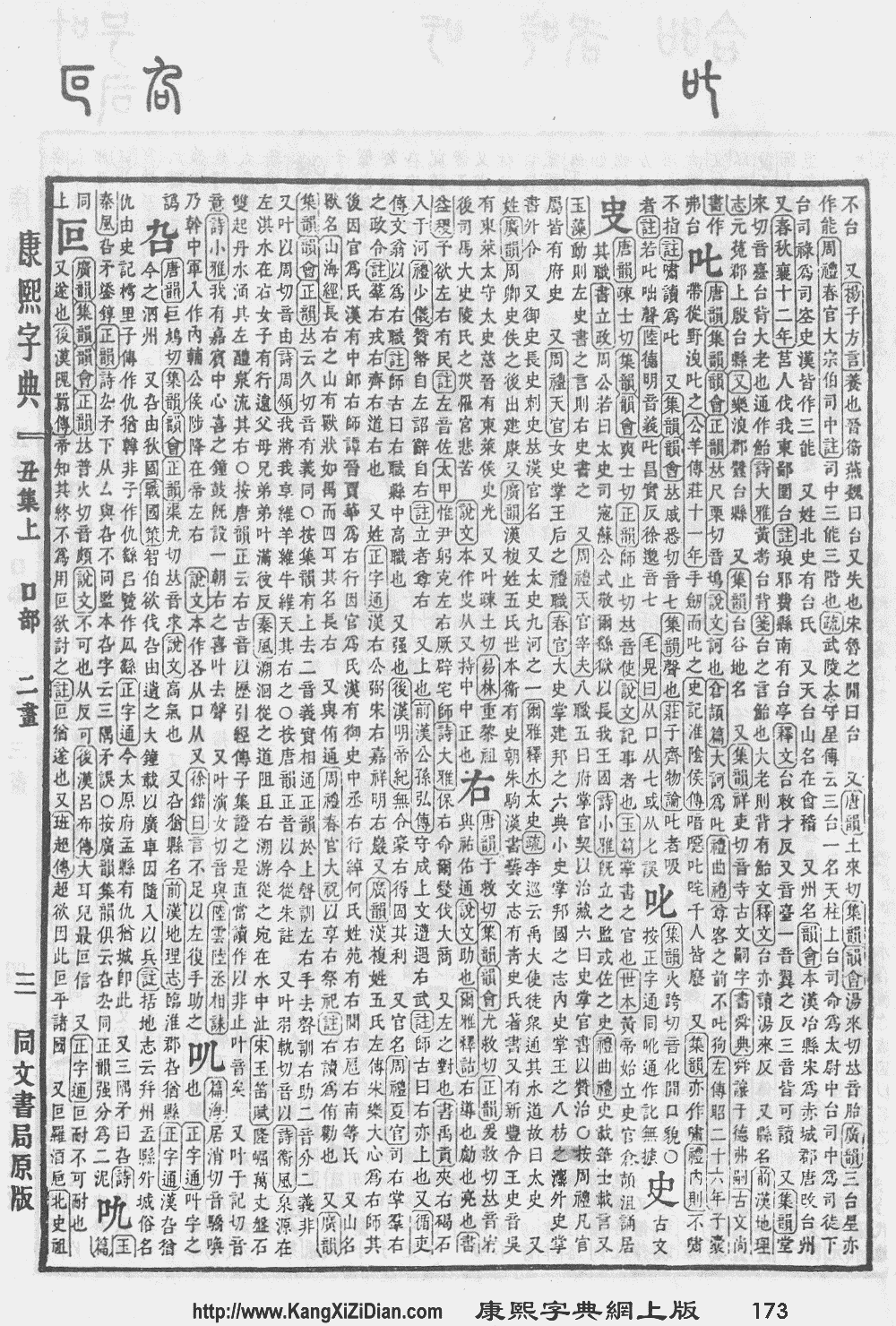
- KangXi: page 173, character 3
- Dai Kanwa Jiten: character 3249
- Dae Jaweon: page 384, character 4
- Hanyu Da Zidian (first edition): volume 1, page 571, character 2
- Unihan data for U+53F2
Chinese
| simp. and trad. |
史 | |
|---|---|---|
| alternative forms | 㕜 | |
Glyph origin
| Historical forms of the character 史 | |||
|---|---|---|---|
| Shang | Western Zhou | Shuowen Jiezi (compiled in Han) | Liushutong (compiled in Ming) |
| Oracle bone script | Bronze inscriptions | Small seal script | Transcribed ancient scripts |
 |
 |
 |
 |
Characters in the same phonetic series (史) (Zhengzhang, 2003)
Pictogram (象形) – 又 (OC *ɢʷɯs, “hand”) holding a fountain pen resembling 中 (OC *tuŋ, *tuŋs)
Etymology
- "to send, to employ, to cause"
- Causative derivation of 理 (OC rəʔ) "envoy (Zuo)" , "jail-official" (Guanzi), "marriage go-between", which is perhaps the same word as 理 (OC rəʔ) "to administer" (Schuessler 2007); the sense "scribe, historian" is derived from this.
- "scribe, historian"
- Possibly from Austroasiatic; Schuessler (2007) compared 理 (OC *rɯʔ), 吏 (OC *rɯs, “official”), 史 (OC *srɯʔ, “scribe, historian”), and 使 (OC *srɯʔ, *srɯs, “ambassador”) to Old Khmer re (“to move, change position”) & its derivatives Old Khmer pre (“to send, order, assign, appoint, delegate, use, employ, make”), in turn related to paṃre (“to serve; service, duty; servant, delegate, representative, minister”); with Sino-Tibetan causative *s- corresponding to Khmer causative *p-.
- Alternatively, Unger (1990) and Starostin & Peiros (1996) derived 史 (OC *srɯʔ) "scribe, secretary" from 理 (OC *rɯʔ) "to mark, to draw lines", which, while cognate with Tibetan འབྲི ('bri, “to write, to draw”), apparently never meant "to write, to record".
Pronunciation
Definitions
史
Compounds
Derived terms from 史
|
|
|
Japanese
Readings
Korean
Etymology
From Middle Chinese 史 (MC ʃɨX).
| Historical Readings | ||
|---|---|---|
| Dongguk Jeongun Reading | ||
| Dongguk Jeongun, 1448 | ᄉᆞᆼ〯 (Yale: sǒ) | |
| Middle Korean | ||
| Text | Eumhun | |
| Gloss (hun) | Reading | |
| Hunmong Jahoe, 1527 | ᄉᆞ〯긧〮 (Yale: sǒkúy-s) | ᄉᆞ〯 (Yale: sǒ) |
Pronunciation
- (SK Standard/Seoul) IPA(key): [sʰa̠(ː)]
- Phonetic hangul: [사(ː)]
- Though still prescribed in Standard Korean, most speakers in both Koreas no longer distinguish vowel length.
Compounds
Vietnamese
This article is issued from Wiktionary. The text is licensed under Creative Commons - Attribution - Sharealike. Additional terms may apply for the media files.