正
| ||||||||
 | ||||||||
Translingual
| Stroke order | |||
|---|---|---|---|
 | |||
| Stroke order | |||
|---|---|---|---|
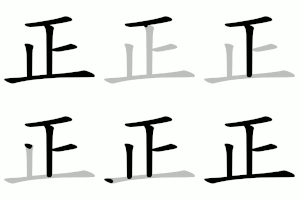 | |||
Alternative forms
As a component of some complex characters, 正 is often written as 𤴓 with its last two strokes different. Compare 昰 and 是.
Han character
正 (Kangxi radical 77, 止+1, 5 strokes, cangjie input 一卜中一 (MYLM), four-corner 10101, composition ⿱一止)
- Shuowen Jiezi radical №31
Usage notes
- (tally marks, 5): The successive strokes of 正 (
 ) are used in China, Taiwan, Japan, Korea and other areas where Chinese characters are prominent to designate tallies in votes, scores, points, sushi orders, and the like, much as
  is used in Africa, the Americas, Australia, and Europe. Tallies beyond five are written with a 正 for each group of five, followed by the remainder. For example, a tally of twelve
  is written as 正正丅.
References
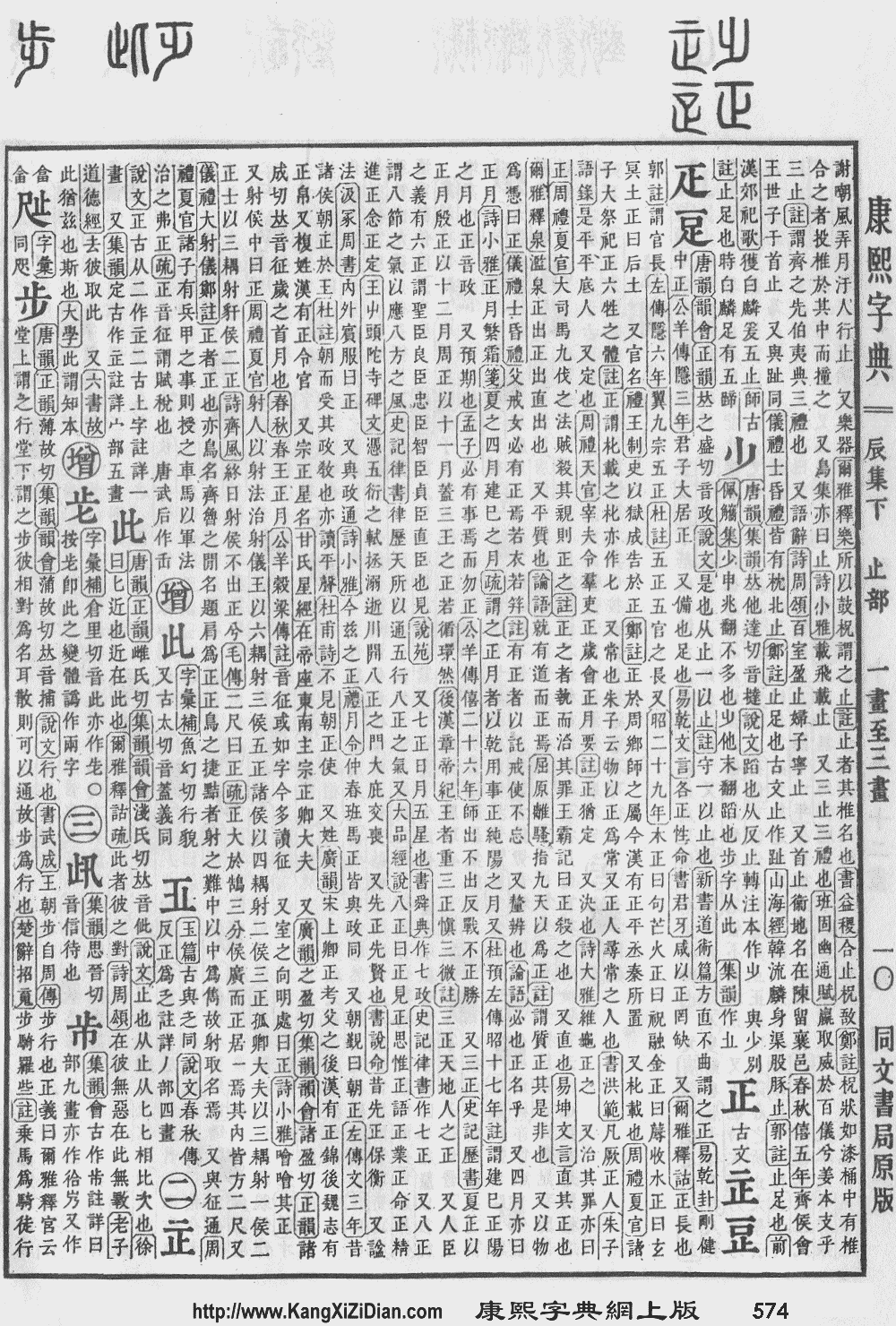
- KangXi: page 574, character 2
- Dai Kanwa Jiten: character 16255
- Dae Jaweon: page 962, character 2
- Hanyu Da Zidian (first edition): volume 2, page 1436, character 1
- Unihan data for U+6B63
Chinese
| simp. and trad. |
正 | |
|---|---|---|
| alternative forms | ||
Glyph origin
| Historical forms of the character 正 | |||
|---|---|---|---|
| Shang | Western Zhou | Shuowen Jiezi (compiled in Han) | Liushutong (compiled in Ming) |
| Oracle bone script | Bronze inscriptions | Small seal script | Transcribed ancient scripts |
 |
 |
 |
 |
Phono-semantic compound (形聲, OC *tjeŋ, *tjeŋs) : phonetic 丁 (OC *rteːŋ, *teːŋ) + semantic 止 (“foot”) – to go on a long journey. Original form of 征 (OC *tjeŋ, “to go on long campaign”).
Etymology
Sino-Tibetan or area word: “centre; target; first (month); straight; correct”.
Compare Mizo dîng (“to go straight or direct (as person, arrow etc.); to go straight through without breaking the journey; straight; direct”). Matisoff sets up Proto-Sino-Tibetan *m-tjak/ŋ ~ tik/ŋ (“good; very; real; straight”) for this, which includes 正, 直 (OC *dɯɡ, “straight; right”) and 實 (OC *ɦliɡ, “solid; true”).
Additionally, Matisoff has Proto-Sino-Tibetan *t(r)waŋ (“straight; straighten”), whence Chepang धेङ्सा (dʰeŋ-, “straight”), Jingpho ding (“straight”), Tibetan དྲང་པོ (drang po, “straight; correct; upright; just; fair”), Burmese တန်း (tan:, “straight; to head straight for”). Also compare Khmer ទៀង (tiĕng, “accurate; correct; exact; precise; honest”).
Derivatives:
- 征 (OC *tjeŋ, “to go straight > to go on a journey”)
- 政 (OC *tjeŋs, “correct; to govern; government; to determine”)
- 整 (OC *tjeŋʔ, “orderly; to arrange; to dispose”)
Pronunciation 2 for the month's name results from the historical avoidance of the taboo on its homophone 政 (OC *tjeŋs), which was the given name of Qin Shi Huang ().
Pronunciation 1
Definitions
正
- straight; upright in proper position; middle
- right; proper; correct; upright
- obverse; right
- regular; standard
- precisely; directly; perfectly
- primary; chief; main; full
- pure; unmixed; authentic; true
- pretty; attractive; beautiful
- (Cantonese) awesome; fantastic
- just now; right now; in the process of
- just; exactly; precisely
- to straighten; to make straight
- 君子正其衣冠,尊其瞻視,儼然人望而畏之,斯不亦威而不猛乎? [Classical Chinese, trad.]
- From: The Analects of Confucius, c. 475 – 221 BCE, translated based on James Legge's version
- Jūnzǐ zhèng qí yīguān, zūn qí zhānshì, yǎnrán rén wàng ér wèi zhī, sī bù yì wēi ér bù měng hū? [Pinyin]
- He adjusts his clothes and cap, and throws a dignity into his looks, so that, thus dignified, he is looked at with awe - is not this to be majestic without being fierce?
君子正其衣冠,尊其瞻视,俨然人望而畏之,斯不亦威而不猛乎? [Classical Chinese, simp.]
- to make right; to rectify; to correct
- 正音 ― zhèngyīn ― to correct one's pronunciation
- (numeral) ten duodecillion(1040)
- (mathematics) regular
- (mathematics) positive; plus
- (physics) positive
- (time) sharp; on the dot
- (Hakka, Teochew) only; merely
- (Hakka, Teochew) just; just now
- (Hakka, Teochew) only then; only after
- (Hakka, Teochew) Used to emphasize that something is/is not.
- (Min Nan) right (direction)
- a surname
- (tally marks) five (successive strokes of 正 are added in writing sequence to tally a count of five per character)
Synonyms
Antonyms
- (right): (Min Nan) 倒 (tò, “left”)
Compounds
|
|
|
See also
| Chinese numerals | ||||||||||||
|---|---|---|---|---|---|---|---|---|---|---|---|---|
| 104 | 108 | 1012 | 1016 | 1020 | 1024 | 1028 | 1032 | 1036 | 1040 | 1044 | 1048 | |
| 萬/万 (wàn) | 億/亿 (yì) | 兆 (zhào) (Taiwan) | 京 (jīng) (Taiwan) | 垓 (gāi) | 秭 (zǐ) | 穰 (ráng) | 溝/沟 (gōu) | 澗/涧 (jiàn) | 正 (zhèng) | 載/载 (zài) | 極/极 (jí) | |
| 萬億/万亿 (wànyì) (Mainland China) |
億億/亿亿 (Mainland China) | |||||||||||
Pronunciation 2
Definitions
正
Descendants
Others:
- Lao: ຈຽງ (chīang, “first month of the lunar year”)
- Lü: ᦵᦈᧂ (ṫseng, “first month in Dai lunar calendar, starting in November”)
- Northern Thai: ᨠ᩠ᨿᨦ (“first month of the lunar year”)
- Shan: ၸဵင် (tsǎeng, “first month of the Shan year, starting December-January”)
- Ahom: 𑜋𑜢𑜂𑜫 (chiṅ, “first month of the lunar year”)
- Vietnamese: giêng (“first month of the Vietnamese lunar year, starting January-February”)
Japanese
Readings
Compounds
Derived terms
Etymology 1
| Kanji in this term |
|---|
| 正 |
| せい Grade: 1 |
| kan’on |
Numeral
正 • (sei)
- A number of ten-duodecillion(1040) in modern Japanese since 17th century.
- 5, as tally marks. Similar to four vertical lines followed by a slanted horizontal line crossing through them, this character is used to count to 5 stroke by stroke. Thus this kanji written up to the third stroke represents 3. After the fifth and final stroke, when this character is completed, one starts writing this character again to count to higher numbers.
Etymology 2
| Kanji in this term |
|---|
| 正 |
| しょう Grade: 1 |
| goon |
Prefix
正 • (shō-)
Proper noun
| Kanji in this term |
|---|
| 正 |
| ただし Grade: 1 |
| nanori |
| Kanji in this term |
|---|
| 正 |
| まさし Grade: 1 |
| nanori |
- a male given name
Korean
Etymology 1
From Middle Chinese 正 (MC t͡ɕiᴇŋH).
| Historical readings |
|---|
|
Pronunciation
- (SK Standard/Seoul) IPA(key): [t͡ɕɘ(ː)ŋ]
- Phonetic hangul: [정(ː)]
- Though still prescribed in Standard Korean, most speakers in both Koreas no longer distinguish vowel length.
Compounds
- 정규 (正規, jeonggyu)
- 정답 (正答, jeongdap)
- 정당 (正當, jeongdang)
- 정도 (正道, jeongdo)
- 정면 (正面, jeongmyeon)
- 정문 (正門, jeongmun)
- 정상 (正常, jeongsang)
- 정색 (正色, jeongsaek)
- 정식 (正式, jeongsik)
- 정안 (正眼, jeong'an)
- 정오 (正午, jeong'o)
- 정오 (正誤, jeong'o)
- 정원 (正員, jeong'won)
- 정의 (正義, jeong'ui)
- 정장 (正裝, jeongjang)
- 정직 (正直, jeongjik)
- 정체 (正體, jeongche)
- 정통 (正統, jeongtong)
- 정품 (正品, jeongpum)
- 정화 (正貨, jeonghwa)
- 정확 (正確, jeonghwak)
- 개정 (改正, gaejeong)
- 경정 (更正, gyeongjeong)
- 경정 (梗正, gyeongjeong)
- 공정 (公正, gongjeong)
- 광정 (匡正, gwangjeong)
- 교정 (校正, gyojeong)
- 교정 (矯正, gyojeong)
- 단정 (端正, danjeong)
- 당정 (黨正, dangjeong)
- 동정 (董正, dongjeong)
- 방정 (方正, bangjeong)
- 보정 (補正, bojeong)
- 부정 (不正, bujeong)
- 사정 (査正, sajeong)
- 사정 (邪正, sajeong)
- 삼정 (芟正, samjeong)
- 서정 (緖正, seojeong)
- 수정 (修正, sujeong)
- 숙정 (肅正, sukjeong)
- 시정 (是正, sijeong)
- 엄정 (嚴正, eomjeong)
- 염정 (廉正, yeomjeong)
- 오정 (午正, ojeong)
- 이정 (里正, ijeong)
- 이정 (釐正, ijeong)
- 인정 (寅正, injeong)
- 자정 (子正, jajeong)
- 적정 (適正, jeokjeong)
- 정정 (訂正, jeongjeong)
- 진정 (眞正, jinjeong)
- 질정 (質正, jiljeong)
- 칙정 (飭正, chikjeong)
- 현정 (顯正, hyeonjeong)
- 정반대 (正反對, jeongbandae)
- 정범자 (正犯者, jeongbeomja)
- 정비례 (正比例, jeongbirye)
Etymology 2
From Middle Chinese 正 (MC t͡ɕiᴇŋ).
| Historical readings |
|---|
|
Pronunciation
- (SK Standard/Seoul) IPA(key): [t͡ɕʌ̹ŋ]
- Phonetic hangul: [정]
Hanja
Compounds
Vietnamese
Han character
正: Hán Việt readings: chinh (
正: Nôm readings: chánh[3][4][1][2][5], chênh[1], chính[3][4][1][2][6], chếnh[1][7][2][5][6], chiếng[3], chỉnh[1], giêng[1]
Derived terms
- 不正 (bất chính)
- 改正 (cải chính)
- 真正 (chân chính)
- 正当 (chính đáng)
- 正名 (chính danh)
- 正义 (chính nghĩa)
- 正果 (chính quả)
- 正國 (chính quốc)
- 正統 (chính thống)
- 正式 (chính thức)
- 正直 (chính trực)
- 正确 (chính xác)
- 公正 (công chính)
- 訂正 (đính chính)
- 端正 (đoan chính)
- 效正 (hiệu chính)
- 廉正 (liêm chính)
- 男正 (nam chính)
- 严正 (nghiêm chính)
- 女正 (nữ chính)
- 斧正 (phủ chính)
- 歸正 (quy chính)
- 修正 (tu chính)
References
- Trần (2004).
- Bonet (1899).
- Nguyễn (2014).
- Nguyễn et al. (2009).
- Génibrel (1898).
- Taberd & Pigneau de Béhaine (1838).
- Hồ (1976).