奏

See also: 秦, 奉, and 泰
奏 U+594F, 奏
CJK UNIFIED IDEOGRAPH-594F
← 奎
[U+594E]
CJK Unified Ideographs 奐 →
[U+5950]

Translingual

Han character

奏 (Kangxi radical 37, 大+6, 9 strokes, cangjie input 手大竹大 (QKHK), four-corner 50430, composition ⿱𡗗天)

Derived characters

  • 凑, 𠸫, 揍, 湊, 𣉅, 楱, 𤋷, 𬍴, 腠, 𭿅, 𥠬, 𦥇, 𦦅, 𧎝, 𧩻, 𧱪, 𨂡, 輳(辏), 𡔿, 𨨯(𬭟), 𩹀, 𪃆, 𪉮(𬸷), 𦴺, 𥯪

References

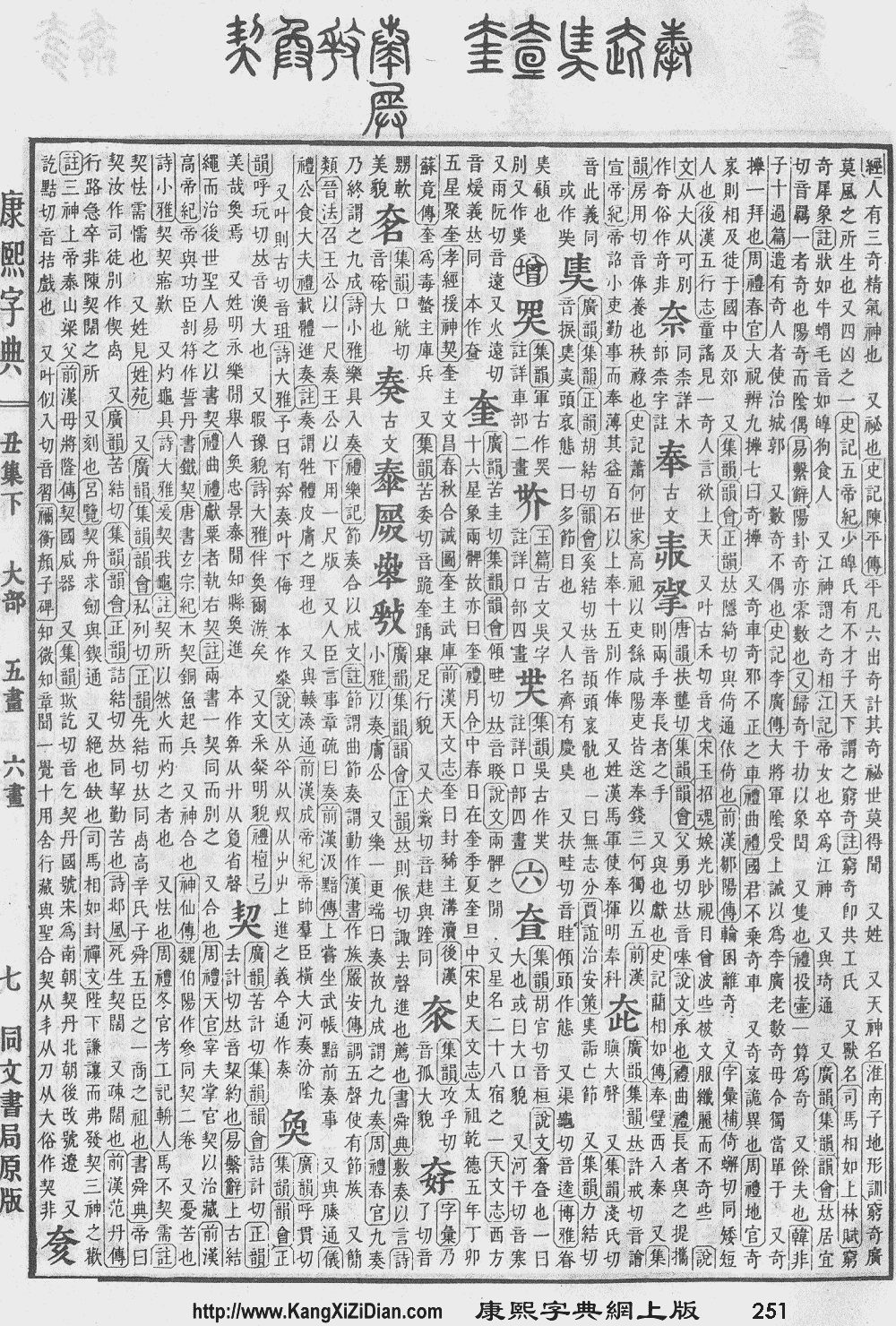
  • KangXi: page 251, character 15
  • Dai Kanwa Jiten: character 5915
  • Dae Jaweon: page 512, character 14
  • Hanyu Da Zidian (first edition): volume 1, page 537, character 1
  • Unihan data for U+594F

Chinese

simp. and trad.
奏
alternative forms 𠂑

Glyph origin

Historical forms of the character 奏
Shuowen Jiezi (compiled in Han) Liushutong (compiled in Ming)
Small seal script Transcribed ancient scripts

Ideogrammic compound (會意) : two hands (廾) holding an object, with various proposed interpretations.

Pronunciation 1


Note:
  • chàu - vernacular;
  • chò/chò͘ - literary.

  • Dialectal data
Variety Location 奏
Mandarin Beijing /t͡sou⁵¹/
Harbin /t͡sou⁵³/
Tianjin /t͡sou⁵³/
Jinan /t͡sou²¹/
Qingdao /t͡sou⁴²/
Zhengzhou /t͡sou³¹²/
Xi'an /t͡sou⁴⁴/
Xining /t͡sɯ²¹³/
Yinchuan /t͡səu¹³/
Lanzhou /t͡sou¹³/
Ürümqi /tɤu²¹³/
Wuhan /t͡səu³⁵/
Chengdu /t͡səu¹³/
Guiyang /t͡səu²¹³/
Kunming /t͡səu²¹²/
Nanjing /t͡səɯ⁴⁴/
Hefei /t͡sɯ⁵³/
Jin Taiyuan /t͡səu⁴⁵/
Pingyao /t͡səu³⁵/
Hohhot /t͡səu⁵⁵/
Wu Shanghai /t͡sɤ³⁵/
Suzhou /t͡sɤ⁵¹³/
Hangzhou /t͡sei⁴⁴⁵/
Wenzhou /t͡sau⁴²/
Hui Shexian /t͡so³²⁴/
Tunxi /t͡siu⁴²/
Xiang Changsha /t͡səu⁵⁵/
Xiangtan /t͡səɯ⁵⁵/
Gan Nanchang /t͡sɛu⁴⁵/
Hakka Meixian /t͡seu⁵³/
Taoyuan /t͡seu⁵⁵/
Cantonese Guangzhou /t͡sɐu³³/
Nanning /t͡sɐu³³/
Hong Kong /t͡sɐu³³/
Min Xiamen (Min Nan) /t͡sɔ²¹/
/t͡sau²¹/
Fuzhou (Min Dong) /t͡sɑu²¹²/
Jian'ou (Min Bei) /t͡se³³/
Shantou (Min Nan) /zau²¹³/
Haikou (Min Nan) /t͡sɔu³⁵/

Rime
Character 奏
Reading # 1/1
Initial (聲) 精 (13)
Final (韻) 侯 (137)
Tone (調) Departing (H)
Openness (開合) Open
Division (等) I
Fanqie 則候切
Baxter tsuwH
Reconstructions
Zhengzhang
Shangfang
/t͡səuH/
Pan
Wuyun
/t͡səuH/
Shao
Rongfen
/t͡səuH/
Edwin
Pulleyblank
/t͡səwH/
Li
Rong
/t͡suH/
Wang
Li
/t͡səuH/
Bernard
Karlgren
/t͡sə̯uH/
Expected
Mandarin
Reflex
zòu
Expected
Cantonese
Reflex
zau3
Baxter–Sagart system 1.1 (2014)
Character 奏
Reading # 1/1
Modern
Beijing
(Pinyin)
zòu
Middle
Chinese
‹ tsuwH ›
Old
Chinese
/*tsˁo(ʔ)-s/
English bring forward; perform (music)

Notes for Old Chinese notations in the Baxter–Sagart system:

* Parentheses "()" indicate uncertain presence;
* Square brackets "[]" indicate uncertain identity, e.g. *[t] as coda may in fact be *-t or *-p;
* Angle brackets "<>" indicate infix;
* Hyphen "-" indicates morpheme boundary;

* Period "." indicates syllable boundary.
Zhengzhang system (2003)
Character 奏
Reading # 1/1
No. 17908
Phonetic
component
奏
Rime
group
侯
Rime
subdivision
0
Corresponding
MC rime
奏
Old
Chinese
/*ʔsoːs/

Definitions

奏

  1. (literary, or in compounds) to offer as tribute; to present with respect; to offer up; to dedicate to
  2. (historical) to present a memorial to an emperor
  3. (literary, or in compounds) to achieve; to gain; to obtain
  4. (literary, or in compounds) to play a musical instrument; to give an instrumental performance
  5. (historical) report; memorial
  6. (literary, or in compounds) beat; meter; rhythm
  7. a surname: Zou

Synonyms

  • (to offer as tribute):
  • (to present a memorial to an emperor): 進奉/进奉 (jìnfèng)
  • (to achieve):
  • (to play a musical instrument):
  • (beat):

Compounds

Pronunciation 2

For pronunciation and definitions of 奏 – see 湊 (“to gather together; to assemble; to approach; to come closer; to draw near; etc.”).
(This character, 奏, is an ancient form of 湊.)
For pronunciation and definitions of 奏 – see 腠 (“the tissue between the skin and the flesh; the tissue between the skin and the flesh”).
(This character, 奏, is an ancient form of 腠.)

Japanese

Kanji

奏

(grade 6 “Kyōiku” kanji)

  1. play music

Readings

Compounds

Korean

Hanja

奏 • (ju) (hangeul 주, revised ju, McCune–Reischauer chu)

  1. This term needs a translation to English. Please help out and add a translation, then remove the text {{rfdef}}.

Vietnamese

Han character

奏: Hán Nôm readings: tấu, táu, tâu, thần

  1. This term needs a translation to English. Please help out and add a translation, then remove the text {{rfdef}}.
This article is issued from Wiktionary. The text is licensed under Creative Commons - Attribution - Sharealike. Additional terms may apply for the media files.