奮

See also: 奋
奮 U+596E, 奮
CJK UNIFIED IDEOGRAPH-596E
← 奭
[U+596D]
CJK Unified Ideographs 奯 →
[U+596F]

Translingual

Han character

奮 (Kangxi radical 37, 大+13, 16 strokes, cangjie input 大人土田 (KOGW), four-corner 40601, composition ⿱奞田)

References

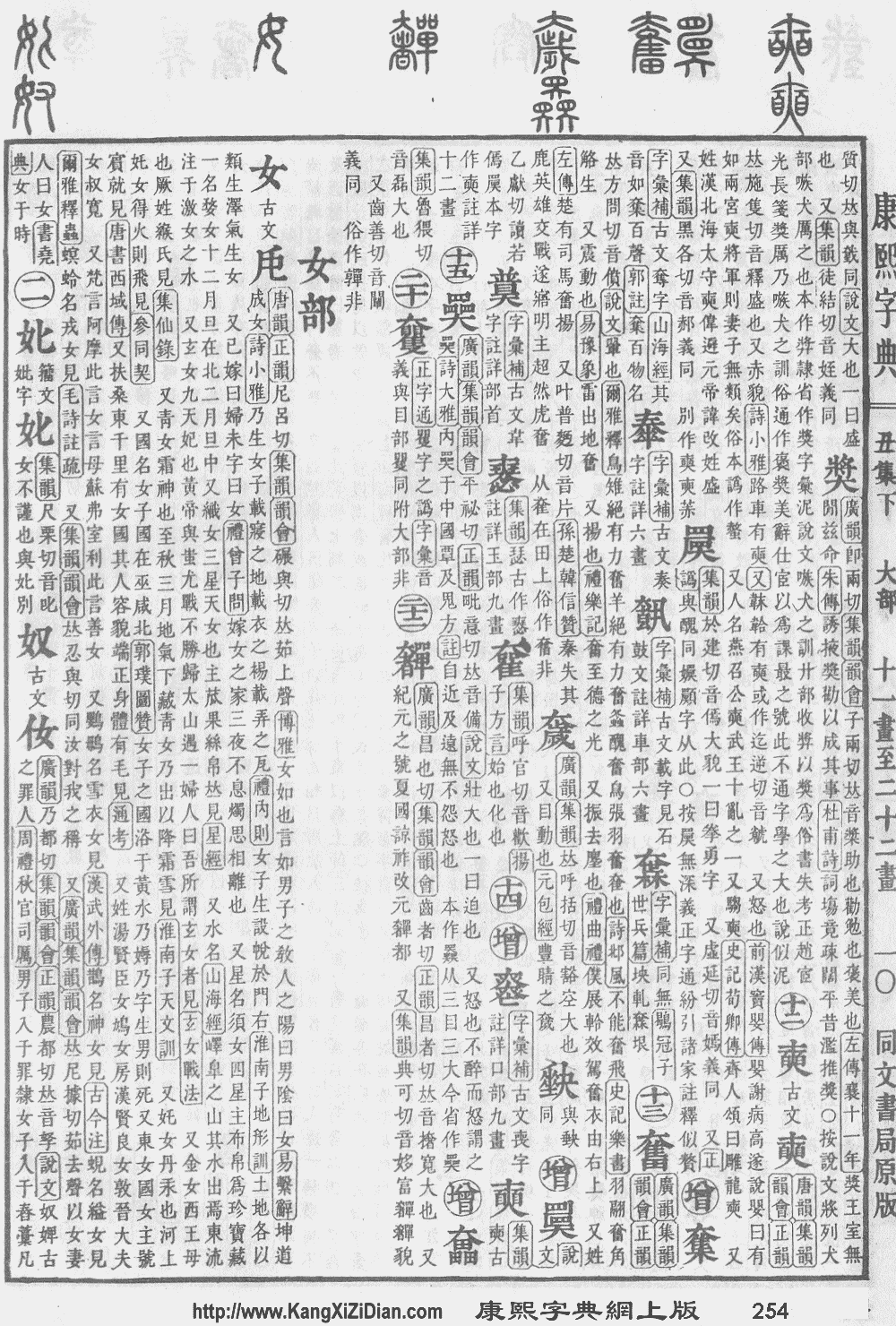
  • KangXi: page 254, character 9
  • Dai Kanwa Jiten: character 6012
  • Dae Jaweon: page 515, character 35
  • Hanyu Da Zidian (first edition): volume 1, page 550, character 3
  • Unihan data for U+596E

Chinese

trad. 奮
simp. 奋*
alternative forms 𡚒 possibly erroneous

Glyph origin

Historical forms of the character 奮
Western Zhou Shuowen Jiezi (compiled in Han) Liushutong (compiled in Ming)
Bronze inscriptions Small seal script Transcribed ancient scripts

Ideogrammic compound (會意) : 奞 (“bird”) + 田 (“field”) – bird spreading its wings to fly.

Etymology

Related to 翂 (OC *pɯn, “appearance of birds flying slowly”) and 飛 (OC *pɯl, “to fly”).

Pronunciation


Rime
Character 奮
Reading # 1/1
Initial (聲) 幫 (1)
Final (韻) 文 (59)
Tone (調) Departing (H)
Openness (開合) Closed
Division (等) III
Fanqie 方問切
Reconstructions
Zhengzhang
Shangfang
/pɨunH/
Pan
Wuyun
/piunH/
Shao
Rongfen
/piuənH/
Edwin
Pulleyblank
/punH/
Li
Rong
/piuənH/
Wang
Li
/pĭuənH/
Bernard
Karlgren
/pi̯uənH/
Expected
Mandarin
Reflex
fèn
Expected
Cantonese
Reflex
fan3
Baxter–Sagart system 1.1 (2014)
Character 奮
Reading # 1/1
Modern
Beijing
(Pinyin)
fèn
Middle
Chinese
‹ pjunH ›
Old
Chinese
/*(Cə.)pə[r]-s/ (W dialect)
English spread wings and fly

Notes for Old Chinese notations in the Baxter–Sagart system:

* Parentheses "()" indicate uncertain presence;
* Square brackets "[]" indicate uncertain identity, e.g. *[t] as coda may in fact be *-t or *-p;
* Angle brackets "<>" indicate infix;
* Hyphen "-" indicates morpheme boundary;

* Period "." indicates syllable boundary.
Zhengzhang system (2003)
Character 奮
Reading # 1/1
No. 3196
Phonetic
component
奮
Rime
group
文
Rime
subdivision
1
Corresponding
MC rime
糞
Old
Chinese
/*pɯns/

Definitions

奮

  1. (of bird) to spread and flutter the wings
  2. to shake; to vibrate
  3. to wield; to wave
  4. to dash ahead; to put to good use
  5. to strive; to exert effort
  6. to arouse; to stimulate
  7. a surname

Compounds

  • 奮發圖強/奋发图强
  • 奮發有為/奋发有为
  • 奮發自強/奋发自强
  • 奮發蹈厲/奋发蹈厉
  • 奮矜/奋矜
  • 奮筆疾書/奋笔疾书
  • 奮翅/奋翅
  • 奮臂/奋臂
  • 奮袂攘襟/奋袂攘襟
  • 奮袂而起/奋袂而起
  • 奮起/奋起 (fènqǐ)
  • 奮起直追/奋起直追
  • 奮身/奋身
  • 奮身獨步/奋身独步
  • 奮辭/奋辞
  • 奮進/奋进 (fènjìn)
  • 奮逸響/奋逸响
  • 奮飛/奋飞
  • 奮鬥/奋斗 (fèndòu)

Japanese

Kanji

奮

(grade 6 “Kyōiku” kanji)

  1. agitation
  2. rouse

Readings

Compounds

Korean

Etymology

From Middle Chinese 奮 (MC pɨunH).

Hanja

奮 (eumhun 떨칠 분 (tteolchil bun))

  1. Hanja form? of 분 (“strive, exert effort”).
  2. Hanja form? of 분 (“arouse”).

Vietnamese

Han character

奮: Hán Nôm readings: phấn[1][2][3][4][5]

  1. chữ Hán form of phấn (“to agitate; to shake; to arouse; impetuous”).

Compounds

References

  1. Génibrel (1898).
  2. Bonet (1899).
  3. Thiều Chửu (1942).
  4. Nguyễn (1974).
  5. Trần (1999).
This article is issued from Wiktionary. The text is licensed under Creative Commons - Attribution - Sharealike. Additional terms may apply for the media files.