妖
| ||||||||
Translingual
Han character
妖 (Kangxi radical 38, 女+4, 7 strokes, cangjie input 女竹大 (VHK), four-corner 42434, composition ⿰女夭)
References
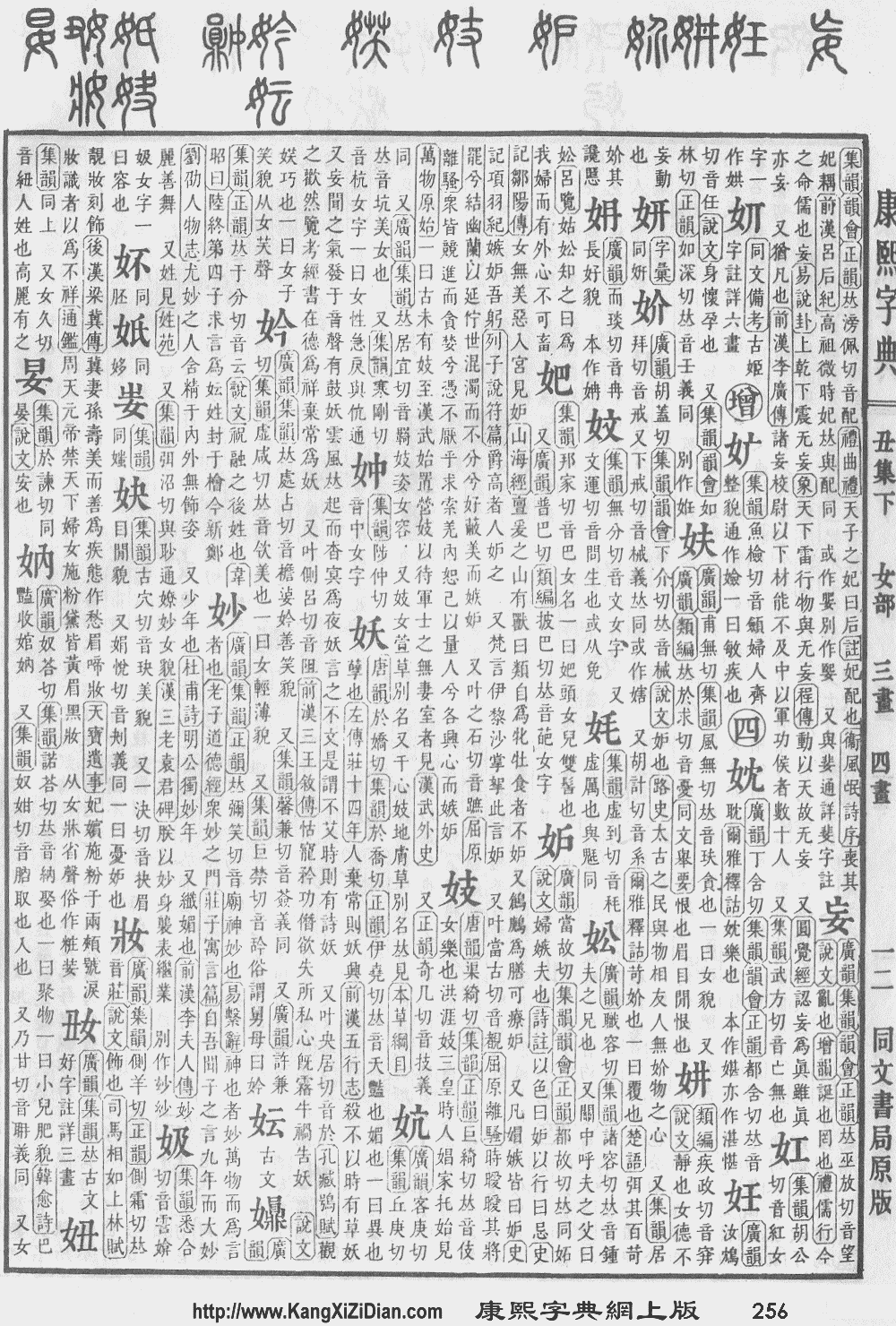
- KangXi: page 256, character 20
- Dai Kanwa Jiten: character 6086
- Dae Jaweon: page 520, character 18
- Hanyu Da Zidian (first edition): volume 2, page 1031, character 7
- Unihan data for U+5996
Chinese
| trad. | 妖 | |
|---|---|---|
| simp. # | 妖 | |
Glyph origin
Characters in the same phonetic series (夭) (Zhengzhang, 2003)
Phono-semantic compound (形聲, OC *qrow) : semantic 女 + phonetic 夭 (OC *qoːwʔ, *qrow, *qrowʔ).
Pronunciation
Definitions
妖
- abnormal or bizarre thing or phenomenon
- 妖由人興也。人無釁焉,妖不自作,人棄常則妖興。 [Classical Chinese, trad.]
- From: Commentary of Zuo, c. 4th century BCE, translated based on James Legge's version
- Yāo yóu rén xīng yě. Rén wú xìn yān, yāo bù zì zuò, rén qì cháng zé yāo xìng. [Pinyin]
- Monsters and monstrous events take their rise from men. If men afford no cause for them, they do not arise of themselves. When men abandon the constant course of virtue, then monstrosities appear.
妖由人兴也。人无衅焉,妖不自作,人弃常则妖兴。 [Classical Chinese, simp.]
- 事體老妖個。 [Shanghainese, trad.]
- From: 2011, Hu Baotan, 弄堂
- [z̥z̩²² tʰi⁴⁴ lɔ³³ iɔ⁵⁵ ɦəʔ²¹] [IPA]
- It's quite an odd happenstance.
事体老妖个。 [Shanghainese, simp.]
- demon; goblin
- evil and fraudulent
- (literary) gorgeous; beautiful; charming
- 美女妖且閑,采桑歧路間。 [Classical Chinese, trad.]
- From: 3rd century, Cao Zhi, 美女篇 ("On a Beautiful Woman"), translated by Wu (1998)[1]
- Měinǚ yāo qiě xián, cǎi sāng qílù jiān. [Pinyin]
- That beautiful woman is charming and graceful, she is plucking mulberries at the crossways.
美女妖且闲,采桑歧路间。 [Classical Chinese, simp.]
- (chiefly of women) bizarrely dressed or behaving frivolously
- (Cantonese, vulgar) yuck! (used in place of its near-homophone 屌 (diu2))
Compounds
Derived terms from 妖
|
References
- Wu Fusheng (1998). The Poetics of Decadence: Chinese Poetry of the Southern Dynasties and Late Tang Periods. Albany: State University of New York Press. pp. 47-48
Japanese
Readings
- Go-on: よう (yō, Jōyō)←えう (eu, historical)
- Kan-on: よう (yō, Jōyō)←えう (eu, historical)
- Kun: あやしい (ayashii, 妖しい, Jōyō); およずれ (oyozure, 妖)←およづれ (oyodure, 妖, historical); なまめく (namameku, 妖めく); わざわい (wazawai, 妖い)←わざはひ (wazafafi, 妖ひ, historical)
Compounds
Compounds
- 妖人 (oyozurebito): a person who leads others astray with their words
- 妖異 (yōi): something strange and mysterious; a monster or phantom
- 妖艶 (yōen), 妖婉 (yōen): bewitchingly attractive; seductive
- 妖花 (yōka): a strangely beautiful flower; metaphorically, a strangely beautiful woman
- 妖怪 (yōkai): a monster, a phantom
- 妖気 (yōki): a weird or unearthly feeling
- 妖姫 (yōki): a seductively beautiful princess, a distractingly attractive woman
- 妖狐 (yōko): a demon fox, kitsune
- 妖犬 (yōken): a demon dog, such as the inugami or yamainu
- 妖猫 (yōbyō): a demon cat, such as the bakeneko, nekomata or kasha
- 妖教 (yōkyō): a religion that leads people astray; heresy
- 妖孽 (yōgetsu): a strange calamity; an omen or portent of misfortune
- 妖言 (yōgen), 妖言 (oyozuregoto): a malicious rumor
- 妖光 (yōkō): a strange and inauspicious light
- 妖術 (yōjutsu): witchcraft, sorcery
- 妖法 (yōhō)
- 妖道 (yōdō)
- 妖術師 (yōjutsushi): a witch, a sorcerer
- 妖女 (yōjo): a seductively or distractingly beautiful woman; a vamp; a female fairy, a siren
- 妖星 (yōsei): an inauspicious or unlucky star
- 妖精 (yōsei): fairy
- 妖精症 (yōseishō): (medical): leprechaunism, a manifestation of secondary insulin resistance
- 妖美 (yōbi): seductively beautiful
- 妖婦 (yōfu): a seductress, a vamp
- 妖変 (yōhen): a strange accident, emergency, or calamity
- 妖魔 (yōma): a monster, a demon
- 妖冶, 妖艶, 妖婉 (yōya): bewitchingly attractive; seductive
- 妖厄神 (yōyakujin): a god of disaster and calamity; a god of disease and misfortune
- 妖霊 (yōrei): an evil spirit; a phantom
- 妖霊星, 妖星 (yōreiboshi): an inauspicious or unlucky star
- 妖麗, 妖美 (yōrei): seductively beautiful
- 妖化 (yōka): a demonic entity or transformation
Noun
Synonyms
- 妖言 (oyozuregoto)
Etymology 2
| Kanji in this term |
|---|
| 妖 |
| よう Grade: S |
| on’yomi |
Pronunciation
- IPA(key): [jo̞ː]
Korean
Hanja
妖 • (yo) (hangeul 요)
- This term needs a translation to English. Please help out and add a translation, then remove the text
{{rfdef}}.
Vietnamese
This article is issued from Wiktionary. The text is licensed under Creative Commons - Attribution - Sharealike. Additional terms may apply for the media files.