常
| ||||||||
Translingual
| Stroke order | |||
|---|---|---|---|
 | |||
Han character
常 (Kangxi radical 50, 巾+8, 11 strokes, cangjie input 火月口中月 (FBRLB), four-corner 90227, composition ⿱𫩠巾 or ⿱龸吊)
Further reading
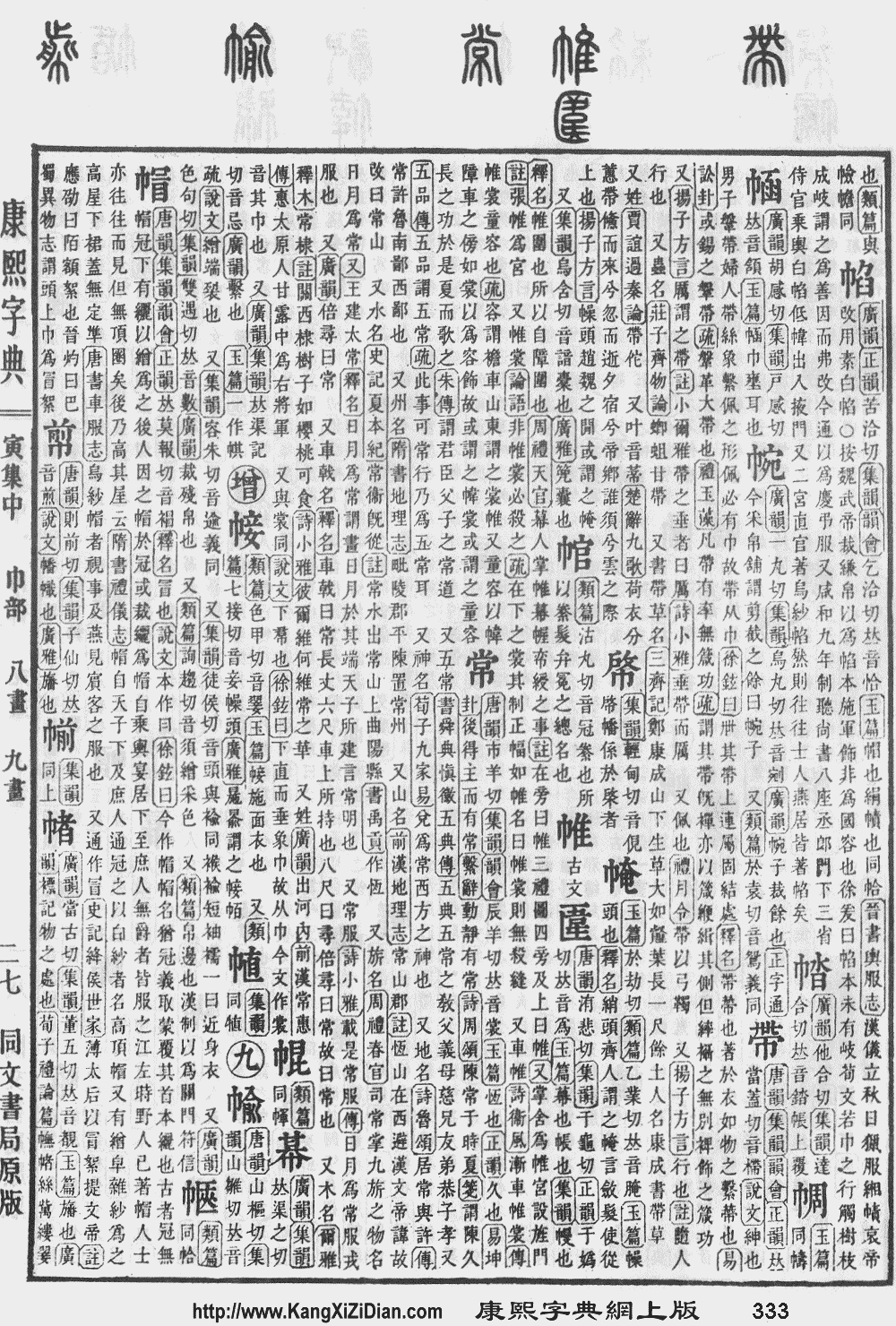
- KangXi: page 333, character 12
- Dai Kanwa Jiten: character 8955
- Dae Jaweon: page 639, character 13
- Hanyu Da Zidian (first edition): volume 1, page 744, character 1
- Unihan data for U+5E38
Chinese
| simp. and trad. |
常 | |
|---|---|---|
| alternative forms | 㦂 | |
Glyph origin
| Old Chinese | |
|---|---|
| 當 | *taːŋ, *taːŋs |
| 襠 | *taːŋ |
| 鐺 | *taːŋ, *sʰraːŋ |
| 簹 | *taːŋ |
| 璫 | *taːŋ |
| 檔 | *taːŋ, *taːŋs |
| 儅 | *taːŋ, *taːŋs |
| 蟷 | *taːŋ |
| 擋 | *taːŋʔ, *taːŋs |
| 黨 | *taːŋʔ, *tʰaːŋʔ |
| 讜 | *taːŋʔ |
| 欓 | *taːŋʔ |
| 譡 | *taːŋs |
| 闣 | *taːŋs |
| 瓽 | *taːŋs |
| 鏜 | *tʰaːŋ |
| 闛 | *tʰaːŋ, *daːŋ |
| 鼞 | *tʰaːŋ |
| 曭 | *tʰaːŋʔ |
| 儻 | *tʰaːŋʔ, *tʰaːŋs |
| 戃 | *tʰaːŋʔ |
| 矘 | *tʰaːŋʔ |
| 爣 | *tʰaːŋʔ |
| 攩 | *hl'aːŋʔ, *ɦʷlaːŋʔ, *ɦʷlaːŋs |
| 淌 | *tʰaːŋʔ |
| 倘 | *tʰaːŋʔ |
| 躺 | *tʰaːŋʔ |
| 趟 | *tʰaːŋs, *rtaːŋ, *rtaːŋs |
| 堂 | *daːŋ |
| 坣 | *daːŋ |
| 棠 | *daːŋ |
| 糛 | *daːŋ |
| 螳 | *daːŋ |
| 隚 | *daːŋ |
| 橖 | *daːŋ |
| 掌 | *tjaŋʔ |
| 廠 | *tʰjaŋʔ, *tʰjaŋs |
| 敞 | *tʰjaŋʔ |
| 僘 | *tʰjaŋʔ |
| 氅 | *tʰjaŋʔ |
| 常 | *djaŋ |
| 嘗 | *djaŋ |
| 裳 | *djaŋ |
| 徜 | *djaŋ |
| 尚 | *djaŋ, *djaŋs |
| 甞 | *djaŋ |
| 鋿 | *djaŋ |
| 嫦 | *djaŋ |
| 償 | *djaŋ, *djaŋs |
| 賞 | *hjaŋʔ |
| 瞠 | *rtʰaːŋ |
| 撐 | *rtʰaːŋ |
| 樘 | *rtʰaːŋ |
| 橕 | *rtʰaːŋ |
| 牚 | *rtʰaːŋs |
| 埫 | *tʰoŋʔ |
Phono-semantic compound (形聲, OC *djaŋ) : phonetic 尚 (OC *djaŋ, *djaŋs) + semantic 巾 (“cloth”).
The character originally referred to "lower garment", before being phonetically borrowed to mean "long-lasting; frequently". The original sense is now represented by the character 裳 (OC *djaŋ, “lower garment”).
Etymology
From Proto-Sino-Tibetan; perhaps related to Tibetan ཡང (yang, “again, once more”) (Schuessler, 2007).
Pronunciation 1
Definitions
常
Synonyms
Descendants
Compounds
|
|
|
Pronunciation 2
Compounds
|
References
- “常”, in 漢語多功能字庫 (Multi-function Chinese Character Database), 香港中文大學 (the Chinese University of Hong Kong), 2014–
- Dictionary of Chinese Character Variants (教育部異體字字典), A01175
- “Query for 常”, in 臺灣閩南語常用詞辭典 [Dictionary of Frequently-Used Taiwan Minnan], Ministry of Education, R.O.C., 2011.
Japanese
Readings
- Go-on: じょう (jō, Jōyō)←じやう (zyau, historical)
- Kan-on: しょう (shō)←しやう (syau, historical)
- Kun: きだ (kida, 常); つね (tsune, 常, Jōyō); とこ (toko, 常, Jōyō); とことわ (tokotowa, 常); とわ (towa, 常)
- Nanori: つら (tsura); とき (toki); ときわ (tokiwa)←ときは (tokifa, historical); のぶ (nobu); ひ (hi); ひさ (hisa); ひさし (hisashi); ひた (hita)
Compounds
- 常陸 (Hitachi)
Etymology 1
| Kanji in this term |
|---|
| 常 |
| じょう Grade: 5 |
| on’yomi |
/d͡ʑau/ → /d͡ʑɔː/ → /d͡ʑoː/
From Middle Chinese 常 (MC d͡ʑɨɐŋ).
Derived terms
- 常温 (jōon)
- 常軌 (jōki)
- 常時 (jōji)
- 常識 (jōshiki)
- 常州 (Jōshū)
- 常習 (jōshū)
- 常人 (jōjin), 常人 (jōnin)
- 常体 (jōtai)
- 常態 (jōtai)
- 常任 (jōnin)
- 常磐 (Jōban)
- 常備 (jōbi)
- 常務 (jōmu)
- 常夜 (jōya)
- 常用 (jōyō)
- 常緑 (jōryoku)
- 異常 (ijō)
- 経常 (keijō)
- 恒常 (kōjō)
- 綱常 (kōjō)
- 五常 (gojō)
- 尋常 (jinjō)
- 正常 (seijō)
- 通常 (tsūjō)
- 日常 (nichijō)
- 非常 (hijō)
- 平常 (heijō)
- 無常 (mujō)
Noun
- a traditional Japanese unit of length, equal to one 丈 (jō, roughly three meters) and three 尺 (shaku, roughly one foot or thirty centimeters)
Etymology 2
| Kanji in this term |
|---|
| 常 |
| きだ Grade: 5 |
| kun’yomi |
*⟨ki1da⟩ → */kʲida/ → /kida/
First attested in the Kojiki (712 CE).
Cognate with root kiza in 刻む (kizamu, “to mince; to slice; to cut a thing into pieces; to groove, to nick, to notch”).[1]
Also sometimes read as kita.
Alternative forms
Pronunciation
- IPA(key): [kʲida̠]
Noun
- (obsolete) a traditional Japanese unit of measure for the length of cut cloth, equal to one 丈 (jō, roughly three meters) and three 尺 (shaku, roughly one foot or thirty centimeters)
- (obsolete) a traditional Japanese unit of measure for the area of an agricultural field or paddy, equal to either 360 歩 (bu, around 1190 square meters), later reduced to 300 歩 (bu)/坪 (tsubo, almost 992 square meters)
- Synonym: 段 (tan)
Counter
常 • (-kida)
- counter for cuts or strips of something
Etymology 3
| Kanji in this term |
|---|
| 常 |
| つね Grade: 5 |
| kun’yomi |
/tune/ → /t͡sune/
From Old Japanese. Appears in the Man'yōshū, compiled around 759 CE.[1] May be cognate with 綱 (tsuna, “thick rope; binding”), with underlying ideas of "connection, continuance".
Alternative forms
Usage notes
This appears as an adjective in older texts with the classical attributive form tsune naru. When used attributively in modern Japanese, this term is used with the particle の (no) instead:
- 常の人
- tsune no hito
- everyday people, regular people
Modern Japanese does still use this term as an adverb, with particle に (ni):
- このカメラは常にオンになっている。
- Kono kamera wa tsune ni on ni natte iru.
- This camera is always on.
- あの会社はサービスが常に悪い。
- Ano kaisha wa sābisu ga tsune ni warui.
- That company has consistently bad service.
Etymology 4
| Kanji in this term |
|---|
| 常 |
| とこ Grade: 5 |
| kun’yomi |
⟨to2ko2⟩ → */təkə/ → /toko/
From Old Japanese. Possibly cognate with 時 (toki, “time”). Alternatively, from Proto-Nivkh *d’ək (whence Nivkh тьык (țək, “(a) long time”)).[4]
The way the term is used in the historical record suggests that this was originally a noun. By the time of written Japanese, however, this term only appears in compounds, never on its own, and its usage is more as an adjective to modify other nouns.
Pronunciation
- IPA(key): [to̞ko̞]
Usage notes
Only used in compounds. Attaches to nouns and other nominals, often (but not always) with the now-obsolete possessive particle つ (tsu).
- 常つ御門、常夏、常とわ
- toko tsu mikado, tokonatsu, tokotowa
- the eternal palace, eternal summer, eternal permanence [→ eternity]
Derived terms
Etymology 5
| Kanji in this term |
|---|
| 常 |
| とことわ Grade: 5 |
| kun’yomi |
/tokotoba/ → /tokotowa/
From Old Japanese. Read as tokotoba until the Heian period.[1][2]
Appears to be originally a compound of 常 (toko, “eternal”, see above) + とわ (towa, “permanence, unchangingness”, from earlier とば toba).
This latter element is of unclear derivation. Some sources[1] indicate that towa as an independent term arose as a contraction of earlier tokotoba, suggesting the possibility that toba was initially a compound of particles と (to, adverbial particle) + は (wa, formerly ba, even earlier pa; topic particle). However, other sources[5] describe tokotowa as an intensified or emphatic form of towa.
Alternative forms
- 常とわ, 恒とわ, (rare) 永久
Pronunciation
Adjective
常 • (tokotowa) ←とことは (tokotofa)?-na (adnominal 常な (tokotowa na), adverbial 常に (tokotowa ni))
Usage notes
Listed in dictionaries[1][2][6] as a 形容動詞 (keiyō dōshi, “-na adjective”). However, actual usage suggests that this was only used with particle に (ni) as an adverb, and never with particle な (na) or classical なる (naru) as an adjective. When this appears attributively, it is followed by particle の (no),[5] the usual construction when using a noun to modify another noun.
Etymology 6
| Kanji in this term |
|---|
| 常 |
| とわ Grade: 5 |
| kun’yomi |
| For pronunciation and definitions of 常 – see the following entry. | ||
| ||
| (This term, 常, is an alternative spelling of the above term.) |
References
- 1988, 国語大辞典(新装版) (Kokugo Dai Jiten, Revised Edition) (in Japanese), Tōkyō: Shogakukan
- 2006, 大辞林 (Daijirin), Third Edition (in Japanese), Tōkyō: Sanseidō, →ISBN
- 1998, NHK日本語発音アクセント辞典 (NHK Japanese Pronunciation Accent Dictionary) (in Japanese), Tōkyō: NHK, →ISBN
- Miyano, Satoshi. "Nivkh Loanwords in Japanese and Korean".
- 1997, 新明解国語辞典 (Shin Meikai Kokugo Jiten), Fifth Edition (in Japanese), Tōkyō: Sanseidō, →ISBN
- 1995, 大辞泉 (Daijisen) (in Japanese), Tōkyō: Shogakukan, →ISBN
Korean
Etymology
From Middle Chinese 常 (MC d͡ʑɨɐŋ).
Compounds
- 상객 (常客, sanggaek)
- 상궤 (常軌, sanggwe)
- 상규 (常規, sanggyu)
- 상도 (常道, sangdo)
- 상례 (常例, sangnye)
- 상례 (常禮, sangnye)
- 상리 (常理, sangni)
- 상무 (常務, sangmu)
- 상민 (常民, sangmin)
- 상반 (常班, sangban)
- 상복 (常服, sangbok)
- 상비 (常備, sangbi)
- 상설 (常設, sangseol)
- 상수 (常數, sangsu)
- 상습 (常習, sangseup)
- 상시 (常時, sangsi)
- 상식 (常識, sangsik)
- 상식 (常食, sangsik)
- 상임 (常任, sang'im)
- 상정 (常情, sangjeong)
- 상존 (常存, sangjon)
- 상주 (常住, sangju)
- 상태 (常態, sangtae)
- 상투 (常套, sangtu)
- 강상 (綱常, gangsang)
- 경상 (經常, gyeongsang)
- 괴상 (乖常, goesang)
- 기상 (旂常, gisang)
- 무상 (無常, musang)
- 반상 (班常, bansang)
- 비상 (非常, bisang)
- 심상 (尋常, simsang)
- 오상 (五常, osang)
- 윤상 (倫常, yunsang)
- 이상 (異常, isang)
- 일상 (日常, ilsang)
- 정상 (定常, jeongsang)
- 정상 (正常, jeongsang)
- 통상 (通常, tongsang)
- 평상 (平常, pyeongsang)
- 항상 (恒常, hangsang)
- 상록수 (常綠樹, sangnoksu)
Vietnamese
Han character
常: Hán Việt readings: thường (
常: Nôm readings: thường[1][2][3][4][6], sàn[7]
Compounds
- 常用 (thường dụng)
- 常常 (thường thường)
- 常川 (thường xuyên)
- 不常 (bất thường)
- 異常 (dị thường)
- 非常 (phi thường)
- 失常 (thất thường)
- 通常 (thông thường)
- 無常 (vô thường)
References
- Nguyễn (2014).
- Nguyễn et al. (2009).
- Trần (2004).
- Bonet (1899).
- Génibrel (1898).
- Taberd & Pigneau de Béhaine (1838).
- Hồ (1976).