形
| ||||||||
 | ||||||||
Translingual
| Stroke order | |||
|---|---|---|---|
 | |||
Han character
形 (Kangxi radical 59, 彡+4, 7 strokes, cangjie input 一廿竹竹竹 (MTHHH), four-corner 12422, composition ⿰开彡)
Derived characters
References
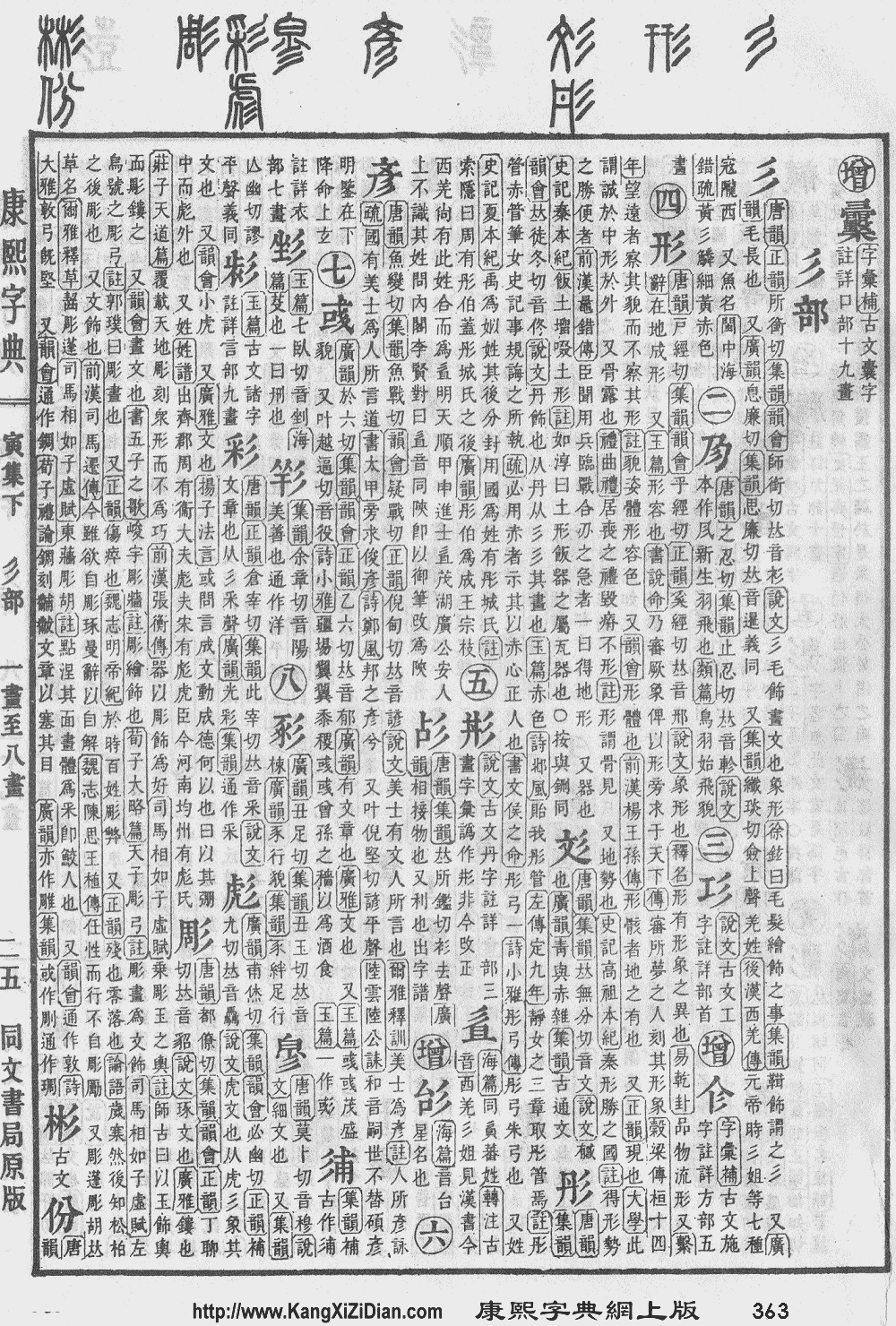
- KangXi: page 363, character 6
- Dai Kanwa Jiten: character 9969
- Dae Jaweon: page 681, character 25
- Hanyu Da Zidian (first edition): volume 2, page 852, character 10
- Unihan data for U+5F62
- Unihan data for U+2F899
Chinese
| simp. and trad. |
形 | |
|---|---|---|
| alternative forms | 𢒈 | |
Glyph origin
| Historical forms of the character 形 | |
|---|---|
| Shuowen Jiezi (compiled in Han) | Liushutong (compiled in Ming) |
| Small seal script | Transcribed ancient scripts |
 |
 |
Ideogrammic compound (會意) : 幵 + 彡. In current form 幵 has been simplified to 开.
It may also be interpreted as a phono-semantic compound (形聲, OC *ɡeːŋ) : phonetic 井 (OC *skeŋʔ) + semantic 彡, if the original character was 𢒈.
Pronunciation
Definitions
形
Compounds
|
|
|
Japanese
Readings
Compounds
- 形声 (keisei): the phonosemantic formation of a kanji character from elements signifying meaning and elements signifying sound
- 形成 (keisei): formation, shape
- 形而下 (keijika): physical, material
- 形而上 (keijijō): metaphysical
- 形而上学 (keijijōgaku): metaphysics
- 形容詞 (keiyōshi): adjective
- 形容動詞 (keiyōdōshi): (Japanese grammar) adjectival noun, na- adjective
- 形態 (keitai): shape, form
- 形態学 (keitaigaku): (biology) morphology
- 形態論 (keitairon): (linguistics) morphology
- 形体 (keitai): physical shape
- 形相 (gyōsō): a facial expression, a look
- 形相 (keisō): (philosophy) the form, the eidos; the Platonic ideal
- 原形質 (genkeishitsu): protoplasm
Etymology 1
| Kanji in this term |
|---|
| 形 |
| かた Grade: 2 |
| kun’yomi |
| Alternative spelling |
|---|
| 型 |
From Old Japanese. First attested in the Nihon Shoki of 720.[1]
Noun
形 • (kata)
Etymology 2
| Kanji in this term |
|---|
| 形 |
| がた Grade: 2 |
| kun’yomi |
| Alternative spelling |
|---|
| 型 |
Derived from kata above.[1] The kata changes to gata as an instance of rendaku (連濁). Found most commonly as a suffixing element in compounds.
The standalone noun sense was originally a shortening of 女形 (onnagata, literally “woman form”), a female role played by a male actor in kabuki theater. This noun sense is only spelled with the 形 kanji.
Noun
Suffix
形 • (-gata)
Usage notes
For a shape, the spelling 形 is more commonly used. For a type, the spelling 型 is more commonly used.
Further reading
- Entry for katai at Gogen-Allguide, mentioning the likely overlap with kata (in Japanese)
Etymology 3
| Kanji in this term |
|---|
| 形 |
| かたち Grade: 2 |
| kun’yomi |
| Alternative spellings |
|---|
| 容 躰 |
From Old Japanese. First attested in the Nihon Shoki of 720.[1]
Compound of 形 (kata, “shape, form”) + ち (-chi),[3] but the derivation of the chi element is unclear.
Noun
形 • (katachi)
- [from 720] shape or form
- [from late 900s] shapeliness: see 形有り (katachiari)
- [from 1688] form, as opposed to substance
Etymology 4
| Kanji in this term |
|---|
| 形 |
| けい Grade: 2 |
| kan’on |
From Middle Chinese 形 (MC ɦeŋ). Compare modern Mandarin 形 (xíng). The kan'on reading, so likely a later borrowing.
Pronunciation
- IPA(key): [ke̞ː]
Suffix
形 • (-kei)
- (linguistics) grammatical tense
- 過去形
- kakokei
- the past tense
- 将来形
- shōraikei
- the future tense
- 過去形
- (Japanese grammar) a conjugation form of a verb
- 連用形
- ren'yōkei
- the continuative form
- 命令形
- meireikei
- the imperative or command form
- 連用形
Etymology 5
| Kanji in this term |
|---|
| 形 |
| なり Grade: 2 |
| kun’yomi |
| Alternative spellings |
|---|
| 態 なり |
From Old Japanese. First attested in the Nihon Shoki of 720.[1]
From 成り (nari), the 連用形 (ren'yōkei, “continuative or stem form”) of the verb 成る (naru, “to become”).[1][2]
First attested as a suffix on a noun in the 曾我物語 (Soga Mongatari),[1] of uncertain dating but probably in the late 1300s. As a suffix on a verb stem, first attested from 1927.[1]
Usage notes
The most common spelling for this use is なり, for all parts of speech.
Noun
形 • (nari)
- [from 720] the shape or form of something
- [from late 900s] one's clothing and appearance
- [from mid 1600s] one's body shape or form
- [from 1477] one's circumstances or situation
- [from 1773] one's reputation
- [from 1763] following the plain imperfective form (attributive form, 連体形 (rentaikei)) or plain perfective form of a verb, indicates the state of the affixed verb or phrase: compare English just as
- 人々の言うなりになった
- hitobito no iu nari ni natta
- things turned out just as people were saying
- 人々の言うなりになった
- [from 1915] following the plain imperfective form (attributive form, 連体形 (rentaikei)) of an adjective, indicates responding to the affixed adjective: compare English fitting
- 寒ければ寒いなりの厚着をする
- samukereba samui nari no atsugi o suru
- if it's cold, then put on warm clothing / if it's cold, then put on warm clothes for cold weather
- 寒ければ寒いなりの厚着をする
- [from 1928] following the plain imperfective form (attributive form, 連体形 (rentaikei)) of a verb, indicates the moment of the action occurring: compare English as soon as
- 断りを聞くなり泣き出した
- kotowari o kiku nari nakidashita
- she burst into tears as soon as she heard the rejection
- 断りを聞くなり泣き出した
Suffix
形 • (-nari)
- following the 連用形 (ren'yōkei, “continuative or stem form”) of a verb, indicates the state of the affixed verb or phrase: compare English just as
- 人々が言いなりになった
- hitobito ga iinari ni natta
- things turned out just as people say
- 人々が言いなりになった
- [from 1951] following a noun, indicates a state fitting or becoming to the affixed noun
- 子供なりに想像する
- kodomo nari ni sōzō suru
- imagine in a way fitting for a child / imagine like a child (implies that the subject is a child)
- 自分なりの判断
- jibun nari no handan
- my own kind of decision / deciding in my own way
- 子供なりに想像する
- [from late 1300s] following a noun, indicates that shape or form: compare English like
- 弓なりになる
- yumi nari ni naru
- to become bow-shaped / to become like a bow
- 弓なりになる
References
- 1988, 国語大辞典(新装版) (Kokugo Dai Jiten, Revised Edition) (in Japanese), Tōkyō: Shogakukan
- 2006, 大辞林 (Daijirin), Third Edition (in Japanese), Tōkyō: Sanseidō, →ISBN
- 1997, 新明解国語辞典 (Shin Meikai Kokugo Jiten), Fifth Edition (in Japanese), Tōkyō: Sanseidō, →ISBN
- 1998, NHK日本語発音アクセント辞典 (NHK Japanese Pronunciation Accent Dictionary) (in Japanese), Tōkyō: NHK, →ISBN
Korean
Etymology
From Middle Chinese 形 (MC ɦeŋ).
| Historical readings |
|---|
|
Pronunciation
- (SK Standard/Seoul) IPA(key): [çʌ̹ŋ]
- Phonetic hangul: [형]