探
See also: 深
| ||||||||
Translingual
Han character
探 (Kangxi radical 64, 手+8, 11 strokes, cangjie input 手月金木 (QBCD), four-corner 57094, composition ⿰扌罙)
Derived characters
- 𠽄
References
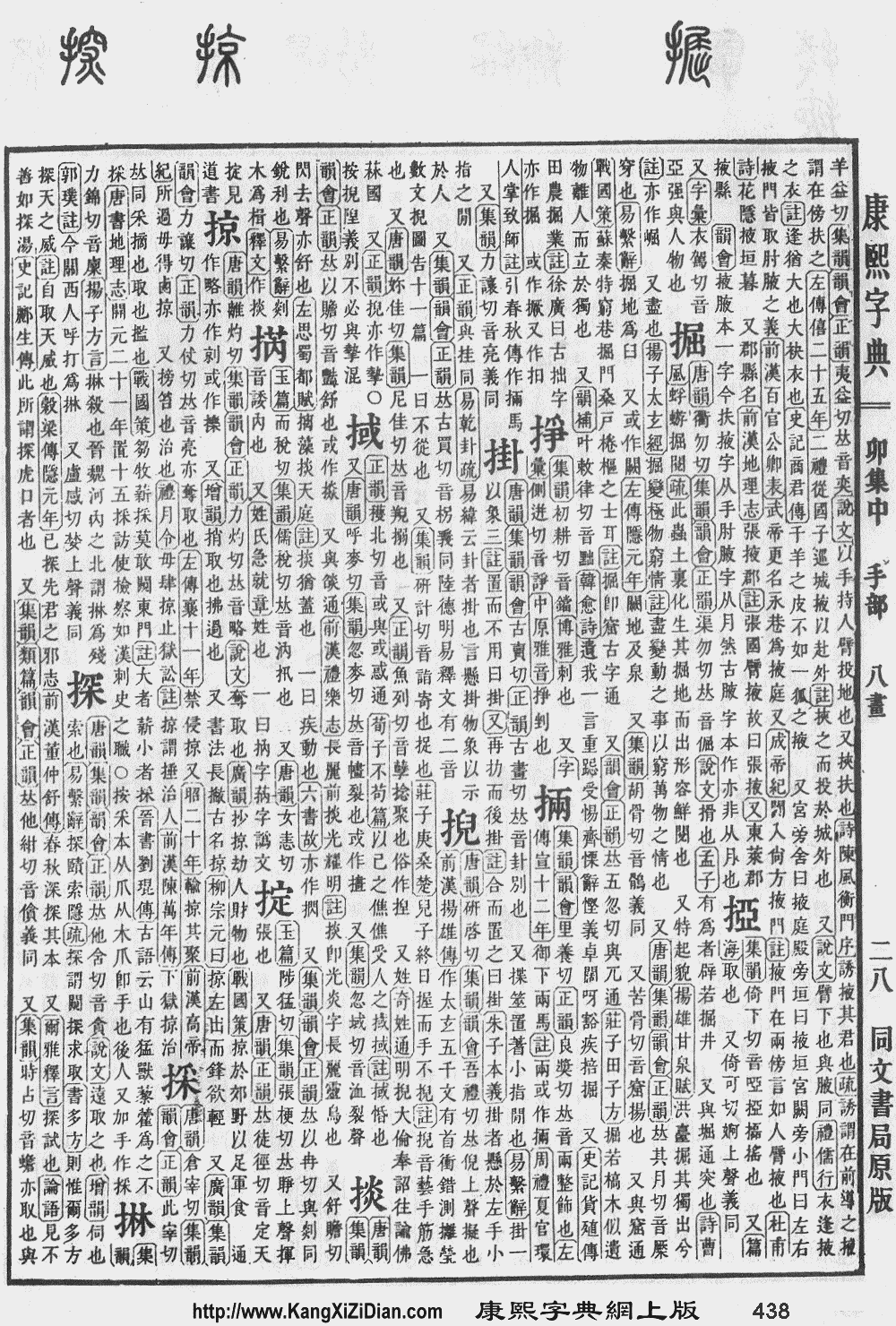
- KangXi: page 438, character 14
- Dai Kanwa Jiten: character 12276
- Dae Jaweon: page 788, character 12
- Hanyu Da Zidian (first edition): volume 3, page 1907, character 6
- Unihan data for U+63A2
Chinese
| trad. | 探 | |
|---|---|---|
| simp. # | 探 | |
| alternative forms | 𢲘 | |
Glyph origin
Characters in the same phonetic series (罙) (Zhengzhang, 2003)
Phono-semantic compound (形聲, OC *l̥ʰuːm, *l̥ʰuːms) : semantic 扌 (“hand”) + phonetic 𥥍 ().
Etymology
As the initial of the 罙 phonetic series is uncertain, 探 (tàn) may be related to 深 (shēn) (provided the initial was *nh-) (Schuessler, 2007).
Alternatively, this agrees with Mizo tham (“to feel (especially with the hand)”).
Pronunciation
Compounds
Derived terms from 探
|
|
|
Japanese
Readings
Suffix
探 • (-tan)
- (archaic) spy from (a country)
- 1947, Ango Sakaguchi, 『二十七歳』
- 独探のケンギを受けて、大正五年だかに国外退去を命じられたという。
- Doku-tan no kengi o ukete, Taishō go-nen daka ni kokugai taikyo o meijirareta to iu.
- [He was] accused of being a German spy and was officially deported in some time around 1916, as the story goes.
- 独探のケンギを受けて、大正五年だかに国外退去を命じられたという。
- 1947, Ango Sakaguchi, 『二十七歳』
Korean
Etymology
From Middle Chinese 探 (MC tʰʌm). Recorded as Middle Korean 탐 (tham) (Yale: tham) in Hunmong Jahoe (訓蒙字會 / 훈몽자회), 1527.
Compounds
Vietnamese
This article is issued from Wiktionary. The text is licensed under Creative Commons - Attribution - Sharealike. Additional terms may apply for the media files.