深

See also: 探
深 U+6DF1, 深
CJK UNIFIED IDEOGRAPH-6DF1
← 淰
[U+6DF0]
CJK Unified Ideographs 淲 →
[U+6DF2]

Translingual

Stroke order
11 strokes

Han character

深 (Kangxi radical 85, 水+8, 11 strokes, cangjie input 水月金木 (EBCD), four-corner 37194, composition ⿰氵罙)

Derived characters

  • 𠽉, 𪮨, 𩴙, 𪒗, 𡪜, 𢊖, 𦸂, 𬔒

References

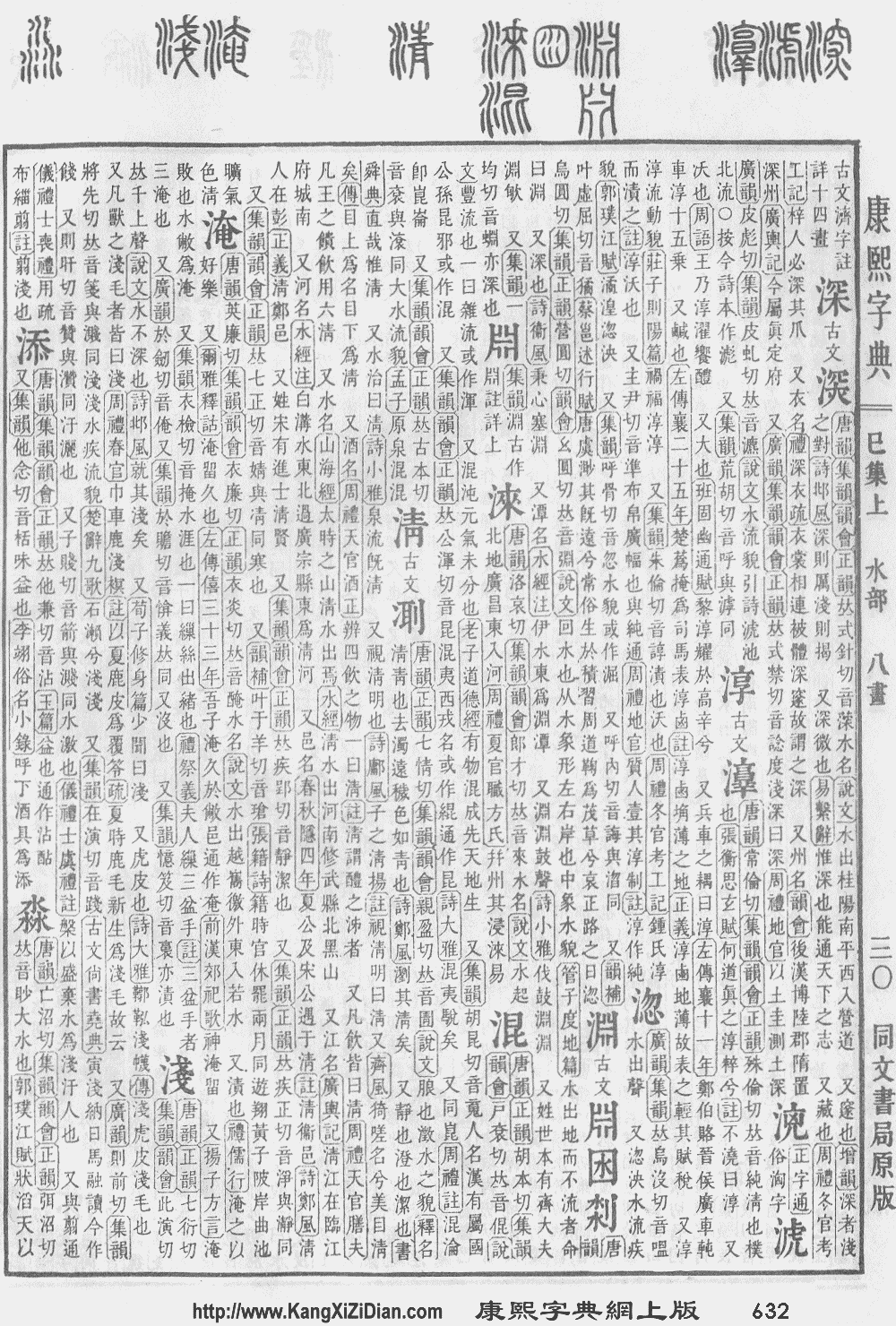
  • KangXi: page 632, character 1
  • Dai Kanwa Jiten: character 17687
  • Dae Jaweon: page 1034, character 8
  • Hanyu Da Zidian (first edition): volume 3, page 1662, character 10
  • Unihan data for U+6DF1

Chinese

trad. 深
simp. # 深
alternative forms 㴱
罙
𰜿

Glyph origin

Phono-semantic compound (形聲, OC *hljum, *hljums) : semantic 氵 (“water”) + phonetic 𥥍 ().

Etymology

Unger (1995) that 深 (shēn) had Old Chinese initial *n- because of 淰 (shěn)'s phonetic component 念 (niàn).

Schuessler (2007) reconstructs 深 (OC *nhəm) & proposes relations to Mizo hniam (“to be low, to sink into (land)”), Burmese နိမ့်သေ (nim.se, “low”), Tangkhul Naga [script needed] (kʰənim, “to be humble”), Tibetan ནེམས་ (nems, “sink a little, give way”), which Schuessler traces to Proto-Tibeto-Burman *nem (“low”), which STEDT in turn derives from Proto-Sino-Tibetan *s-n(i/u)(ː)p/m ~ *r/s-nyap/m (“pinch, squeeze; press, oppress; submerge, sink into, west, low, soft”). If so, 深 (OC *nhəm) is from Proto-Sino-Tibetan.

Schuessler also notices 深 (OC *nhəm)'s similarity to 沉 (OC *d-ləm), which he considers to be an areal etymon.

Possibly cognate with 探 (tàn) and 揇 (nǎn) (however, see there).

深 (OC *nhəms), "depth" (in Rites of Zhou) & whence MC ɕiɪmH, is nominal derivation with suffix *-s (> departing tone).

淰 (OC *nhəmʔ), "be startled and flee (of fish); i.e. to sink into the deep" (in Liji) & whence Mandarin shěn, is endoactive derivative with *-ʔ (> rising tone).

Pronunciation


Note:
  • chhim - vernacular;
  • sim - literary.
Note:
  • cim1 - Chaozhou, Shantou;
  • cing1 - Chenghai.
  • Wu
  • Xiang
    • (Changsha)
      • Wiktionary: shen1
      • Sinological IPA (key) (old-style): /ʂən³³/
      • Sinological IPA (key) (new-style): /sən³³/

  • Dialectal data
Variety Location 深
Mandarin Beijing /ʂən⁵⁵/
Harbin /ʂən⁴⁴/
Tianjin /ʂən²¹/
/sən²¹/
Jinan /ʈ͡ʂʰẽ²¹³/
Qingdao /ʃə̃²¹³/
Zhengzhou /ʈ͡ʂʰən²⁴/
Xi'an /ʂẽ²¹/
Xining /ʂə̃⁴⁴/
Yinchuan /ʂəŋ⁴⁴/
Lanzhou /ʂə̃n³¹/
Ürümqi /ʂɤŋ⁴⁴/
Wuhan /sən⁵⁵/
Chengdu /sən⁵⁵/
Guiyang /sen⁵⁵/
Kunming /ʂə̃⁴⁴/
Nanjing /ʂən³¹/
Hefei /ʂən²¹/
/ʈ͡ʂʰən²¹/
Jin Taiyuan /səŋ¹¹/
Pingyao /ʂəŋ¹³/
Hohhot /sə̃ŋ³¹/
Wu Shanghai /səŋ⁵³/
Suzhou /t͡sən⁵⁵/
Hangzhou /sen³³/
Wenzhou /saŋ³³/
Hui Shexian /ɕiʌ̃³¹/
Tunxi /ɕian¹¹/
Xiang Changsha /ʂən³³/
Xiangtan /ʂən³³/
Gan Nanchang /sɨn⁴²/
Hakka Meixian /t͡sʰəm⁴⁴/
Taoyuan /tʃʰem²⁴/
Cantonese Guangzhou /sɐm⁵³/
Nanning /sɐm⁵⁵/
Hong Kong /sɐm⁵⁵/
Min Xiamen (Min Nan) /sim⁵⁵/
/t͡sʰim⁵⁵/
Fuzhou (Min Dong) /t͡sʰiŋ⁴⁴/
Jian'ou (Min Bei) /t͡sʰeiŋ⁵⁴/
Shantou (Min Nan) /t͡sʰim³³/
Haikou (Min Nan) /sim²³/

Rime
Character 深 深
Reading # 1/2 2/2
Initial (聲) 書 (26) 書 (26)
Final (韻) 侵 (139) 侵 (139)
Tone (調) Level (Ø) Departing (H)
Openness (開合) Open Open
Division (等) III III
Fanqie 式針切 式禁切
Baxter syim syimH
Reconstructions
Zhengzhang
Shangfang
/ɕiɪm/ /ɕiɪmH/
Pan
Wuyun
/ɕim/ /ɕimH/
Shao
Rongfen
/ɕjem/ /ɕjemH/
Edwin
Pulleyblank
/ɕim/ /ɕimH/
Li
Rong
/ɕiəm/ /ɕiəmH/
Wang
Li
/ɕĭĕm/ /ɕĭĕmH/
Bernard
Karlgren
/ɕi̯əm/ /ɕi̯əmH/
Expected
Mandarin
Reflex
shēn shèn
Expected
Cantonese
Reflex
sam1 sam3
Baxter–Sagart system 1.1 (2014)
Character 深 深
Reading # 1/2 2/2
Modern
Beijing
(Pinyin)
shēn shēn
Middle
Chinese
‹ syim › ‹ syimH ›
Old
Chinese
/*[l̥][ə]m/ /*[l̥][ə]m-s/
English deep depth

Notes for Old Chinese notations in the Baxter–Sagart system:

* Parentheses "()" indicate uncertain presence;
* Square brackets "[]" indicate uncertain identity, e.g. *[t] as coda may in fact be *-t or *-p;
* Angle brackets "<>" indicate infix;
* Hyphen "-" indicates morpheme boundary;

* Period "." indicates syllable boundary.
Zhengzhang system (2003)
Character 深 深
Reading # 1/2 2/2
No. 11255 11256
Phonetic
component
罙 罙
Rime
group
侵 侵
Rime
subdivision
3 3
Corresponding
MC rime
深 深
Old
Chinese
/*hljum/ /*hljums/

Definitions

深

  1. (of distance) deep
    Antonym: 淺/浅 (qiǎn)
  2. depth; deepness
  3. (of relationships, etc.) deep; profound
  4. (of difficulty) great; profound; obtuse; obscure
    呢一題好深。/呢一题好深。 [Cantonese]  ―  ni1 jat1 tai4 hou2 sam1. [Jyutping]  ―  This question is really hard to solve.
    本書太深喇,我讀極都唔明。 [Cantonese, trad.]
    本书太深喇,我读极都唔明。 [Cantonese, simp.]
    bun2 syu1 taai3 sam1 laa3, ngo5 duk6 gik6 dou1 m4 ming4. [Jyutping]
    This book is too hard; I still can't get it after reading it many times.
  5. (of time) long
  6. (of colors) deep; dark
    Synonym: 濃/浓 (nóng)
    Antonyms: 淺/浅 (qiǎn), 淡 (dàn)
  7. very; extremely
    Synonym: 非常 (fēicháng)

Compounds

References

Japanese

Kanji

深

(grade 3 “Kyōiku” kanji)

  1. deep, close, thick, profound

Readings

Derived terms

Korean

Hanja

深 (eumhun 깊을 심 (gipeul sim))

  1. Hanja form? of 심 (“deep”).

Compounds

Vietnamese

Han character

深: Hán Nôm readings: thâm, thăm, thum, thẫm

  1. This term needs a translation to English. Please help out and add a translation, then remove the text {{rfdef}}.
This article is issued from Wiktionary. The text is licensed under Creative Commons - Attribution - Sharealike. Additional terms may apply for the media files.