檜
| ||||||||
Translingual
Han character
檜 (Kangxi radical 75, 木+13, 17 strokes, cangjie input 木人一日 (DOMA), four-corner 48966, composition ⿰木會)
References
- KangXi: page 557, character 11
- Dai Kanwa Jiten: character 15676
- Dae Jaweon: page 946, character 18
- Hanyu Da Zidian (first edition): volume 2, page 1303, character 4
- Unihan data for U+6A9C

Chinese
| trad. | 檜 | |
|---|---|---|
| simp. | 桧 | |
Pronunciation 1
Definitions
檜
- Chinese juniper
- 淇水滺滺、檜楫松舟。 [Pre-Classical Chinese, trad.]
- From: The Classic of Poetry, c. 11th – 7th centuries BCE, translated based on James Legge's version
- Qíshuǐ yóuyóu, guìjí sōngzhōu. [Pinyin]
- The waters of the Qi flow smoothly; there are the oars of juniper and boats of pine.
淇水滺滺、桧楫松舟。 [Pre-Classical Chinese, simp.]
Pronunciation 2
Usage notes
Its use in personal names is now rare because of Qin Hui (1090-1155), a chancellor of the Southern Song who is widely regarded and condemned as a traitor to the Chinese people for his part in the persecution and execution of his political enemy, Yue Fei, a general who fought for the Song against the Jin dynasty during the Jin–Song Wars.
Japanese
| 桧 | |
| 檜 |
Readings
- Go-on: け (ke)←け (ke, historical)←くゑ (kwe, ancient); かち (kachi)←くわち (kwati, historical)
- Kan-on: かい (kai)←くわい (kwai, historical); かつ (katsu)←くわつ (kwatu, historical)
- Kun: ひ (hi, 檜); ひのき (hinoki, 檜)
Etymology 1
| Kanji in this term |
|---|
| 檜 |
| ひのき Jinmeiyō |
| kun’yomi |
| Alternative spelling |
|---|
| 檜木 |
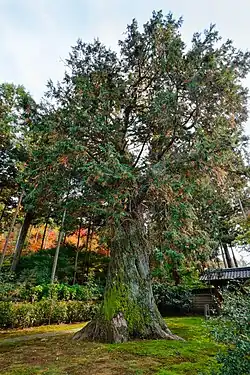
Compound of 檜 (hi, “Japanese cypress”, see below) + の (no, attributive particle) + 木 (ki, “tree”).[1][2]
The wood and bark was commonly used as tinder, and the term was previously thought to be from 火 (hi, “fire”) + の (no, attributive particle) + 木 (ki, “tree”). However, later research into ancient kana usage in Old Japanese revealed that 檜 had a reading of ⟨pi1⟩, while 火 was read as ⟨pi2⟩, ruling out this derivation.[1]
Pronunciation
Usage notes
As with many terms that name organisms, this term is often spelled in katakana, especially in biological contexts (where katakana is customary), as ヒノキ.
Derived terms
- 檜翌檜 (hinoki asunaro)
- 檜笠 (hinokigasa)
- 檜玉 (hinokidama)
- 檜綱 (hinokizuna)
- 檜舞台 (hinoki butai)
- 明日は檜 (asu wa hinoki)
- 木曽檜 (Kiso Hinoki)
- 台湾檜 (Taiwan hinoki)
Descendants
- → English: hinoki
- ⇒ English: hinokitiol
Etymology 2
| Kanji in this term |
|---|
| 檜 |
| ひ Jinmeiyō |
| kun’yomi |
⟨pi1⟩ → */pʲi/ → /ɸi/ → /hi/
From Old Japanese,[1][2][3] from Proto-Japonic *pi. Cognate with Okinawan 檜 (finuchi, < *pinoki).
Derived terms
References
- 1988, 国語大辞典(新装版) (Kokugo Dai Jiten, Revised Edition) (in Japanese), Tōkyō: Shogakukan
- 2006, 大辞林 (Daijirin), Third Edition (in Japanese), Tōkyō: Sanseidō, →ISBN
- 1995, 大辞泉 (Daijisen) (in Japanese), Tōkyō: Shogakukan, →ISBN
Korean
Hanja
檜 • (hoe, gwal) (hangeul 회, 괄, revised hoe, gwal, McCune–Reischauer hoe, kwal, Yale hoy, kwal)
- This term needs a translation to English. Please help out and add a translation, then remove the text
{{rfdef}}.
Compounds
- 회목 (檜木, hoemok, “Japanese cypress”)
Old Japanese
Etymology
From Proto-Japonic *pi. Cognate with Okinawan 檜 (finuchi, < *pinoki).
Descendants
- Japanese: 檜 (hi, hinoki)