外
| ||||||||
Translingual
| Stroke order | |||
|---|---|---|---|
 | |||
| Stroke order | |||
|---|---|---|---|
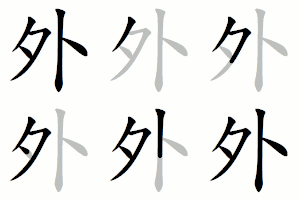 | |||
Han character
外 (Kangxi radical 36, 夕+2, 5 strokes, cangjie input 弓戈卜 (NIY), four-corner 23200, composition ⿰夕卜(GHTVHK))
References
- KangXi: page 246, character 2
- Dai Kanwa Jiten: character 5750
- Dae Jaweon: page 487, character 5
- Hanyu Da Zidian (first edition): volume 2, page 860, character 1
- Unihan data for U+5916

Chinese
| trad. | 外 | |
|---|---|---|
| simp. # | 外 | |
| alternative forms | 𡖄 | |
Glyph origin
| Historical forms of the character 外 | |||
|---|---|---|---|
| Shang | Western Zhou | Shuowen Jiezi (compiled in Han) | Liushutong (compiled in Ming) |
| Oracle bone script | Bronze inscriptions | Small seal script | Transcribed ancient scripts |
 |
 |
 |
 |
Phono-semantic compound (形聲, OC *ŋʷaːds) : semantic 卜 + phonetic 月 (OC *ŋod).
Pronunciation
Definitions
外
- out; outside; external
- beyond; above; in addition to; other than; except
- other; foreign; alien (not of one's own family, clan, locality, school, country, etc.)
- foreign country
- (literary) to alienate; to other; to exclude; to distance
- 見外/见外 ― jiànwài ― to make me feel like an outsider (literally, "to have me excluded [from the familiar circle]")
- 內其國而外諸夏,內諸夏而外夷狄。 [Classical Chinese, trad.]
- From: Commentary of Gongyang, c. 206 BCE– 9 CE
- Nèi qí guó ér wài Zhūxià, nèi Zhūxià ér wài Yídí. [Pinyin]
- to deem one's own state "the in" and treat the other Xias as "the other", while allying oneself with the Xias and distancing oneself from the Barbarians.
内其国而外诸夏,内诸夏而外夷狄。 [Classical Chinese, simp.]
- relatives of one's mother, sister or daughter
- additional
- unofficial
- (Hokkien, Teochew, after an amount but before the classifier) as much as
Synonyms
Dialectal synonyms of 外面 (“outside”) [map]
Compounds
Derived terms from 外
|
|
|
Japanese
Readings
Etymology 1
| Kanji in this term |
|---|
| 外 |
| そと Grade: 2 |
| kun’yomi |
Appears from roughly the Muromachi period,[1] superseding earlier to reading (see below). Likely a compound of either 背 (so, “back, behind”, ancient reading found in compounds) + 外 (to, “outside”), or 背 (so, “back, behind”, ancient reading found in compounds) + 所 (to, “place”).[2]
Noun
外 • (soto)
Etymology 2
| Kanji in this term |
|---|
| 外 |
| ほか Grade: 2 |
| kun’yomi |
Alternative forms
Etymology 3
| Kanji in this term |
|---|
| 外 |
| よそ Grade: 2 |
| irregular |
| For pronunciation and definitions of 外 – see the following entry. | ||
| ||
| (This term, 外, is an alternative spelling of the above term.) |
Etymology 4
| Kanji in this term |
|---|
| 外 |
| と Grade: 2 |
| kun’yomi |
Pronunciation
- IPA(key): [to̞]
Pronunciation
- IPA(key): [ɡa̠i]
Derived terms
Derived terms
- 外骨格 (gaikokkaku): an exoskeleton
- 外形 (gaikei): external shape/form
- 外祖母 (gaisobo): (rare) maternal grandmother, mother's mother
- 外交 (gaikō)
- 外人 (gaijin)
- 外傷 (gaishō)
- 外出 (gaishutsu)
- 外務省 (gaimushō)
- 外国 (gaikoku)
- 外国人 (gaikokujin)
- 外国語 (gaikokugo)
- 外来 (gairai)
- 外来語 (gairaigo)
- 外泊 (gaihaku)
- 外相 (gaishō)
- 外耳 (gaiji)
- 外苑 (gaien)
- 外資 (gaishi)
- 外貨 (gaika)
- 外装 (gaisō)
- 外部 (gaibu)
- 海外 (kaigai)
- 室外 (shitsugai): outside a room, outdoor
Derived terms
Usage notes
The printed form of this character often differs from its handwritten form; in the latter, the last stroke often does not pass through, as in the printed Chinese form.
Korean
Etymology
From Middle Chinese 外 (MC ŋuɑiH).
| Historical Readings | ||
|---|---|---|
| Dongguk Jeongun Reading | ||
| Dongguk Jeongun, 1448 | ᅌᅬᆼ〮 (Yale: ngwóy) | |
| Middle Korean | ||
| Text | Eumhun | |
| Gloss (hun) | Reading | |
| Hunmong Jahoe, 1527 | 밧 (Yale: pàs) | 외〯 (Yale: wǒy) |
Pronunciation
- (SK Standard/Seoul) IPA(key): [we̞(ː)] ~ [ø̞(ː)]
- Phonetic hangul: [웨(ː)/외(ː)]
- Though still prescribed in Standard Korean, most speakers in both Koreas no longer distinguish vowel length.
Compounds
Vietnamese
Han character
外: Hán Nôm readings: ngoại, ngoái, ngoải, ngoài, nguậy
- This term needs a translation to English. Please help out and add a translation, then remove the text
{{rfdef}}.
Readings
- Nôm: ngoái, ngoài, ngoại, ngòi, ngồi
Compounds
- ngoại quốc (外國)
References
- Thiều Chửu : Hán Việt Tự Điển Hà Nội 1942
- Trần Văn Chánh: Từ Điển Hán Việt NXB Trẻ, Ho Chi Minh Ville, 1999
- Vũ Văn Kính: Đại Tự Điển Chữ Nôm, NXB Văn Nghệ, Ho Chi Minh Ville
This article is issued from Wiktionary. The text is licensed under Creative Commons - Attribution - Sharealike. Additional terms may apply for the media files.