眉
| ||||||||
Translingual
Han character
眉 (Kangxi radical 109, 目+4, 9 strokes, cangjie input 日竹月山 (AHBU), four-corner 77267, composition ⿸𠃜目)
Derived characters
References
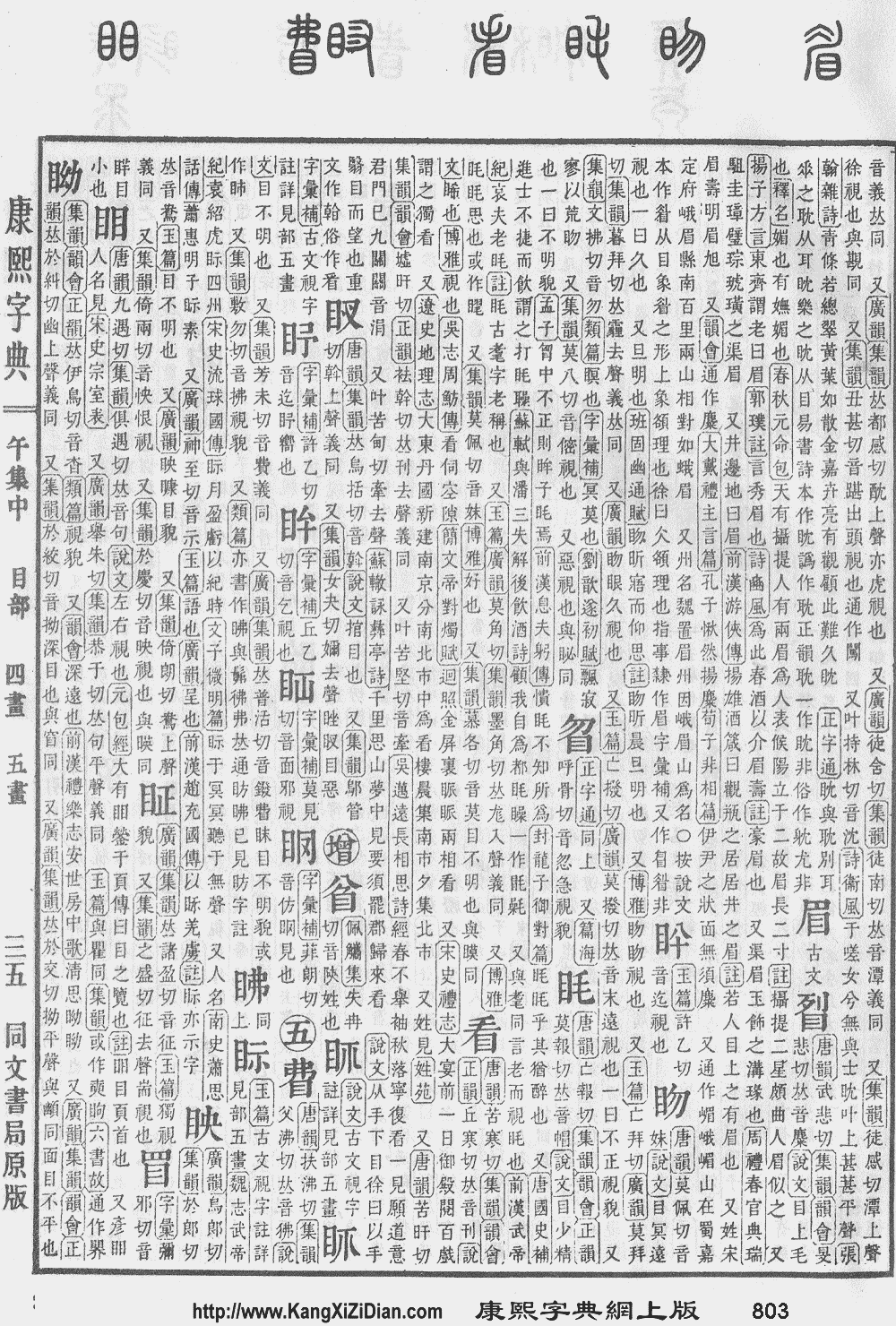
- KangXi: page 803, character 1
- Dai Kanwa Jiten: character 23190
- Dae Jaweon: page 1218, character 20
- Hanyu Da Zidian (first edition): volume 4, page 2478, character 3
- Unihan data for U+7709
Chinese
| simp. and trad. |
眉 | |
|---|---|---|
| 2nd round simp. | 𠃜 | |
| alternative forms | 屓/屃 𪎯 𪎭 𣅩 | |
Glyph origin
| Historical forms of the character 眉 | |||
|---|---|---|---|
| Shang | Western Zhou | Shuowen Jiezi (compiled in Han) | Liushutong (compiled in Ming) |
| Oracle bone script | Bronze inscriptions | Small seal script | Transcribed ancient scripts |
 |
 |
 |
 |
Pictogram (象形) : 𠃜 + 目 (eye), hair above an eye. The component for hair became 𠃜 during the development into the seal and clerical scripts.
Etymology
From Proto-Sino-Tibetan *s/r-m(u/i/ja)l (“hair; fur; feather”) (STEDT). Cognate with Tibetan སྨིན་མ (smin ma, “eyebrow”), Burmese အမွေး (a.mwe:, “hair; fur; feather”).
Pronunciation
Definitions
眉
Synonyms
Compounds
|
|
|
Japanese
Etymology 1
| Kanji in this term |
|---|
| 眉 |
| まゆ Grade: S |
| kun’yomi |
/majo/ → /maju/
From Old Japanese. Appears in the Man'yōshū poetry anthology of the mid-700s with the reading mayo. The ma element is very likely 目 (ma, “eye”, ancient combining form of modern me reading), but the derivation of the yo element is unclear.
Derived terms
References
- 1988, 国語大辞典(新装版) (Kokugo Dai Jiten, Revised Edition) (in Japanese), Tōkyō: Shogakukan
Korean
Etymology
From Middle Chinese 眉 (MC mˠiɪ). Recorded as Middle Korean 미 (mi) (Yale: mi) in Hunmong Jahoe (訓蒙字會 / 훈몽자회), 1527.
Vietnamese
Han character
眉: Hán Nôm readings: mi, mày, mầy, mì, my
- This term needs a translation to English. Please help out and add a translation, then remove the text
{{rfdef}}.
References
- Nom Foundation
- Lê Sơn Thanh, "Nom-Viet.dat", WinVNKey (details)