目
| ||||||||
| ||||||||
Translingual
| Stroke order | |||
|---|---|---|---|
 | |||
| Stroke order | |||
|---|---|---|---|
 | |||
Han character
目 (Kangxi radical 109, 目+0, 5 strokes, cangjie input 月山 (BU), four-corner 60101, composition ⿴囗𠄠)
- Kangxi radical #109, ⽬.
Derived characters
References
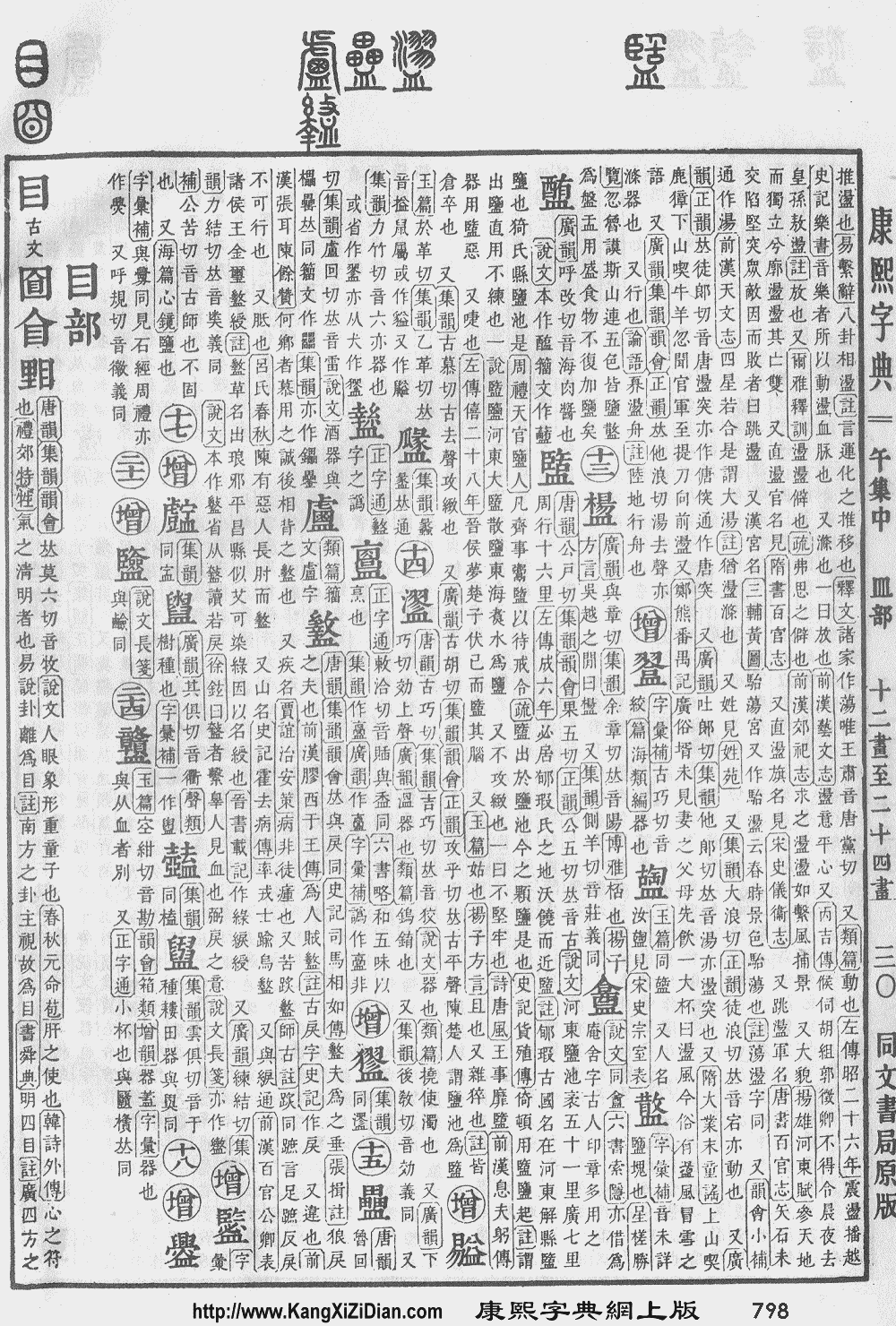
- KangXi: page 798, character 25
- Dai Kanwa Jiten: character 23105
- Dae Jaweon: page 1213, character 21
- Hanyu Da Zidian (first edition): volume 4, page 2467, character 1
- Unihan data for U+76EE
Chinese
| simp. and trad. |
目 | |
|---|---|---|
| alternative forms | 𥃦 𡇡 𥆤 ⿵𦉪山 | |
Glyph origin
| Historical forms of the character 目 | |||||
|---|---|---|---|---|---|
| Shang | Western Zhou | Warring States | Shuowen Jiezi (compiled in Han) | Liushutong (compiled in Ming) | |
| Oracle bone script | Bronze inscriptions | Qin slip script | Ancient script | Small seal script | Transcribed ancient scripts |
 |
 |
 |
 |
 |
 |
Pictogram (象形) – human eye, now rotated 90 degrees. Compare 臣 and the Egyptian hieroglyph 𓁹.
Etymology
From Proto-Sino-Tibetan *s-mjak ~ s-mik. Cognate with Tibetan མིག (mig, “eye”), Burmese မျက် (myak, “eye, face”).
Pronunciation

Definitions
目
- (literary or Min) eye (Classifier: 雙/双 mn-t)
- See also: 眼
- 耳目 ― ěrmù ― ears and eyes; spies
- 目睭 [Hokkien] ― ba̍k-chiu [Pe̍h-ōe-jī] ― eye
- † eyesight
- † to look; to view; to see
- † to wink at
- † to judge; to comment on
- † opinion; viewpoint
- † to view as; to regard
- † hole; eyelet
- ⁜ item; entry
- † title; headline
- † section
- ⁜ list; catalogue; table of contents
- † name
- ⁜ target; goal
- † chief; head; leader
- (taxonomy) order
- (Classical Chinese) to call; to address (of people's names and titles)
Synonyms
Compounds
|
|
|
Descendants
See also
References
- “目”, in 漢語多功能字庫 (Multi-function Chinese Character Database), 香港中文大學 (the Chinese University of Hong Kong), 2014–
- Dictionary of Chinese Character Variants (教育部異體字字典), A02756
- “Entry #1864”, in 臺灣閩南語常用詞辭典 [Dictionary of Frequently-Used Taiwan Minnan] (in Chinese and Min Nan), Ministry of Education, R.O.C., 2011.
Japanese
Readings
Etymology 1
| Kanji in this term |
|---|
| 目 |
| め Grade: 1 |
| kun’yomi |
| For pronunciation and definitions of 目 – see the following entry. | ||
| ||
| (This term, 目, is an alternative spelling of the above term.) |
Etymology 2
| Kanji in this term |
|---|
| 目 |
| ま Grade: 1 |
| kun’yomi |
| For pronunciation and definitions of 目 – see ま. (This term, 目, is an alternative spelling of the above terms.) |
(The following entry is uncreated: ま.)
Etymology 3
| Kanji in this term |
|---|
| 目 |
| もく Grade: 1 |
| goon |
From Middle Chinese 目 (MC mɨuk̚). The 呉音 (goon, literally “Wu sound”) reading, so likely the initial borrowing from Middle Chinese.
Noun
目 • (moku)
Derived terms
- 目迎 (mokugei, “turning one's gaze towards the direction from which someone is coming”)
- 目撃 (mokugeki, “witnessing something”)
- 目今 (mokukon), 目今 (mokkon)
- 目算 (mokusan, “eyeballing something, making a visual estimate or calculation of something”)
- 目視 (mokushi, “looking at something with one's own eyes”)
- 目次 (mokuji, “table of contents”)
- 目笑 (mokushō, “smiling with one's eyes; smiling at one another, catching another's eye and smiling or laughing”)
- 目睫 (mokushō, “eyes and eyelashes; extremely close by”)
- 目食耳視 (mokushoku jishi, “eating with one's eyes, looking with one's ears→ choosing foods based on what they look like instead of their taste, and choosing fashions based on what people say instead of how comfortable they are → all style and no substance”)
- 目銭 (mokusen): a kind of tax levied in the Kamakura and Muromachi periods; a tax on sake bottles; a property tax based on the area of agricultural land
- 目前 (mokuzen, “right before one's eyes, right away, imminent, immediate”)
- 目送 (mokusō, “following something or someone with one's eyes”)
- 目測 (mokuso, “eyeballing a distance or length”)
- 目代 (mokudai): an agent or executor of a lord starting from the late Heian period; an on-site official or deputy starting from the Kamakura period; a local administrator in the Edo period
- 目的 (mokuteki, “intent, purpose, goal, objective”)
- 目途 (mokuto, “mark, guide, target”)
- 目睹 (mokuto, “witnessing something”)
- 目標 (mokuhyō, “target, goal, aim; landmark”)
- 目礼 (mokurei, “greeting or acknowledging someone with one's eyes”)
- 目録 (mokuroku, “list, a catalog”)
- 目論見 (mokuromi), 目論 (mokuron, “plan, a scheme, a design, a plot”)
- 目論む (mokuromu, “to plan, to scheme, to design, to plot”)
- 目割れ (mokuware, “plot, conspiracy, or other hidden plan being exposed or found out”)
- 細目 (saimoku, “details, particulars, breakdown”)
- 真面目 (shinmenmoku, “real appearance or worth of something; serious”)
- 新面目 (shinmenmoku, “new appearance or look for something”)
- 不面目 (fumenmoku, “dishonor, loss of face”)
- 面目 (menmoku, “one's honor, one's metaphorical face; external appearance”)
Related terms
Conjugation
| Katsuyōkei ("stem forms") | ||||
|---|---|---|---|---|
| Mizenkei ("imperfective") | 目し | もくし | moku shi | |
| Ren’yōkei ("continuative") | 目し | もくし | moku shi | |
| Shūshikei ("terminal") | 目する | もくする | moku suru | |
| Rentaikei ("attributive") | 目する | もくする | moku suru | |
| Kateikei ("hypothetical") | 目すれ | もくすれ | moku sure | |
| Meireikei ("imperative") | 目せよ¹ 目しろ² |
もくせよ¹ もくしろ² |
moku seyo¹ moku shiro² | |
| Key constructions | ||||
| Passive | 目される | もくされる | moku sareru | |
| Causative | 目させる 目さす |
もくさせる もくさす |
moku saseru moku sasu | |
| Potential | 目できる | もくできる | moku dekiru | |
| Volitional | 目しよう | もくしよう | moku shiyō | |
| Negative | 目しない | もくしない | moku shinai | |
| Negative continuative | 目せず | もくせず | moku sezu | |
| Formal | 目します | もくします | moku shimasu | |
| Perfective | 目した | もくした | moku shita | |
| Conjunctive | 目して | もくして | moku shite | |
| Hypothetical conditional | 目すれば | もくすれば | moku sureba | |
| ¹ Written imperative ² Spoken imperative | ||||
Etymology 4
| Kanji in this term |
|---|
| 目 |
| ぼく Grade: 1 |
| kan’on |
From Middle Chinese 目 (MC mɨuk̚). The 漢音 (kan'on, literally “Han sound”) reading, so likely a later borrowing from Middle Chinese.
Compare modern Min Nan 目 (bo̍k).
Only used in compounds.
Pronunciation
- IPA(key): [bo̞kɯ̟ᵝ]
Derived terms
- 瞬目 (shunboku, “blink of an eye, moment, instant”)
- 真面目 (shinmenboku, “real appearance or worth of something; serious”)
- 新面目 (shinmenboku, “new appearance or look for something”)
- 不面目 (fumenboku, “dishonor, loss of face”)
- 面目 (menboku), 面目 (meiboku, “one's honor, one's metaphorical face; external appearance”)
Korean
Etymology
From Middle Chinese 目 (MC mɨuk̚).
| Historical Readings | ||
|---|---|---|
| Dongguk Jeongun Reading | ||
| Dongguk Jeongun, 1448 | 목〮 (Yale: mwók) | |
| Middle Korean | ||
| Text | Eumhun | |
| Gloss (hun) | Reading | |
| Hunmong Jahoe, 1527 | 눈〮 (Yale: nwún) | 목〮 (Yale: mwók) |
Pronunciation
- (SK Standard/Seoul) IPA(key): [mo̞k̚]
- Phonetic hangul: [목]
Compounds
Miyako
Northern Amami-Oshima
Okinawan
Southern Amami-Oshima
Toku-No-Shima
Vietnamese
Han character
目: Hán Việt readings: mục (
目: Nôm readings: mục[2][1][4][5], mụt[6][1]
Compounds
References
- Bonet (1899).
- Nguyễn et al. (2009).
- Trần (2004).
- Génibrel (1898).
- Taberd & Pigneau de Béhaine (1838).
- Hồ (1976).