買

See also: 买 and 員
買 U+8CB7, 買
CJK UNIFIED IDEOGRAPH-8CB7
← 貶
[U+8CB6]
CJK Unified Ideographs 貸 →
[U+8CB8]

Translingual

Stroke order
12 strokes

Han character

買 (Kangxi radical 154, 貝+5, 12 strokes, cangjie input 田中月山金 (WLBUC), four-corner 60806, composition ⿱罒貝)

Descendants

References

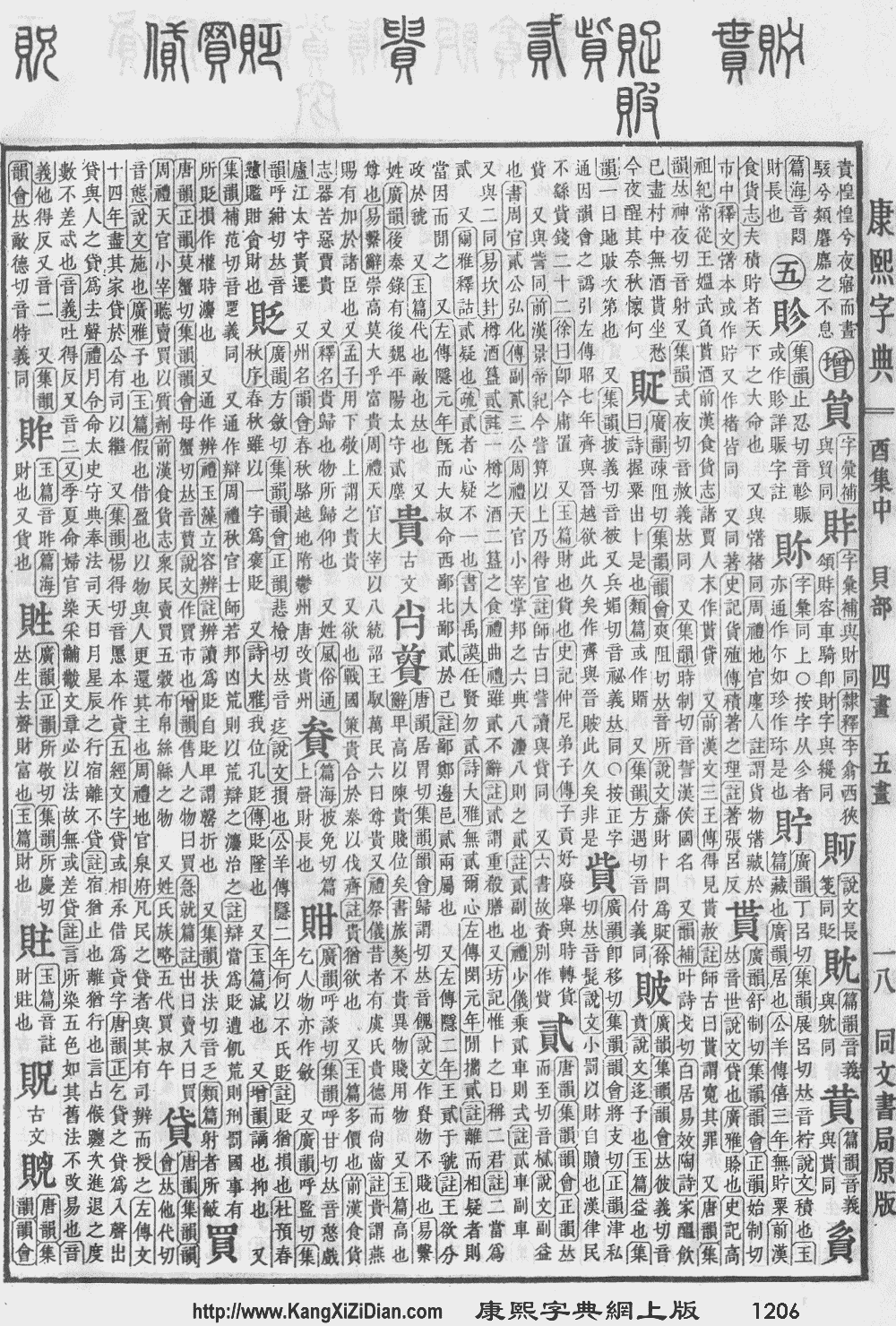
  • KangXi: page 1206, character 21
  • Dai Kanwa Jiten: character 36708
  • Dae Jaweon: page 1669, character 9
  • Hanyu Da Zidian (first edition): volume 6, page 3633, character 7
  • Unihan data for U+8CB7

Chinese

trad. 買
simp. 买
nonstandard simp. 𧹒
alternative forms 𧵽

Glyph origin

Historical forms of the character 買
Shang Spring and Autumn
Bronze inscriptions Bronze inscriptions

Ideogrammic compound (會意) : 网 (“net”) + 貝 (“money cowrie”).

Baxter and Sagart (2014) consider it to be a phono-semantic compound (形聲) : abbreviated phonetic 羅 (*rˤaj) + semantic 貝 (“money cowrie”).

Etymology

Possibly from Proto-Sino-Tibetan *g/m/s-laj ~ *r/s-lej ~ *b-rej (“to buy; to barter”); compare Proto-Karen *breᴬ (“to buy”), Proto-Bodo-Garo *prai¹ (“to buy”), Tibetan རྗེ (rje, “to exchange; to barter”) (Schuessler, 2007; Sagart, 1999, 2011). Benedict (1967, 1972) considers this allofam to be a result of borrowing from Austro-Tai *(m)baḷi several times into Sino-Tibetan languages.

Alternatively, Haudricourt and Strecker (1991) consider 買 and 賣 to be borrowed from Hmong-Mien, which may have a family of verbs related to possession: *mɛjX (“to buy”, corresponding to 買), *mɛjH (“to buy”, corresponding to 賣), *ʔ-mɛj (“to grasp”), *n-mɛj (“to have”) (Ratliff, 2010). However, Sagart (1995) argues that the direction of borrowing is more likely to be from Chinese to Hmong-Mien because Hmong-Mien does not seem to have a suffix that would give rise to the tone in the word for “to buy”. In addition to these two ways of relating the Chinese word to Hmong-Mien, Ratliff (2010) proposes common inheritance as a third option and maintains that more evidence is needed to determine which of the three explanations are correct.

Pronunciation


Note:
  • mā̤ - vernacular;
  • māi - literary.
Note:
  • bóe/bé - vernacular;
  • mái - literary.

  • Dialectal data
Variety Location 買
Mandarin Beijing /mai²¹⁴/
Harbin /mai²¹³/
Tianjin /mai¹³/
Jinan /mɛ⁵⁵/
Qingdao /mɛ⁵⁵/
Zhengzhou /mai⁵³/
Xi'an /mai⁵³/
Xining /mɛ⁵³/
Yinchuan /mɛ⁵³/
Lanzhou /mɛ⁴⁴²/
Ürümqi /mai⁵¹/
Wuhan /mai⁴²/
Chengdu /mai⁵³/
Guiyang /mai⁴²/
Kunming /mæ⁵³/
Nanjing /mae²¹²/
Hefei /me̞²⁴/
Jin Taiyuan /mai⁵³/
Pingyao /mæ⁵³/
Hohhot /mɛ⁵³/
Wu Shanghai /ma²³/
Suzhou /mɑ³¹/
Hangzhou /me̞⁵³/
Wenzhou /ma³⁵/
Hui Shexian /ma³⁵/
Tunxi /ma²⁴/
Xiang Changsha /mai⁴¹/
Xiangtan /mai⁴²/
Gan Nanchang /mai²¹³/
Hakka Meixian /mai⁴⁴/
Taoyuan /mɑi²⁴/
Cantonese Guangzhou /mai²³/
Nanning /mai²⁴/
Hong Kong /mai¹³/
Min Xiamen (Min Nan) /mai⁵³/
/bue⁵³/
Fuzhou (Min Dong) /mɛ³²/
Jian'ou (Min Bei) /mai²¹/
Shantou (Min Nan) /boi⁵³/
Haikou (Min Nan) /mai²¹³/ ~办
/vɔi²¹³/

Rime
Character 買
Reading # 1/1
Initial (聲) 明 (4)
Final (韻) 佳 (31)
Tone (調) Rising (X)
Openness (開合) Open
Division (等) II
Fanqie 莫蟹切
Reconstructions
Zhengzhang
Shangfang
/mˠɛX/
Pan
Wuyun
/mᵚæX/
Shao
Rongfen
/mæiX/
Edwin
Pulleyblank
/maɨjX/
Li
Rong
/mɛX/
Wang
Li
/maiX/
Bernard
Karlgren
/maiX/
Expected
Mandarin
Reflex
mǎi
Expected
Cantonese
Reflex
maai5
Baxter–Sagart system 1.1 (2014)
Character 買
Reading # 1/1
Modern
Beijing
(Pinyin)
mǎi
Middle
Chinese
‹ meaX ›
Old
Chinese
/*mˁrajʔ/
English buy

Notes for Old Chinese notations in the Baxter–Sagart system:

* Parentheses "()" indicate uncertain presence;
* Square brackets "[]" indicate uncertain identity, e.g. *[t] as coda may in fact be *-t or *-p;
* Angle brackets "<>" indicate infix;
* Hyphen "-" indicates morpheme boundary;

* Period "." indicates syllable boundary.
Zhengzhang system (2003)
Character 買
Reading # 1/1
No. 8727
Phonetic
component
買
Rime
group
支
Rime
subdivision
0
Corresponding
MC rime
買
Old
Chinese
/*mreːʔ/

Definitions

買

  1. to buy; to purchase
    我買了輛新車。/我买了辆新车。  ―  Wǒ mǎi le liàng xīn chē.  ―  I bought a new car.
  2. to bribe
  3. to persuade
  4. a surname

Antonyms

  • (to buy): 賣/卖 (mài, “to sell”)

Compounds

Descendants

  • → Proto-Hmong-Mien: *mɛjX (“to buy”)

Further reading

Japanese

Kanji

買

(grade 2 “Kyōiku” kanji)

  1. to buy

Readings

Compounds

Antonyms

Derived terms

Korean

Hanja

買 (eumhun 살 매 (sal mae))

  1. Hanja form? of 매 (“buy”).
  2. "Goguryeo" language: me, “river, water”

Vietnamese

Han character

買: Hán Nôm readings: mãi, mạy, mảy, mấy, mới, mái, mải, với

  1. This term needs a translation to English. Please help out and add a translation, then remove the text {{rfdef}}.
This article is issued from Wiktionary. The text is licensed under Creative Commons - Attribution - Sharealike. Additional terms may apply for the media files.