雛
| ||||||||
Translingual
Han character
雛 (Kangxi radical 172, 隹+10, 18 strokes, cangjie input 心山人土 (PUOG), four-corner 20414, composition ⿰芻隹)
References
- KangXi: page 1368, character 39
- Dai Kanwa Jiten: character 42121
- Dae Jaweon: page 1874, character 5
- Hanyu Da Zidian (first edition): volume 6, page 4105, character 6
- Unihan data for U+96DB

Chinese
| trad. | 雛 | |
|---|---|---|
| simp. | 雏 | |
| alternative forms | 鶵/𬸅 𨿉 𪀫 𪀩 𨿊 | |
Glyph origin
| Historical forms of the character 雛 | |
|---|---|
| Shang | Shuowen Jiezi (compiled in Han) |
| Oracle bone script | Small seal script |
 |
 |
Phono-semantic compound (形聲, OC *zro) : phonetic 芻 (OC *sʰro) + semantic 隹 (“bird”).
Pronunciation
Definitions
雛
- chick; fledgling
- 是月也,天子乃以雛嘗黍,羞以含桃,先薦寢廟。 [Classical Chinese, trad.]
- From: The Book of Rites, c. 4th – 2nd century BCE
- Shìyuè yě, tiānzǐ nǎi yǐ chú cháng shǔ, xiū yǐ hán táo, xiān jiàn qǐnmiào. [Pinyin]
- In this month, the Son of Heaven partakes of millet along with pullets, and with cherries set forth beside them, first offering a portion in the apartment behind the ancestral temple.
是月也,天子乃以雏尝黍,羞以含桃,先荐寝庙。 [Classical Chinese, simp.]
- infant; toddler
- young; small
- Used in 鵷雛/鹓雏.
Compounds
References
- “雛”, in 漢語多功能字庫 (Multi-function Chinese Character Database), 香港中文大學 (the Chinese University of Hong Kong), 2014–
Japanese
Readings
Etymology 1

| Kanji in this term |
|---|
| 雛 |
| ひな Jinmeiyō |
| kun’yomi |
*/pina/ → /fina/ → /hina/
Appears to be from Old Japanese. The derivative form hiwina (later hīna) appears in The Tale of Genji, dated to before 1021.[1]
Noun
雛 • (hina)
Compounds
- 雛遊び, 雛遊 (ひなあそび, hina asobi): playing with hina dolls
- 雛霰 (ひなあられ, hina arare): a type of 霰 (arare, “tiny rice crackers”) given as an offering to the hina dolls on Hina matsuri
- 雛合わせ, 雛合 (ひなあわせ, hina awase): a visit to play with hina dolls; particularly, such a visit on Hina matsuri
- 雛市 (ひないち, hinaichi): a market selling hina dolls and accoutrements for Hina matsuri
- 雛会 (ひなえ, Hinae): alternate name for Hina matsuri
- 雛送り, 雛送 (ひなおくり, hinaokuri): alternate for 雛流し (hinanagashi): see below
- 雛男 (ひなおとこ, hina otoko): an elegant and refined man
- 雛菓子 (ひながし, hinagashi): sweets given as offerings on the 雛壇 (hina dan, “special tiered display for hina dolls”) at Hina matsuri
- 雛形, 雛型 (ひながた, hinagata): a model or miniature; a sample or specimen; the front peak of an 折烏帽子 (ori eboshi, “a tall formal peaked black hat”)
- 雛形尺 (ひながたざし, hinagatazashi): a bamboo ruler made to be as long as the width of a bolt of cotton fabric
- 雛蚊屋吊, 雛蚊帳釣 (ひながやつり, hinagayatsuri): Cyperus flaccidus, a type of 蚊帳吊草 (kayatsurigusa, “sedge”) native to wet areas in Honshū, Shikoku, and Kyūshū
- 雛鑑定器 (ひなかんていき, hina kanteiki): a chicken tester (a device)
- 雛鑑別者 (ひなかんべつしゃ, hina kanbetsusha): a chicken sexer (a job)
- 雛桔梗 (ひなぎきょう, hinagikyō): a type of bluebell or bellflower of the genus Wahlenbergia
- 雛菊 (ひなぎく, hinagiku): Bellis perennis, a daisy
- 雛衣 (ひなぎぬ, hinaginu): clothes for a hina doll
- 雛罌粟, 雛芥子 (ひなげし, hinageshi): Papaver rhoeas, the common field or red poppy
- 雛事 (ひなごと, hinagoto): alternate for 雛遊び (hina asobi), playing with hina dolls
- 雛尖 (ひなさき, hinasaki): the clitoris; the part of an 烏帽子 (eboshi) just below the front peak that protrudes slightly
- 雛桜 (ひなざくら, hinazakura): Primula nipponica, a type of primrose or cowslip, called a "mini cherry blossom" for the shape of its flower
- 雛裁ち, 雛裁 (ひなだち, hinadachi): a 一つ身 (hitotsumi), a short kimono for children up to the age of one or two years old, made from one piece of fabric and without a seam up the back
- 雛壇, 雛段 (ひなだん, hina dan): a special tiered display for hina dolls (see image below); a similarly tiered platform for kabuki musicians; the tiered seats for ministers in the Diet
- 雛鶴 (ひなづる, hinazuru): a crane chick; a shōgun's or daimyō's daughter
- 雛鳥 (ひなどり, hinadori): alternate for hiyoko ("chick"): see also Noun entry below
- 雛流し, 雛流 (ひなながし, hinanagashi): letting loose small boats made of paper, ceramic, or other materials and holding hina dolls on rivers or the sea on the night of Hina matsuri
- 雛人形 (ひなにんぎょう, hina ningyō): a hina doll: see also Noun entry below
- 雛の臼壺 (ひなのうすつぼ, hina no usutsubo):
- 雛の簪 (ひなのかんざし, hina no kanzashi): an annual plant of the family Polygalaceae, a type of milkwort
- 雛の錫杖 (ひなのしゃくじょう, hina no shakujō): an annual flowering plant of family Burmanniaceae
- 雛の錫杖科 (ひなのしゃくじょうか, hina no shakujōka): Burmanniaceae, the botanical name for a family of monocot flowering plants
- 雛の節句 (ひなのせく, Hina no Seku): alternate name for Hina matsuri
- 雛の節句 (ひなのせっく, Hina no Sekku): alternate name for Hina matsuri
- 雛の使い (ひなのつかい, hina no tsukai): in modern Japan, the act of sending relatives a display of outfitted hina dolls for Hina matsuri
- 雛保育器 (ひなほいくき, hina hoikuki): a chick incubator
- 雛祭り, 雛祭 (ひなまつり, Hina matsuri): Girl's Day, the doll festival
- 雛屋 (ひなや, hinaya): a dollhouse for hina dolls; a store selling hina dolls
- 雛欄 (ひならん, hina ran): an orchid of the genus Amitostigma, native to East Asia
- 初生雛 (しょせいひな, shosei hina): a newly hatched chick that has just started eating
- 後の雛 (のちのひな, Nochi no Hina): the counterpart to Hina Matsuri, held on the ninth day of the ninth month in the old lunar calendar
- 初雛 (はつひな, hatsu hina): a girl's first springtime seasonal celebration; the hina dolls set out as decoration at such a time
Etymology 2
| Kanji in this term |
|---|
| 雛 |
| ひいな Jinmeiyō |
| kun’yomi |
*/pipina/ → */fifina/ → /fiwina/ → /hiːna/
Possibly an alteration of a reduplicated form hinahina.
Usage notes
This reading with the long ī is archaic. In modern Japanese, the shorter reading hina is more common for this sense.
Compounds
- 雛遊び, 雛遊 (ひいなあそび, hīna asobi): playing with hina dolls
- 雛合わせ, 雛合 (ひいなあわせ, hīna awase): a visit to play with hina dolls; particularly, such a visit on Hina matsuri
- 雛衣 (ひいなぎぬ, hīnaginu): clothes for a hina doll
- 雛草 (ひいなぐさ, hīnagusa): alternate name for 髢草 (kamojigusa), a type of wild rye or wheatgrass
- 雛本 (ひいなぼん, hīnabon): a type of small children's book in the Edo period used at Hina matsuri and when playing house
- 雛祭り, 雛祭 (ひいなまつり, Hīna matsuri): Girl's Day, the doll festival
- 雛屋 (ひいなや, hīnaya): a dollhouse for hina dolls; a store selling hina dolls
Etymology 3
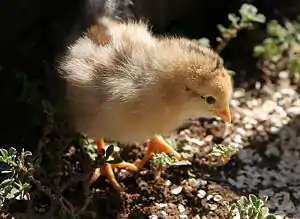
| Kanji in this term |
|---|
| 雛 |
| ひよこ Jinmeiyō |
| kun’yomi |
*/pijoko/ → /fijoko/ → /hijoko/
Compound of ひよ (hiyo, “onomatopoeia for the sound a chick makes”) + 子 (ko, “diminutive suffix”).
Compounds
Etymology 4
| Kanji in this term |
|---|
| 雛 |
| ひよっこ Jinmeiyō |
| kun’yomi |
/hijoko/ → /hijokko/
Alteration of hiyoko above. The geminate kk sound emphasizes the diminutiveness.
Etymology 5
| Kanji in this term |
|---|
| 雛 |
| すう Jinmeiyō |
| on’yomi |
From Middle Chinese. Most reconstructions of the original Middle Chinese reading start with an affricate, so this Japanese reading may have come from a dialect; compare Hakka reading ts'u1.
Pronunciation
- IPA(key): [sɨᵝː]
Usage notes
Only used in compounds.
Compounds
- 雛妓 (すうぎ, sūgi): alternate name for a 半玉 (hangyoku), an apprentice geisha
- 雛僧 (すうそう, sūsō): a young monk, a novitiate
- 育雛 (いくすう, ikusū): raising chicks
- 臥竜鳳雛 (がりょうほうすう, garyō hōsū): a diamond in the rough, an unnoticed greatness
- 伏竜鳳雛 (ふくりょうほうすう, fukuryō hōsū): a diamond in the rough, an unnoticed greatness
- 鳳雛 (ほうすう, hōsū): a very promising young man, a boy with very high prospects
- 帰趨 (きすう, kisū): a return arrival, getting back to one's starting point
Korean
Hanja
雛 (eum 추 (chu))
- This term needs a translation to English. Please help out and add a translation, then remove the text
{{rfdef}}.