爪
| ||||||||
| ||||||||
| ||||||||
Translingual
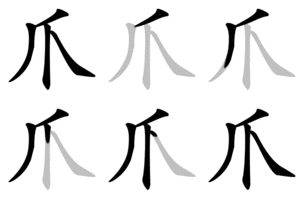
| Stroke order | |||
|---|---|---|---|
 | |||
Alternative forms
- 爫 – when used as a top radical
Han character
爪 (Kangxi radical 87, 爪+0, 4 strokes, cangjie input 竹中人 (HLO), four-corner 72230, composition ⿸𠂆⿰丨乀)
- Kangxi radical #87, ⽖.
Derived terms
References
- KangXi: page 688, character 26
- Dai Kanwa Jiten: character 19653
- Dae Jaweon: page 1101, character 12
- Hanyu Da Zidian (first edition): volume 3, page 2030, character 1
- Unihan data for U+722A

Chinese
Glyph origin
| Historical forms of the character 爪 | |||
|---|---|---|---|
| Shang | Western Zhou | Shuowen Jiezi (compiled in Han) | Liushutong (compiled in Ming) |
| Oracle bone script | Bronze inscriptions | Small seal script | Transcribed ancient scripts |
 |
 |
 |
 |
Pictogram (象形) – a hand grabbing from above (in earlier forms from side); compare 手, 寸, 九.
Pronunciation
Definitions
爪
Usage notes
- 爪 (zhuǎ) ― paws or claws of vertebrates, except for humans, bears, ducks, geese and swans
- 鉗/钳 (qián) ― claws of arthropods (crabs, clawed lobsters, scorpions, etc.)
- 掌 (zhǎng) ― hands, paws or claws of humans (only in compounds), bears, ducks, geese or swans
- 手 (shǒu) ― hands or hooves of humans or swine (only for culinary swine hooves)
- 蹄 (tí) ― hooves
Synonyms
- (claw):
| Variety | Location | Words |
|---|---|---|
| Classical Chinese | 爪 | |
| Formal (Written Standard Chinese) | 爪子 | |
| Mandarin | Beijing | 爪子, 爪兒 |
| Taiwan | 爪子 | |
| Harbin | 爪子 | |
| Yantai (Muping) | 爪子 | |
| Jinan | 爪子 | |
| Luoyang | 爪兒 | |
| Wanrong | 爪子 | |
| Xi'an | 爪子, 爪爪兒 | |
| Yinchuan | 爪子 | |
| Xining | 爪子 | |
| Ürümqi | 爪爪子, 爪子 | |
| Wuhan | 爪子 | |
| Chengdu | 爪爪, 爪子 | |
| Guiyang | 爪爪 | |
| Liuzhou | 爪 | |
| Xuzhou | 爪子 | |
| Yangzhou | 爪子 | |
| Nanjing | 爪子 | |
| Hefei | 爪子 | |
| Nantong | 爪子 | |
| Cantonese | Guangzhou | 爪 |
| Hong Kong | 爪 | |
| Yangjiang | 爪, 腳爪 | |
| Gan | Nanchang | 爪子 |
| Lichuan | 爪 | |
| Pingxiang | 腳爪 | |
| Hakka | Meixian | 腳爪, 爪 |
| Yudu | 腳爪 | |
| Miaoli (N. Sixian) | 爪 | |
| Pingtung (Neipu; S. Sixian) | 爪 | |
| Hsinchu County (Zhudong; Hailu) | 爪 | |
| Taichung (Dongshi; Dabu) | 爪 | |
| Hsinchu County (Qionglin; Raoping) | 爪 | |
| Yunlin (Lunbei; Zhao'an) | 爪 | |
| Huizhou | Jixi | 腳爪 |
| Jin | Taiyuan | 爪爪, 爪子 |
| Xinzhou | 爪子 | |
| Min Bei | Jian'ou | 跤爪, 爪 |
| Min Dong | Fuzhou | 跤爪 |
| Min Nan | Xiamen | 跤爪, 爪, 爪仔 |
| Quanzhou | 跤爪, 爪 | |
| Zhangzhou | 跤爪, 爪 | |
| Chaozhou | 爪 | |
| Shantou | 爪 | |
| Leizhou | 跤爪 | |
| Haikou | 跤爪 | |
| Southern Pinghua | Nanning (Tingzi) | 撓, 爪 |
| Wu | Shanghai | 腳爪 |
| Shanghai (Chongming) | 腳爪 | |
| Suzhou | 腳爪 | |
| Danyang | 腳爪 | |
| Hangzhou | 腳爪兒 | |
| Ningbo | 腳爪 | |
| Wenzhou | 腳爪, 爪 | |
| Jinhua | 腳鈀 | |
| Xiang | Changsha | 爪子, 腳爪子 |
| Loudi | 腳爪爪 | |
| Shuangfeng | 爪子 | |
Compounds
Pronunciation
Definitions
爪
References
- “爪”, in 漢語多功能字庫 (Multi-function Chinese Character Database), 香港中文大學 (the Chinese University of Hong Kong), 2014–
Japanese
Readings
Etymology 1
| Kanji in this term |
|---|
| 爪 |
| つめ Grade: S |
| kun’yomi |
From Old Japanese,[1] in turn from Proto-Japonic *tumay. The standalone form of tsuma below.[1] Likely derived as a fusion of tsuma + emphatic nominalizing particle い (i), similar to the phonetic development of 目 (me, from ma + i) or 神 (kami, from kamu + i).
Derived terms
- 鷹の爪 (taka no tsume)
Etymology 2
| Kanji in this term |
|---|
| 爪 |
| つま Grade: S |
| kun’yomi |
From Old Japanese, presumably in turn from Proto-Japonic *tuma. The root form of tsume above, generally only used in compounds. Cognate with 端 (tsuma, “edge, side of something”) and 妻 (tsuma, “wife”, original sense of “spouse”).[1]
Derived terms
- 爪音 (tsumaoto, “the sound of a stringed instrument when plucked with a pick or plectrum; the sound of a horse's hoofbeat”)
- 爪弾く (tsumabiku, “to pluck with one's fingernail, such as a stringed instrument”)
- 爪折る (tsumaoru, “to pick or break something off with one's fingernails”)
- 爪隠, 爪隠し (tsumakakushi, “hiding one's claws; a kind of zōri grass sandal, where the front end extends and folds over the tops of the toes”)
- 爪先 (tsumasaki, “tiptoe”)
- 摘まむ (tsumamu, “to pinch; to pick at; to pick something up with the tips of one's fingers”)
- 摘む (tsumu, “to pick something up with the tips of one's fingers; to snip the tip off of something”)
- 躓く (tsumazuku, “to stumble”)
- 爪楊枝 (tsuma yōji, “a small toothpick”)
References
- 1988, 国語大辞典(新装版) (Kokugo Dai Jiten, Revised Edition) (in Japanese), Tōkyō: Shogakukan
- 2006, 大辞林 (Daijirin), Third Edition (in Japanese), Tōkyō: Sanseidō, →ISBN
Khitan
Etymology
Distantly related with Proto-Mongolic *jaxun (“hundred”), whence Classical Mongolian ᠵᠠᠭᠤᠨ (ǰaɣun) (> Mongolian зуу (zuu) and Daur jau).
Korean
Etymology
From Middle Chinese 爪 (MC t͡ʃˠauX). Recorded as Middle Korean 조〮 (cwó) (Yale: cwo) in Hunmong Jahoe (訓蒙字會 / 훈몽자회), 1527.
Compounds
- 가조 (假爪, gajo)
- 유조류 (有爪類, yujoryu)
- 유조동물 (有爪動物, yujodongmul)