父
| ||||||||
| ||||||||
Translingual
| Traditional | 父 |
|---|---|
| Simplified | 父 |
| Japanese | 父 |
| Korean | 父 |
| Stroke order | |||
|---|---|---|---|
 | |||
| Stroke order | |||
|---|---|---|---|
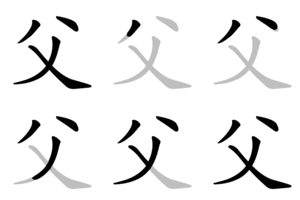 | |||
Han character
父 (Kangxi radical 88, 父+0, 4 strokes, cangjie input 金大 (CK), four-corner 80400, composition ⿱八乂(GHJTV) or ⿱八⿻乀丿(K))
- Kangxi radical #88, ⽗.
Derived characters
References
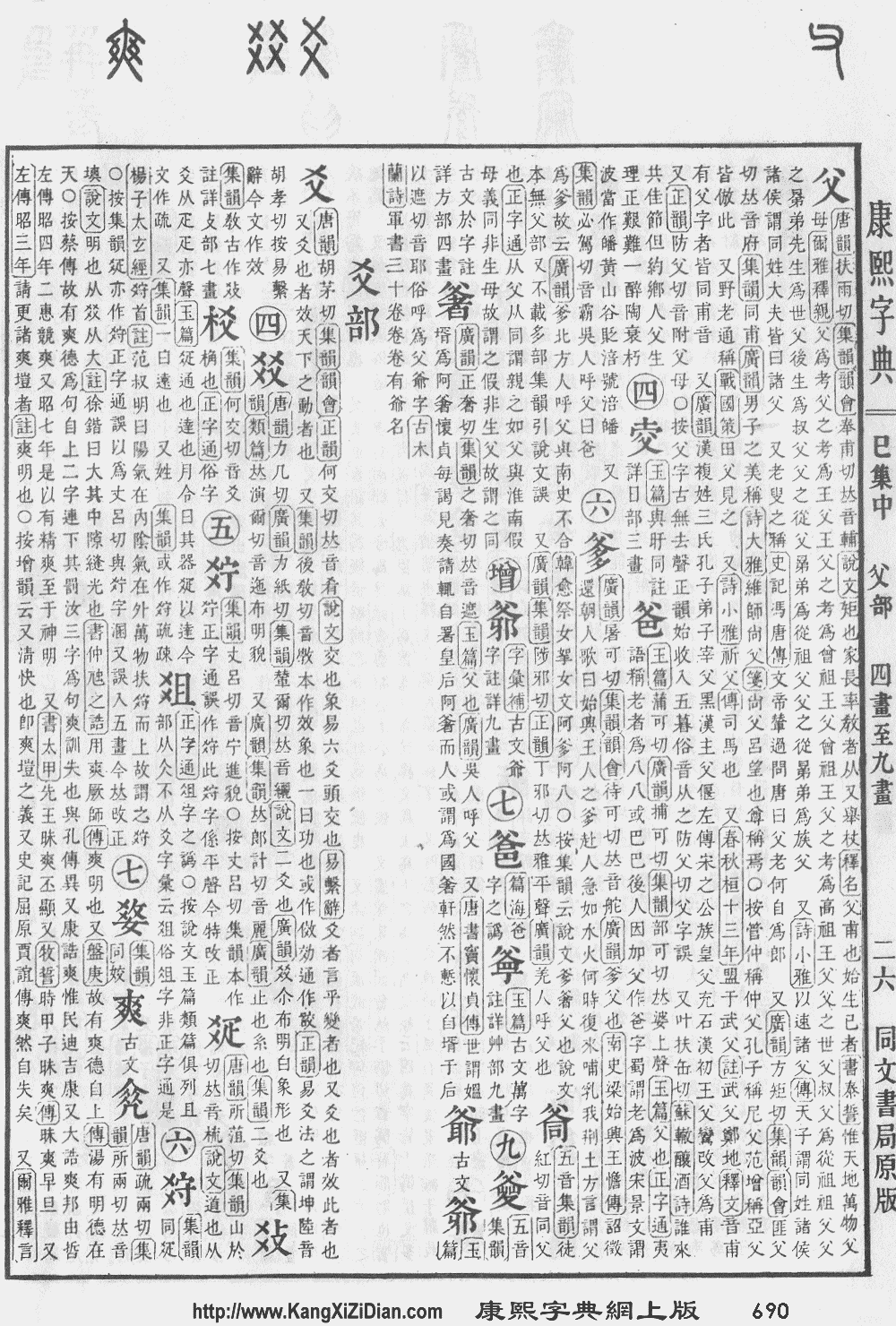
- KangXi: page 690, character 1
- Dai Kanwa Jiten: character 19721
- Dae Jaweon: page 1103, character 1
- Hanyu Da Zidian (first edition): volume 3, page 2039, character 1
- Unihan data for U+7236

Chinese
| simp. and trad. |
父 | |
|---|---|---|
| alternative forms | 𠇑 | |
Glyph origin
| Historical forms of the character 父 | ||||
|---|---|---|---|---|
| Shang | Western Zhou | Warring States | Shuowen Jiezi (compiled in Han) | Liushutong (compiled in Ming) |
| Oracle bone script | Bronze inscriptions | Chu slip and silk script | Small seal script | Transcribed ancient scripts |
 |
 |
 |
 |
 |
Pictogram (象形) – A hand holding a stone, referring to a man working with a stone axe.
Etymology
From Proto-Sino-Tibetan *p/ba (“male; father”).
Regular development from Middle Chinese would lead to the labiodental fù in Mandarin, but the colloquial word resisted the sound changes and is now written as 爸 (bà), with the 巴 (bā) phonetic component added to it to indicate the unchanged bilabial initial.
Pronunciation 1
Definitions
父
- father
- 父親/父亲 ― fùqīn ― (formal) father
- 父母 ― fùmǔ ― parents; father and mother
- 父子 ― fùzǐ ― father and son
- 父女 ― fùnǚ ― father and daughter
- 父輩/父辈 ― fùbèi ― one's father's generation
- 家父 ― jiāfù ― (humble) my father
- 生父 ― shēngfù ― biological father
- 養父/养父 ― yǎngfù ― adoptive father
- 繼父/继父 ― jìfù ― stepfather
- 天父 ― tiānfù ― (Christianity) Heavenly Father
- 國父/国父 ― guófù ― father of a nation; (specifically) Father of the Republic (Sun Yat-sen)
- 雜交水稻之父/杂交水稻之父 ― zájiāo shuǐdào zhī fù ― (specifically) Father of Hybrid Rice (Yuan Longping)
- Antonym: 母 (mǔ)
- Used to address a male elder member of a family.
- 祖父 ― zǔfù ― paternal grandfather (one's father's father)
- 伯父 ― bófù ― paternal uncle (father's elder brother)
- 叔父 ― shūfù ― paternal uncle (father's younger brother)
- 岳父 ― yuèfù ― father-in-law (wife's father)
- 舅父 ― jiùfù ― maternal uncle (mother's brother)
- 姨父 ― yífù ― maternal uncle (husband of mother's sister)
- 姑父 ― gūfù ― paternal uncle (husband of father's sister)
- Antonym: 母 (mǔ)
Synonyms
Pronunciation 2
Definitions
父
Compounds
References
- “父”, in 漢語多功能字庫 (Multi-function Chinese Character Database), 香港中文大學 (the Chinese University of Hong Kong), 2014–
- Dictionary of Chinese Character Variants (教育部異體字字典), A02471
Japanese
Readings
Etymology 1
| Kanji in this term |
|---|
| 父 |
| ちち Grade: 2 |
| kun’yomi |
From Old Japanese 父 (titi).
Still in modern usage.
Pronunciation
Noun
父 • (chichi)
- father
- 野比のび助は、主人公のび太の父。
- Nobi Nobisuke wa, shujinkō Nobita no chichi.
- Nobi Nobisuke is the father of the protagonist Nobita.
- 931–938, Minamoto no Shitagō, Wamyō Ruijushō (book 1, page 115)[3]
- 父 爲考、和名知々、日本紀私記云加曾
- Father: considered in Japanese as chichi; in the Nihon Shoki it is pronounced kaso
- 野比のび助は、主人公のび太の父。
- (by extension, figurative) a father figure (male initiator or founder of something)
- (Christianity) God, the Holy Father
Usage notes
- This term conveys neither positive nor negative connotations. However, using it to describe someone the speaker knows personally is often considered lacking respect, where more polite forms like お父さん (otōsan) are preferred.
- This term is sometimes used in objective narrations, but for this purpose, 父親 (chichioya) is more common.
Derived terms
- 父君 (chichigimi)
- 父御 (chichigo)
- 父者人 (chichija hito)
- 小父 (oji)
- 伯父 (oji)
- 叔父 (oji)
- 親父 (oyaji)
- 父上 (chichiue, “honourable father”, term in respect primarily used in writing)
- 父親 (chichioya, “father”, specifically as someone's parent)
- 父無し子 (chichinashigo, “fatherless child”)
- 父母 (chichihaha, “father and mother, both parents”)
Etymology 2
| Kanji in this term |
|---|
| 父 |
| ちち > てて Grade: 2 |
| irregular |
Appears in the Utsubo Monogatari of roughly 970 CE.[4]
Usage continued until at least the early 1700s.[4]
Pronunciation
- IPA(key): [te̞te̞]
Derived terms
Etymology 3
| Kanji in this term |
|---|
| 父 |
| とと Grade: 2 |
| irregular |
Appears in the Nippo Jisho of 1603.[4]
Originally a shift from chichi or tete in baby talk, used by children to refer to their own father.
Still in modern usage.
Noun
父 • (toto)
Derived terms
- 父さん (tōsan)
- お父さん (otōsan)
Etymology 4
| Kanji in this term |
|---|
| 父 |
| ちゃん Grade: 2 |
| irregular |
| Alternative spelling |
|---|
| 爺 |
/totosan/ → /totːɕan/ → /t͡ɕan/
Likely a contraction of 父さん (toto-san).
Noun
父 • (chan)
- (informal, possibly dialect) one's own father [from Edo to early-Meiji period]
- (by later extension) the head or master of an establishment such as a teahouse, boathouse, etc.
Etymology 5
| Kanji in this term |
|---|
| 父 |
| ふ Grade: 2 |
| goon |
The “father” and “uncle” affixes is from Middle Chinese 父 (MC bɨoX).
The “old man” affix is from Middle Chinese 父 (MC pɨoX).
Pronunciation
- IPA(key): [ɸɯ̟ᵝ]
Derived terms
Etymology 6
| Kanji in this term |
|---|
| 父 |
| ほ Grade: 2 |
| kan’yōon |
From a corruption of Middle Chinese 父 (MC pɨoX).
Pronunciation
- IPA(key): [ho̞]
Derived terms
- 尼父 (Jiho)
Etymology 7
| Kanji in this term |
|---|
| 父 |
| かそ Grade: 2 |
| irregular |
⟨kaso2⟩ → */kasə/ → /kaso/ → /kazo/
From Old Japanese. Appears in the Nihon Shoki of 720 CE as unvoiced kaso.[1][4] Further derivation unknown.[4]
May have fallen out of use by 1603, when neither kaso nor kazo are found in the Nippo Jisho. Kaso would be here as the sixth entry from the bottom on the left, and kazo would be here as the eighth from the bottom on the right.
Pronunciation
- IPA(key): [ka̠zo̞]
Noun
父 • (kazo)
- (obsolete) one's own father
- 931–938, Minamoto no Shitagō, Wamyō Ruijushō (book 1, page 115)[3]
- 父 爲考、和名知々、日本紀私記云加曾
- Father: considered in Japanese as chichi; in the Nihon Shoki it is pronounced kaso
- 931–938, Minamoto no Shitagō, Wamyō Ruijushō (book 1, page 115)[3]
Derived terms
- 父母 (kazo iroha)
References
- 2006, 大辞林 (Daijirin), Third Edition (in Japanese), Tōkyō: Sanseidō, →ISBN
- 1998, NHK日本語発音アクセント辞典 (NHK Japanese Pronunciation Accent Dictionary) (in Japanese), Tōkyō: NHK, →ISBN
- Minamoto, Shitagō; Kyōto Daigaku Bungakubu Kokugogaku Kokubungaku Kenkyūshitu (931–938) Shohon Shūsei Wamyō Ruijushō: Honbunhen (in Japanese), Kyōto: Rinsen, published 1968, →ISBN.
- 1988, 国語大辞典(新装版) (Kokugo Dai Jiten, Revised Edition) (in Japanese), Tōkyō: Shogakukan
- 1995, 大辞泉 (Daijisen) (in Japanese), Tōkyō: Shogakukan, →ISBN
- 1997, 新明解国語辞典 (Shin Meikai Kokugo Jiten), Fifth Edition (in Japanese), Tōkyō: Sanseidō, →ISBN
Korean
Etymology 1
From Middle Chinese 父 (MC bɨoX, “father”).
| Historical readings |
|---|
|
Pronunciation
- (SK Standard/Seoul) IPA(key): [pu]
- Phonetic hangul: [부]
Compounds
- 부계 (父系, bugye)
- 부권 (父權, bugwon)
- 부녀 (父女, bunyeo)
- 부도 (父道, budo)
- 부로 (父老, buro)
- 부명 (父命, bumyeong)
- 부모 (父母, bumo)
- 부사 (父師, busa)
- 부자 (父子, buja)
- 부조 (父祖, bujo)
- 부집 (父執, bujip)
- 부친 (父親, buchin)
- 부형 (父兄, buhyeong)
- 가부 (家父, gabu)
- 계부 (繼父, gyebu)
- 군부 (君父, gunbu)
- 내부 (乃父, naebu)
- 노부/로부 (老父, nobu/robu)
- 대부 (代父, daebu)
- 망부 (亡父, mangbu)
- 백부 (伯父, baekbu)
- 빙부 (聘父, bingbu)
- 사부 (師父, sabu)
- 생부 (生父, saengbu)
- 성부 (聖父, seongbu)
- 숙부 (叔父, sukbu)
- 신부 (神父, sinbu)
- 악부 (岳父, akbu)
- 양부 (養父, yangbu)
- 어부 (漁父, eobu)
- 엄부 (嚴父, eombu)
- 왕부 (王父, wangbu)
- 유부 (猶父, yubu)
- 의부 (義父, uibu)
- 이부 (李父, ibu)
- 자부 (慈父, jabu)
- 제부 (諸父, jebu)
- 조부 (祖父, jobu)
- 천부 (天父, cheonbu)
- 친부 (親父, chinbu)
- 부사지 (父事之, busaji)
- 부선망 (父先亡, buseonmang)
- 부주전 (父主前, bujujeon)
- 조부모 (祖父母, jobumo)
- 고조부 (高祖父, gojobu)
- 족대부 (族大父, jokdaebu)
- 족조부 (族祖父, jokjobu)
- 증조부 (曾祖父, jeungjobu)
Etymology 2
From Middle Chinese 父 (MC pɨoX, “old man; elderly man”).
| Historical readings |
|---|
|
Pronunciation
- (SK Standard/Seoul) IPA(key): [po̞]
- Phonetic hangul: [보]
Hanja
Compounds
- 공보 (孔父, gongbo)
- 선보 (宣父, seonbo)
- 이보/니보 (尼父, ibo/nibo)
Old Japanese
Etymology 1
Reduplication of ti below.[1]
Noun
父 (titi) (kana ちち)
Derived terms
- 父母 (titipapa)
- 母父 (omotiti)
Descendants
- Japanese: 父 (chichi, tete, toto)
Etymology 2
Eastern dialect of titi above.
Derived terms
- 母父 (amosisi, “mother and father”)
Etymology 3
From Proto-Japonic *ti.
Noun
父 (ti) (kana ち)
- (honorific) a term of respect for males
- 711–712, Kojiki (poem 48)
- 加志能布邇余久須袁都久理余久須邇迦美斯意富美岐宇麻良爾岐許志母知袁勢麻呂賀知
- kasi no2 pu ni yo2kusu wo tukuri yo2kusu ni kami1si opomi1ki1 umara ni ki1ko2simo2tiwose maro2 ga ti
- (please add an English translation of this usage example)
- Note: Poem 39 of the Nihon Shoki is similar to this but replaces 迦美斯 (kami1si) with 伽綿蘆 (kame1ru).
- 711–712, Kojiki (poem 48)
Derived terms
Etymology 4
Unknown.[2]
Noun
父 (kaso2) (kana かそ)
- one's own father
- 720, Nihon Shoki (Emperor Ninken, entry 11: sixth year, ninth month in autumn)
- 菱城邑人鹿父〈鹿父、人名也。俗、呼父為柯曾〉聞而向前曰「何哭之哀甚、若此乎」。
- A man of Pisikï village, Kakasö (his name is Kakasö; it was customary to call one's father kasö) heard [the woman's] cries, turned to her, and asked, “Why these cries of grief, young one?”
- Antonym: 母 (iro2pa)
- 720, Nihon Shoki (Emperor Ninken, entry 11: sixth year, ninth month in autumn)
Descendants
- Japanese: 父 (kazo)
References
- 2006, 大辞林 (Daijirin), Third Edition (in Japanese), Tōkyō: Sanseidō, →ISBN
- 1988, 国語大辞典(新装版) (Kokugo Dai Jiten, Revised Edition) (in Japanese), Tōkyō: Shogakukan
Vietnamese
Derived terms
References
- Nguyễn et al. (2009).
- Trần (2004).
- Bonet (1899).
- Génibrel (1898).
- Taberd & Pigneau de Béhaine (1838).