哭

哭 U+54ED, 哭
CJK UNIFIED IDEOGRAPH-54ED
← 哬
[U+54EC]
CJK Unified Ideographs 哮 →
[U+54EE]

Translingual

Stroke order
10 strokes

Han character

哭 (Kangxi radical 30, 口+7, 10 strokes, cangjie input 口口戈大 (RRIK), four-corner 66430, composition ⿱吅犬)

  1. Shuowen Jiezi radical №25

Descendants

References

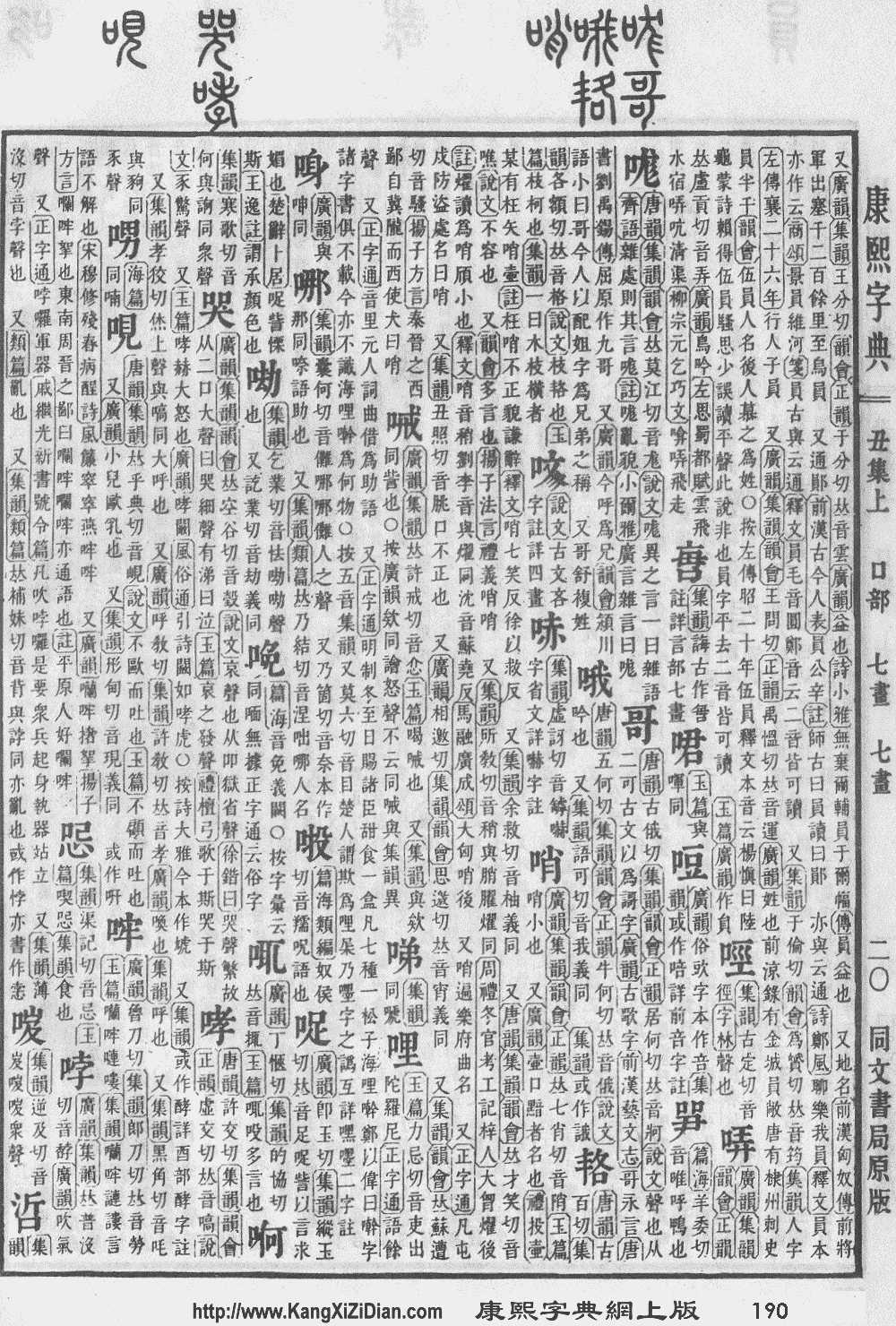
  • KangXi: page 190, character 25
  • Dai Kanwa Jiten: character 3658
  • Dae Jaweon: page 410, character 6
  • Hanyu Da Zidian (first edition): volume 1, page 629, character 2
  • Unihan data for U+54ED

Chinese

simp. and trad.
哭
alternative forms 𠴃
𡘜
哭

Glyph origin

Shuowen interprets it to be a phono-semantic compound (形聲, OC *ŋ̊ʰoːɡ) : semantic 吅 (“to speak loudly”) + abbreviated phonetic 獄 (OC *ŋoɡ), simplified to 犬.

Alternatively, it may be an ideogrammic compound (會意) : 吅 (“to speak loudly”) + 犬 (“dog”) – a dog's bark > cry; weep.

Etymology

From Proto-Sino-Tibetan *kuːk (“to weep; to wail”); cognate with Mizo kûk (“to shriek”) (STEDT).

This seems to be an area word; compare Proto-Mon-Khmer *kuk ~ kuuk ~ kuək ~ kək (“to call”), Proto-Austronesian *-kuk (“sound of a sob”) (Schuessler, 2007).

Pronunciation


Note:
  • khàu - vernacular;
  • khok - literary.

  • Dialectal data
Variety Location 哭
Mandarin Beijing /kʰu⁵⁵/
Harbin /kʰu⁴⁴/
Tianjin /kʰu²¹/
Jinan /kʰu²¹³/
Qingdao /kʰu⁵⁵/
Zhengzhou /kʰu²⁴/
Xi'an /kʰu²¹/
Xining /kʰv̩⁴⁴/
Yinchuan /kʰu¹³/
Lanzhou /kʰu¹³/
Ürümqi /kʰu²¹³/
Wuhan /kʰu²¹³/
Chengdu /kʰu³¹/
Guiyang /kʰu²¹/
Kunming /kʰu³¹/
Nanjing /kʰuʔ⁵/
Hefei /kʰuəʔ⁵/
Jin Taiyuan /kʰuəʔ²/
Pingyao /kʰuʌʔ¹³/
Hohhot /kʰuəʔ⁴³/
Wu Shanghai /kʰoʔ⁵/
Suzhou /kʰoʔ⁵/
Hangzhou /kʰoʔ⁵/
Wenzhou /kʰu²¹³/
Hui Shexian /kʰuʔ²¹/
Tunxi /kʰu⁵/
Xiang Changsha /kʰu²⁴/
Xiangtan /kʰu²⁴/
Gan Nanchang /kʰuʔ⁵/
Hakka Meixian /kʰuk̚¹/
Taoyuan /kʰuk̚²²/
Cantonese Guangzhou /hok̚⁵/
Nanning /huk̚⁵⁵/
Hong Kong /huk̚⁵/
Min Xiamen (Min Nan) /kʰɔk̚³²/
/kʰau¹/
Fuzhou (Min Dong) /kʰouʔ²³/
Jian'ou (Min Bei) /kʰu²⁴/
Shantou (Min Nan) /kʰau²¹³/ 訓讀
Haikou (Min Nan) /xau³⁵/ 訓號

Rime
Character 哭
Reading # 1/1
Initial (聲) 溪 (29)
Final (韻) 東 (3)
Tone (調) Checked (Ø)
Openness (開合) Open
Division (等) I
Fanqie 空谷切
Baxter khuwk
Reconstructions
Zhengzhang
Shangfang
/kʰuk̚/
Pan
Wuyun
/kʰuk̚/
Shao
Rongfen
/kʰuk̚/
Edwin
Pulleyblank
/kʰəwk̚/
Li
Rong
/kʰuk̚/
Wang
Li
/kʰuk̚/
Bernard
Karlgren
/kʰuk̚/
Expected
Mandarin
Reflex
ku
Expected
Cantonese
Reflex
huk1
Baxter–Sagart system 1.1 (2014)
Character 哭
Reading # 1/1
Modern
Beijing
(Pinyin)
kū
Middle
Chinese
‹ khuwk ›
Old
Chinese
/*[kʰ]ˁok/
English weep

Notes for Old Chinese notations in the Baxter–Sagart system:

* Parentheses "()" indicate uncertain presence;
* Square brackets "[]" indicate uncertain identity, e.g. *[t] as coda may in fact be *-t or *-p;
* Angle brackets "<>" indicate infix;
* Hyphen "-" indicates morpheme boundary;

* Period "." indicates syllable boundary.
Zhengzhang system (2003)
Character 哭
Reading # 1/1
No. 16031
Phonetic
component
獄
Rime
group
屋
Rime
subdivision
0
Corresponding
MC rime
哭
Old
Chinese
/*ŋ̊ʰoːɡ/
Notes 說文獄省聲

Definitions

哭

  1. to weep; to cry; to wail

Synonyms

Compounds

Descendants

  • → Vietnamese: khóc (哭, 泣)

References

Japanese

Kanji

哭

(uncommon “Hyōgai” kanji)

  1. to cry; to wail

Readings

Compounds

Korean

Etymology

From Middle Chinese 哭 (MC kʰuk̚).

Historical readings

Pronunciation

Hanja

Wikisource 哭 (eumhun 울 곡 (ul gok))

  1. Hanja form? of 곡 (“cry”).

Compounds

References

  • 국제퇴계학회 대구경북지부 (國際退溪學會 大邱慶北支部) (2007). Digital Hanja Dictionary, 전자사전/電子字典.

Vietnamese

Han character

哭: Hán Nôm readings: khốc, khóc

  1. This term needs a translation to English. Please help out and add a translation, then remove the text {{rfdef}}.
This article is issued from Wiktionary. The text is licensed under Creative Commons - Attribution - Sharealike. Additional terms may apply for the media files.