奠

奠 U+5960, 奠
CJK UNIFIED IDEOGRAPH-5960
← 奟
[U+595F]
CJK Unified Ideographs 奡 →
[U+5961]

Translingual

Han character

奠 (Kangxi radical 37, 大+9, 12 strokes, cangjie input 廿田大 (TWK), four-corner 80430, composition ⿱酋大)

Derived characters

  • 𡼓, 𢵫, 𣾇, 𬯚, 橂, 𨗖, 磸, 𨣆, 䥖, 鄭, 𤡽, 𡰙, 㽀, 𠪝, 𭔕, 㞟, 𥳢, 𥂴

References

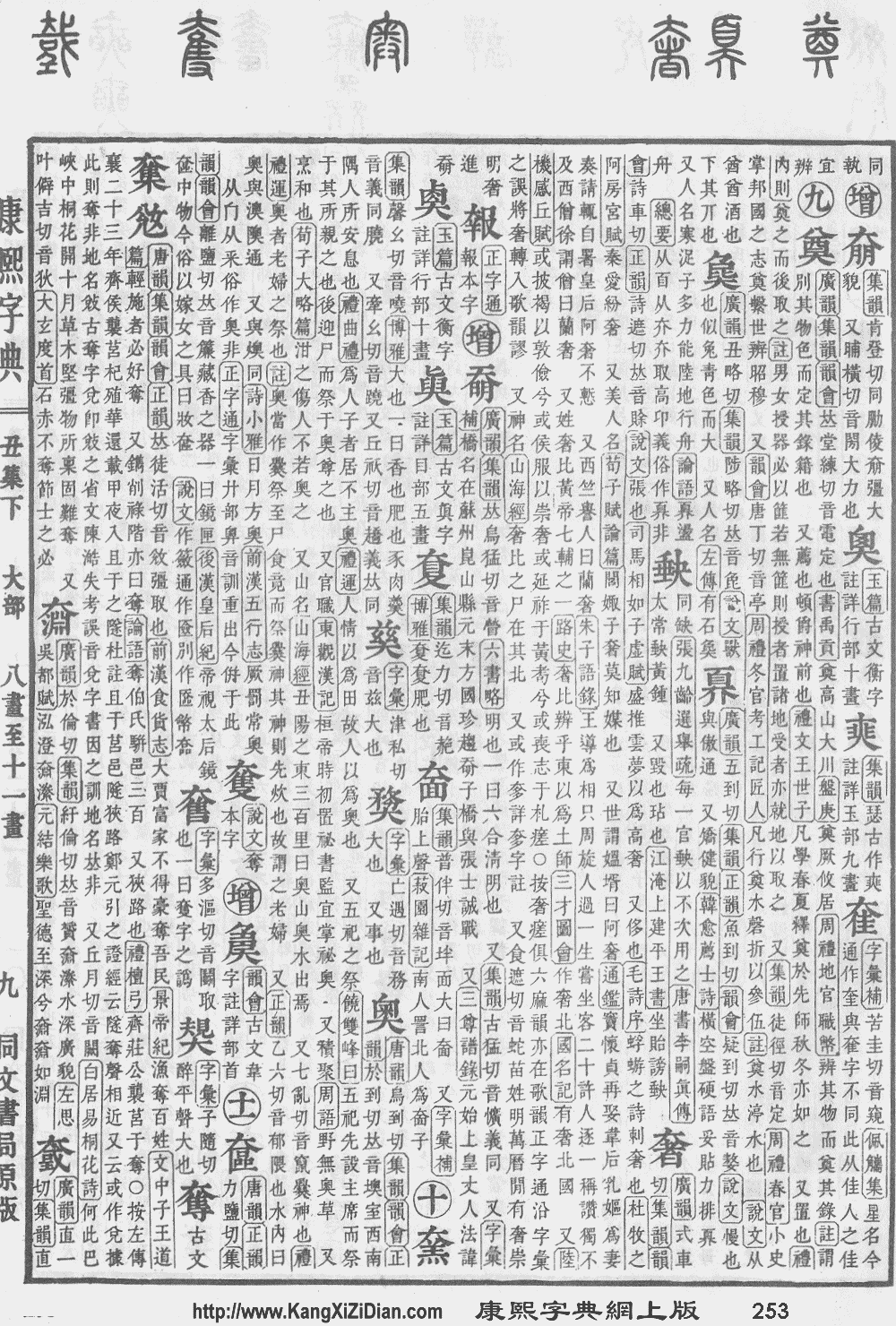
  • KangXi: page 253, character 5
  • Dai Kanwa Jiten: character 5960
  • Dae Jaweon: page 514, character 30
  • Hanyu Da Zidian (first edition): volume 1, page 546, character 6
  • Unihan data for U+5960

Chinese

trad. 奠
simp. # 奠
alternative forms ⿱酉丌
𠪝

Glyph origin

Historical forms of the character 奠
Shang Western Zhou Shuowen Jiezi (compiled in Han) Liushutong (compiled in Ming)
Oracle bone script Bronze inscriptions Small seal script Transcribed ancient scripts

Oracle bone script: Pictogram (象形) – an alcohol vessel (酉) placed on a mat (一).

In the bronze inscriptions, two strokes (八) were sometimes added above the alcohol vessel, representing overflowing alcohol; this is inherited in the small seal script as 酋. In some bronze inscriptions, two horizontal strokes were sometimes also added below the line representing a mat; the strokes sometimes were changed to something like 八. These two strokes then fused with the mat to give 丌 (a table with two legs) in the small seal script. 丌 later evolved into 大 by process of libian (隸變).

Pronunciation 1


Rime
Character 奠
Reading # 1/2
Initial (聲) 定 (7)
Final (韻) 先 (85)
Tone (調) Departing (H)
Openness (開合) Open
Division (等) IV
Fanqie 堂練切
Reconstructions
Zhengzhang
Shangfang
/denH/
Pan
Wuyun
/denH/
Shao
Rongfen
/dɛnH/
Edwin
Pulleyblank
/dɛnH/
Li
Rong
/denH/
Wang
Li
/dienH/
Bernard
Karlgren
/dʱienH/
Expected
Mandarin
Reflex
diàn
Expected
Cantonese
Reflex
din6
Baxter–Sagart system 1.1 (2014)
Character 奠 奠
Reading # 1/2 2/2
Modern
Beijing
(Pinyin)
diàn diàn
Middle
Chinese
‹ denH › ‹ denH ›
Old
Chinese
/*N-tˁe[n]-s/ /*m-tˁe[n]-s/
English be fixed (v.i.) set forth (v.t.)

Notes for Old Chinese notations in the Baxter–Sagart system:

* Parentheses "()" indicate uncertain presence;
* Square brackets "[]" indicate uncertain identity, e.g. *[t] as coda may in fact be *-t or *-p;
* Angle brackets "<>" indicate infix;
* Hyphen "-" indicates morpheme boundary;

* Period "." indicates syllable boundary.
Zhengzhang system (2003)
Character 奠
Reading # 1/1
No. 2351
Phonetic
component
奠
Rime
group
眞
Rime
subdivision
2
Corresponding
MC rime
電
Old
Chinese
/*diːŋs/

Definitions

奠

  1. to set; to lay; to place down (typically in ceremonial contexts)
  2. to make offerings to the dead; to libate
  3. to establish

Compounds

  • 供奠
  • 奠地
  • 奠基 (diànjī)
  • 奠安
  • 奠定 (diàndìng)
  • 奠敬
  • 奠祭 (diànjì)
  • 奠立
  • 路奠
  • 遣奠
  • 奠儀/奠仪 (diànyí)
  • 弔奠/吊奠
  • 澆奠/浇奠
  • 設奠/设奠
  • 釋奠/释奠 (shìdiàn)
  • 饋奠/馈奠

Pronunciation 2


Rime
Character 奠
Reading # 2/2
Initial (聲) 端 (5)
Final (韻) 青 (125)
Tone (調) Departing (H)
Openness (開合) Open
Division (等) IV
Fanqie 丁定切
Reconstructions
Zhengzhang
Shangfang
/teŋH/
Pan
Wuyun
/teŋH/
Shao
Rongfen
/tɛŋH/
Edwin
Pulleyblank
/tɛjŋH/
Li
Rong
/teŋH/
Wang
Li
/tieŋH/
Bernard
Karlgren
/tieŋH/
Expected
Mandarin
Reflex
dìng
Expected
Cantonese
Reflex
ding3

Definitions

奠

  1. Alternative form of 飣/饤 (dìng).
  2. fake

Pronunciation 3

For pronunciation and definitions of 奠 – see 鄭 (“proper noun sense”).
(This character, 奠, is an ancient form of 鄭.)

Usage notes

Usage seen in oracle bone and bronze inscriptions.

Pronunciation 4

For pronunciation and definitions of 奠 – see 停 (“to stop; to halt; to stay; to remain; etc.”).
(This character, 奠, is a variant form of 停.)

Pronunciation 5

For pronunciation and definitions of 奠 – see 尊 (“to respect; to revere; to venerate; to honor; etc.”).
(This character, 奠, is a variant form of 尊.)

Japanese

Kanji

奠

(uncommon “Hyōgai” kanji)

  1. to make offerings
  2. to establish

Readings

(Can we verify(+) this pronunciation?)

Compounds

  • 奠(てん)菜(さい) (tensai)
  • 奠(てん)茶(ちゃ) (tencha)
  • 奠(てん)都(と) (tento)
  • 奠(てん)湯(とう) (tentō) (点(てん)湯(とう))
  • 香(こう)奠(でん) (kōden) (香(こう)典(でん))
  • 祭(さい)奠(てん) (saiten)
  • 釈(さく)奠(てん) (sakuten)
  • 釈(しゃく)奠(てん) (shakuten)
  • 釈(せき)奠(てん) (sekiten)
  • 奉(ほう)奠(てん) (hōten)
  • 礼(れい)奠(てん) (reiten)

Korean

Etymology 1

From Middle Chinese 奠 (MC denH).

Pronunciation

Hanja

Wikisource 奠 (eumhun 정(定)할 전 (jeonghal jeon))
奠 (eumhun 제사(祭祀) 전 (jesa jeon))

  1. This term needs a translation to English. Please help out and add a translation, then remove the text {{rfdef}}.
Compounds
  • 전거 (奠居, jeon'geo)
  • 전도 (奠都, jeondo)
  • 전례 (奠禮, jeollye)
  • 전로 (奠爐, jeollo)
  • 전물 (奠物, jeonmul)
  • 전안 (奠雁, jeonan)
  • 전알 (奠謁, jeonal)
  • 전읍 (奠邑, jeoneup)
  • 전의 (奠儀, jeonui)
  • 전작 (奠酌, jeonjak)
  • 전작 (奠爵, jeonjak)
  • 전접 (奠接, jeonjeop)
  • 전정 (奠定, jeonjeong)
  • 전제 (奠祭, jeonje)
  • 전찬 (奠饌, jeonchan)
  • 전폐 (奠幣, jeonpye)
  • 견전 (遣奠, gyeonjeon)
  • 노전 (路奠, nojeon)
  • 대전 (代奠, daejeon)
  • 망전 (望奠, mangjeon)
  • 별전 (別奠, byeoljeon)
  • 삭전 (朔奠, sakjeon)
  • 석전 (夕奠, seokjeon)
  • 석전 (釋奠, seokjeon)
  • 습전 (襲奠, seupjeon)
  • 예전 (禮奠, yejeon)
  • 은전 (殷奠, eunjeon)
  • 제전 (祭奠, jejeon)
  • 조전 (助奠, jojeon)
  • 조전 (祖奠, jojeon)
  • 조전 (朝奠, jojeon)
  • 천전 (遷奠, cheonjeon)
  • 치전 (致奠, chijeon)
  • 토전 (土奠, tojeon)
  • 향전 (香奠, hyangjeon)

Etymology 2

From Middle Chinese 奠 (MC teŋH).

Pronunciation

Hanja

奠 (eumhun 멈출 정 (meomchul jeong))

  1. This term needs a translation to English. Please help out and add a translation, then remove the text {{rfdef}}.

References

Vietnamese

Han character

奠: Hán Nôm readings: điện

  1. This term needs a translation to English. Please help out and add a translation, then remove the text {{rfdef}}.
This article is issued from Wiktionary. The text is licensed under Creative Commons - Attribution - Sharealike. Additional terms may apply for the media files.