妄
| ||||||||
| Stroke order | |||
|---|---|---|---|
 | |||
Translingual
Han character
妄 (Kangxi radical 38, 女+3, 6 strokes, cangjie input 卜女女 (YVV), four-corner 00404, composition ⿱亡女)
References
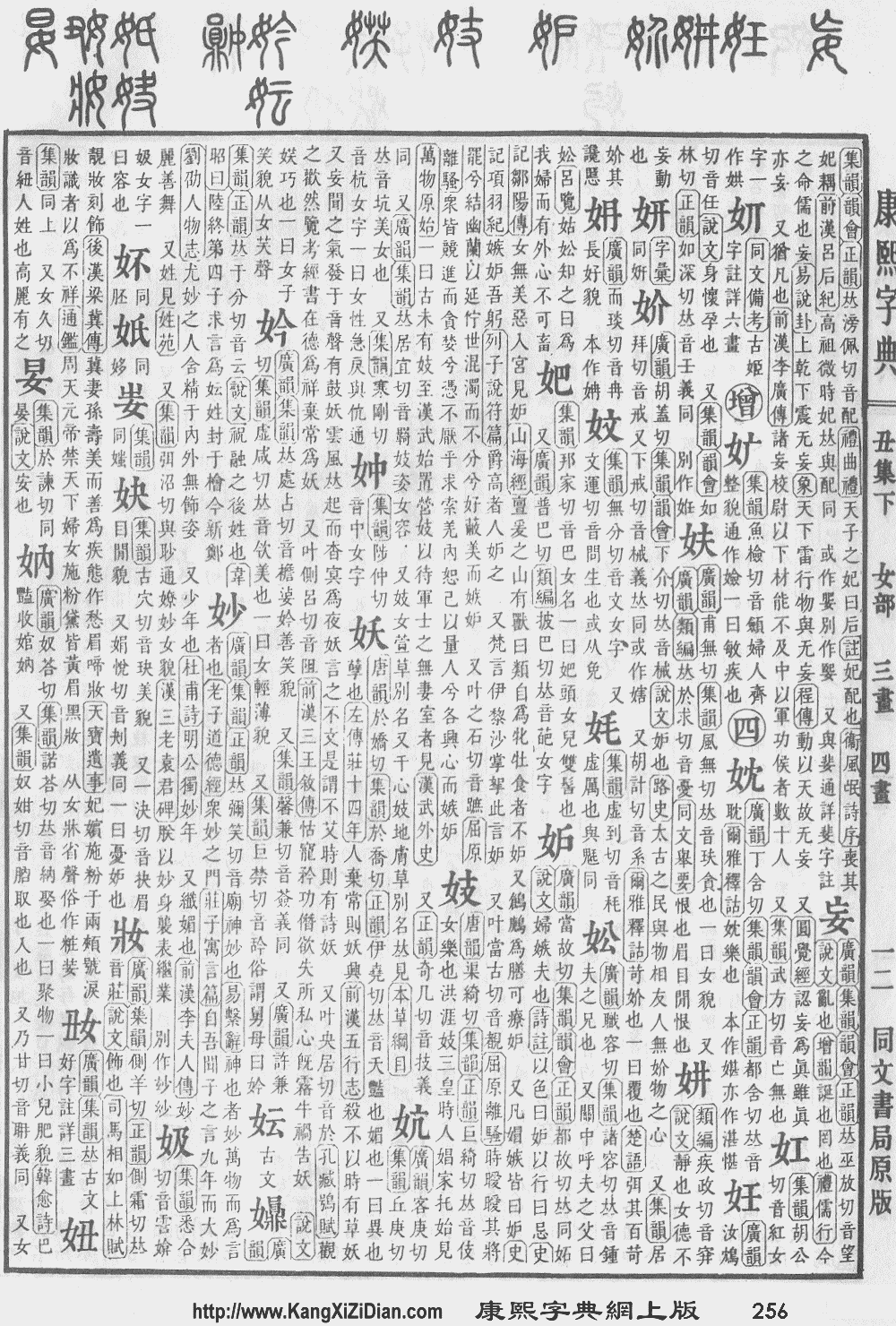
- KangXi: page 256, character 1
- Dai Kanwa Jiten: character 6063
- Hanyu Da Zidian (first edition): volume 2, page 1027, character 9
- Unihan data for U+5984
Chinese
| trad. | 妄 | |
|---|---|---|
| simp. # | 妄 | |
| alternative forms | 𡚶 𡔞 | |
Glyph origin
| Historical forms of the character 妄 | ||
|---|---|---|
| Western Zhou | Shuowen Jiezi (compiled in Han) | Liushutong (compiled in Ming) |
| Bronze inscriptions | Small seal script | Transcribed ancient scripts |
 |
 |
 |
Characters in the same phonetic series (亡) (Zhengzhang, 2003)
| Old Chinese | |
|---|---|
| 忙 | *maːŋ |
| 芒 | *maːŋ, *maŋ |
| 茫 | *maːŋ |
| 恾 | *maːŋ |
| 吂 | *maːŋ, *maːŋs |
| 汒 | *maːŋ, *maŋs |
| 朚 | *maːŋ, *hmaːŋ, *maŋ, *mraːŋ, *mraːŋs |
| 邙 | *maːŋ, *maŋ |
| 杗 | *maːŋ, *maŋ |
| 荒 | *hmaːŋ, *hmaːŋs |
| 肓 | *hmaːŋ |
| 衁 | *hmaːŋ |
| 巟 | *hmaːŋ |
| 詤 | *hmaːŋ, *hmaːŋʔ, *hmaŋʔ |
| 慌 | *hmaːŋ, *hmaːŋʔ |
| 謊 | *hmaːŋʔ |
| 喪 | *smaːŋs, *smaːŋ |
| 亡 | *maŋ |
| 望 | *maŋ, *maŋs |
| 莣 | *maŋ |
| 朢 | *maŋ, *maŋs |
| 鋩 | *maŋ |
| 硭 | *maŋ |
| 忘 | *maŋ, *maŋs |
| 网 | *mlaŋʔ |
| 罔 | *mlaŋʔ |
| 蛧 | *maŋʔ |
| 網 | *mlaŋʔ |
| 輞 | *maŋʔ |
| 棢 | *maŋʔ |
| 惘 | *maŋʔ |
| 菵 | *maŋʔ |
| 誷 | *maŋʔ |
| 魍 | *maŋʔ |
| 妄 | *maŋs |
| 盲 | *mraːŋ |
| 蝱 | *mraːŋ |
| 虻 | *mraːŋ |
| 氓 | *mraːŋ |
| 甿 | *mraːŋ |
Phono-semantic compound (形聲, OC *maŋs) : phonetic 亡 (OC *maŋ) + semantic 女.
Pronunciation
Definitions
妄
Compounds
Japanese
Korean
Vietnamese
This article is issued from Wiktionary. The text is licensed under Creative Commons - Attribution - Sharealike. Additional terms may apply for the media files.