妾
| ||||||||
Translingual
Han character
妾 (Kangxi radical 38, 女+5, 8 strokes, cangjie input 卜廿女 (YTV), four-corner 00404, composition ⿱立女)
Derived characters
- 接 𮀨
References
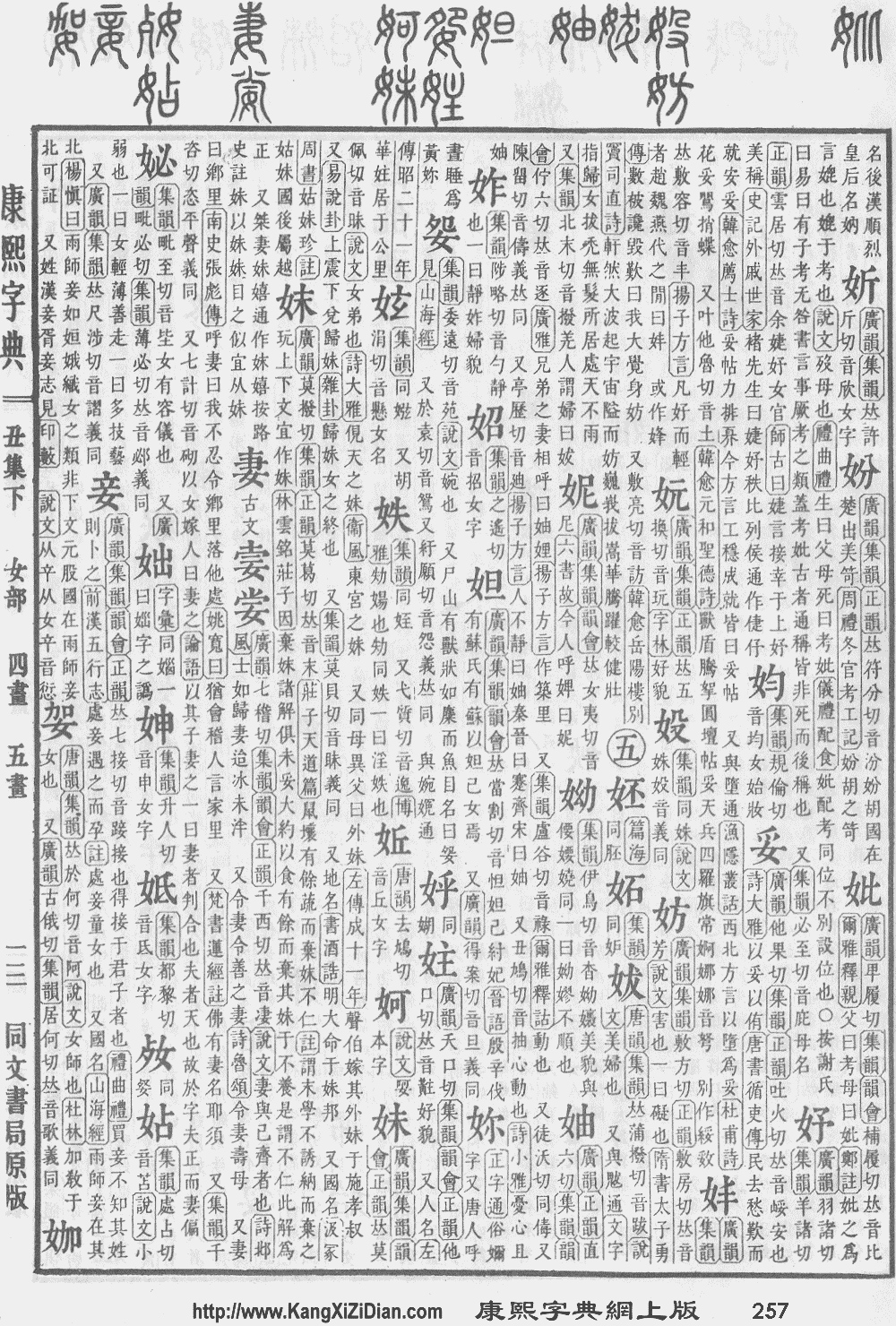
- KangXi: page 257, character 39
- Dai Kanwa Jiten: character 6147
- Dae Jaweon: page 523, character 6
- Hanyu Da Zidian (first edition): volume 2, page 1040, character 8
- Unihan data for U+59BE
Chinese
| trad. | 妾 | |
|---|---|---|
| simp. # | 妾 | |
Glyph origin
| Historical forms of the character 妾 | |||
|---|---|---|---|
| Shang | Western Zhou | Shuowen Jiezi (compiled in Han) | Liushutong (compiled in Ming) |
| Oracle bone script | Bronze inscriptions | Small seal script | Transcribed ancient scripts |
 |
 |
 |
 |
Characters in the same phonetic series (妾) (Zhengzhang, 2003)
Uncertain.
Possibly a pictogram (象形) of a woman with a headdress. Cognate to 女 with 辛 on top, though in the modern form the headdress has simplified to unrelated 立.
Alternatively, may be an ideogrammic compound (會意) : 辛 (“torture device”) + 女 (“woman”) – female criminal.
Etymology
Cognate to 捷 (OC *zeb, “victory; booty”) (Schuessler, 2007). See there for more.
Pronunciation
Definitions
妾
- slave woman
- 馬牛其風,臣妾逋逃,勿敢越逐,祗復之,我商賚汝。 [Classical Chinese, trad.]
- From: The Book of Documents, circa 7th – 4th centuries BCE
- Mǎ niú qí fēng, chén qiè būtáo, wù gǎn yuè zhú, zhī fù zhī, wǒ shāng lài rǔ. [Pinyin]
- When horses or oxen run about in heat, or when slaves and slave women abscond, do not dare go away [from the camp] and pursue them; but if you [catch them and] respectfully return them, I will reward you.
马牛其风,臣妾逋逃,勿敢越逐,祗复之,我商赉汝。 [Classical Chinese, simp.]
- concubine
- 初命曰:「誅不孝,無易樹子,無以妾為妻。」 [Classical Chinese, trad.]
- From: Mencius, c. 4th century BCE
- Chū mìng yuē: “Zhū bùxiào, wú yì shùzǐ, wú yǐ qiè wèi qī.” [Pinyin]
- The first injunction in their agreement was, "Slay the unfilial; change not the son who has been appointed heir; exalt not a concubine to be the wife."
初命曰:“诛不孝,无易树子,无以妾为妻。” [Classical Chinese, simp.]
- (archaic, humble) I; me (used by women to show modesty)
- 妾有黃金釵,嫁時爲首飾。今日贈君行,千里長相憶。 [Korean Literary Sinitic, trad.]
- From: 《效崔國輔體》, Heo Nanseolheon, early 1600s
- Cheop yu hwanggeum chae, ga si wi susik. Geumil jeung gun haeng, cheol li jang sang eok. [Sino-Korean]
- I have a golden hairpin: my jewelry when I was married. Today I give it to you as you leave; long shall we remember each other, a thousand miles away.
- a surname
Synonyms
- (slave woman): 女奴 (nǚnú)
- (concubine):
Dialectal synonyms of 妾 (“concubine”) [map]
Descendants
Compounds
Derived terms from 妾
|
Japanese
Readings
- Go-on: しょう (shō)←せふ (sefu, historical)
- Kan-on: しょう (shō)←せふ (sefu, historical)
- Kun: めかけ (mekake, 妾); わらわ (warawa, 妾)
Compounds
Etymology 1
| Kanji in this term |
|---|
| 妾 |
| めかけ Hyōgaiji |
| kun’yomi |
| For pronunciation and definitions of 妾 – see the following entry. | ||
| ||
| (This term, 妾, is an alternative spelling of the above term.) |
Etymology 2
| Kanji in this term |
|---|
| 妾 |
| わらわ Hyōgaiji |
| kun’yomi |
| For pronunciation and definitions of 妾 – see the following entry. | ||
| ||
| (This term, 妾, is an alternative spelling of the above term.) |
Etymology 3
| Kanji in this term |
|---|
| 妾 |
| てかけ Hyōgaiji |
| kun’yomi |
| For pronunciation and definitions of 妾 – see てかけ. (This term, 妾, is an alternative spelling of the above terms.) |
(The following entry is uncreated: てかけ.)
Etymology 4
| Kanji in this term |
|---|
| 妾 |
| おんなめ Hyōgaiji |
| kun’yomi |
| For pronunciation and definitions of 妾 – see おんなめ. (This term, 妾, is an alternative spelling of the above terms.) |
(The following entry is uncreated: おんなめ.)
Etymology 5
| Kanji in this term |
|---|
| 妾 |
| しょう Hyōgaiji |
| on’yomi |
Korean
Etymology
From Middle Chinese 妾 (MC t͡sʰiᴇp̚). Recorded as Middle Korean 쳡〮 (chyép) (Yale: chyep) in Hunmong Jahoe (訓蒙字會 / 훈몽자회), 1527.
Vietnamese
This article is issued from Wiktionary. The text is licensed under Creative Commons - Attribution - Sharealike. Additional terms may apply for the media files.