接

接 U+63A5, 接
CJK UNIFIED IDEOGRAPH-63A5
← 掤
[U+63A4]
CJK Unified Ideographs 掦 →
[U+63A6]

Translingual

Stroke order
11 strokes

Han character

接 (Kangxi radical 64, 手+8, 11 strokes, cangjie input 手卜廿女 (QYTV), four-corner 50044, composition ⿰扌妾)

References

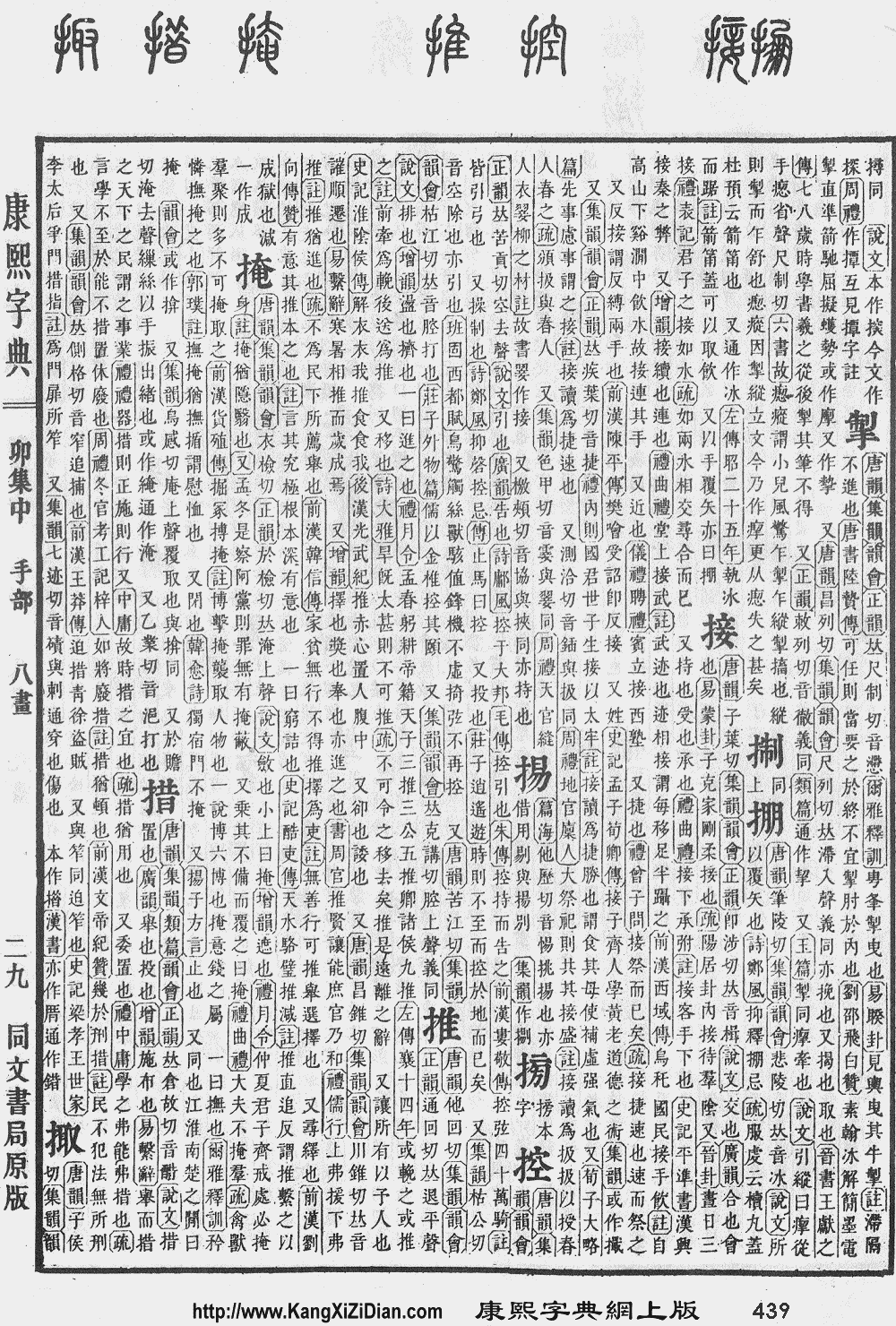
  • KangXi: page 439, character 4
  • Dai Kanwa Jiten: character 12280
  • Dae Jaweon: page 789, character 4
  • Hanyu Da Zidian (first edition): volume 3, page 1905, character 1
  • Unihan data for U+63A5

Chinese

trad. 接
simp. # 接

Glyph origin

Phono-semantic compound (形聲, OC *ʔseb) : semantic 扌 + phonetic 妾 (OC *sʰeb) – to receive (in the hand).

Pronunciation


Note: diap1 - “to catch, to pick up (a person)”.
Note:
  • chih - vernacular;
  • chiap - literary.
Note:
  • zih4 - vernacular;
  • ziab4 - literary.
  • Wu
    • (Shanghainese)
      • Wiktionary: 4jiq
      • Sinological IPA (key): /t͡ɕi̯ɪʔ⁵⁵/
  • Xiang
    • (Changsha)
      • Wiktionary: zie6
      • Sinological IPA (key) (old-style): /t͡sie̞²⁴/
      • Sinological IPA (key) (new-style): /t͡ɕie̞²⁴/

  • Dialectal data
Variety Location 接
Mandarin Beijing /t͡ɕiɛ⁵⁵/
Harbin /t͡ɕiɛ⁴⁴/
Tianjin /t͡ɕie²¹/
Jinan /t͡ɕiə²¹³/
Qingdao /t͡siə⁵⁵/
Zhengzhou /t͡siɛ²⁴/
Xi'an /t͡ɕiɛ²¹/
Xining /t͡ɕi⁴⁴/
Yinchuan /t͡ɕie¹³/
Lanzhou /t͡ɕiə¹³/
Ürümqi /t͡ɕiɤ²¹³/
Wuhan /t͡ɕie²¹³/
Chengdu /t͡ɕie³¹/
Guiyang /t͡ɕie²¹/
Kunming /t͡ɕiɛ³¹/
Nanjing /t͡sieʔ⁵/
Hefei /t͡ɕiɐʔ⁵/
Jin Taiyuan /t͡ɕiəʔ²/
Pingyao /t͡ɕiʌʔ¹³/
Hohhot /t͡ɕiaʔ⁴³/
Wu Shanghai /t͡ɕiɪʔ⁵/
Suzhou /t͡siəʔ⁵/
Hangzhou /t͡ɕiəʔ⁵/
Wenzhou /t͡ɕi²¹³/
Hui Shexian /t͡seʔ²¹/
Tunxi /t͡siɛ⁵/
Xiang Changsha /t͡sie²⁴/
Xiangtan /t͡sie²⁴/
Gan Nanchang /t͡ɕiɛʔ⁵/
Hakka Meixian /t͡siap̚¹/
Taoyuan /t͡siɑp̚²²/
Cantonese Guangzhou /t͡sip̚³/
Nanning /t͡sip̚³³/
Hong Kong /t͡sip̚³/
Min Xiamen (Min Nan) /t͡siap̚³²/
/t͡siʔ³²/
Fuzhou (Min Dong) /t͡siɛʔ²³/
Jian'ou (Min Bei) /t͡siɛ²⁴/
Shantou (Min Nan) /t͡siap̚²/
/t͡siʔ²/
Haikou (Min Nan) /t͡siap̚⁵/
/t͡si⁵⁵/

Rime
Character 接
Reading # 1/1
Initial (聲) 精 (13)
Final (韻) 鹽 (155)
Tone (調) Checked (Ø)
Openness (開合) Open
Division (等) III
Fanqie 即葉切
Baxter tsjiep
Reconstructions
Zhengzhang
Shangfang
/t͡siᴇp̚/
Pan
Wuyun
/t͡siɛp̚/
Shao
Rongfen
/t͡sjæp̚/
Edwin
Pulleyblank
/t͡siap̚/
Li
Rong
/t͡siɛp̚/
Wang
Li
/t͡sĭɛp̚/
Bernard
Karlgren
/t͡si̯ɛp̚/
Expected
Mandarin
Reflex
jie
Expected
Cantonese
Reflex
zip3
Baxter–Sagart system 1.1 (2014)
Character 接
Reading # 1/1
Modern
Beijing
(Pinyin)
jiē
Middle
Chinese
‹ tsjep ›
Old
Chinese
/*[ts][a]p/
English connect

Notes for Old Chinese notations in the Baxter–Sagart system:

* Parentheses "()" indicate uncertain presence;
* Square brackets "[]" indicate uncertain identity, e.g. *[t] as coda may in fact be *-t or *-p;
* Angle brackets "<>" indicate infix;
* Hyphen "-" indicates morpheme boundary;

* Period "." indicates syllable boundary.
Zhengzhang system (2003)
Character 接
Reading # 1/1
No. 10463
Phonetic
component
妾
Rime
group
盍
Rime
subdivision
2
Corresponding
MC rime
接
Old
Chinese
/*ʔseb/

Definitions

接

  1. to come near to; to be close to; to come into contact
    接觸/接触  ―  jiēchù  ―  to touch; to come into contact
  2. to receive
    接受  ―  jiēshòu  ―  to accept; to receive
    交接  ―  jiāojiē  ―  to transfer; to hand over
  3. to host; to receive or admit someone
    接待  ―  jiēdài  ―  to host (visitors)
  4. to catch
    接球  ―  jiēqiú  ―  to catch a ball
  5. to continue; to follow
    接續/接续  ―  jiēxù  ―  to continue; to relay
    接二連三/接二连三  ―  jiē'èrliánsān  ―  to follow one another
    再接再厲/再接再厉  ―  zàijiēzàilì  ―  to keep on
  6. to take over
    接管  ―  jiēguǎn  ―  to take over
  7. to connect
    接口  ―  jiēkǒu  ―  (computing) interface
    嫁接  ―  jiàjiē  ―  to graft
  8. to pick up the phone
    無人接聽/无人接听  ―  wúrén jiētīng  ―  nobody's answering
  9. to meet, greet and welcome (someone); to pick up (a person)
    我現在在開車去接你。 [MSC, trad.]
    我现在在开车去接你。 [MSC, simp.]
    Wǒ xiànzài zài kāichē qù jiē nǐ. [Pinyin]
    I'm driving over to pick you up right now.
  10. a surname: Jie

Synonyms

  • (to come near to):
  • (to connect):
  • (to continue):
  • (to pick up the phone): (Cantonese) 聽/听 (tīng)
  • (to meet, greet and welcome): 迎接 (yíngjiē), (literary) 迎迓 (yíngyà)

Compounds

References

Japanese

Kanji

接

(grade 5 “Kyōiku” kanji)

  1. touch

Readings

Korean

Hanja

接 (eumhun 이을 접 (ieul jeop))

  1. Hanja form? of 접 (“touch”).

Compounds

Vietnamese

Han character

接: Hán Nôm readings: tiếp

  1. This term needs a translation to English. Please help out and add a translation, then remove the text {{rfdef}}.
This article is issued from Wiktionary. The text is licensed under Creative Commons - Attribution - Sharealike. Additional terms may apply for the media files.