相
| ||||||||
Translingual
| Stroke order | |||
|---|---|---|---|
 | |||
Han character
相 (Kangxi radical 109, 目+4, 9 strokes, cangjie input 木月山 (DBU), four-corner 46900, composition ⿰木目)
References
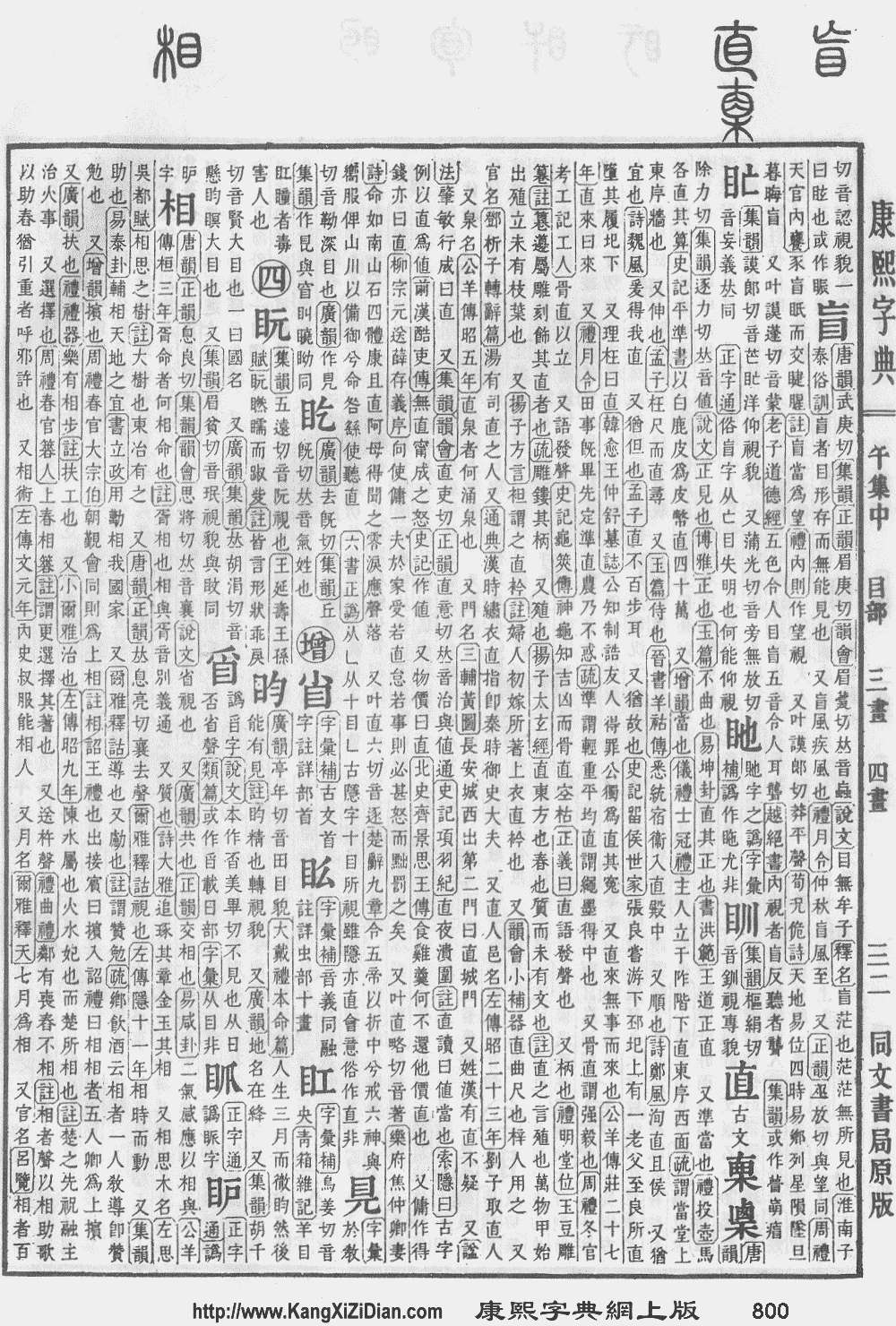
- KangXi: page 800, character 18
- Dai Kanwa Jiten: character 23151
- Dae Jaweon: page 1216, character 8
- Hanyu Da Zidian (first edition): volume 4, page 2470, character 13
- Unihan data for U+76F8
Chinese
| simp. and trad. |
相 | |
|---|---|---|
Glyph origin
Ideogrammic compound (會意) : 木 (“tree”) + 目 (“eye”) – looking at, or watching the tree.
Etymology
An allofam is 胥 (OC *sŋa, *sŋaʔ, “each other; mutually; all; to observe; to assist”) (Gong, 1995; Schuessler, 2007).
Derivative: 想 (OC *slaŋʔ, “to think”) (“appearance > to visualise > to think”).
Pronunciation 1
Definitions
相
- to see for oneself; to evaluate by seeing for oneself
- 相女婿 ― xiāng nǚxù ― assess the suitability of a prospective son-in-law or husband
- mutually; reciprocally; towards each other; one another
- together; jointly
- successively; one after another
- towards; to
- a surname
Compounds
|
|
|
Pronunciation 2
Definitions
相
- to look at; to examine the appearance and judge; to observe
- 相鼠有皮,人而無儀。 [Pre-Classical Chinese, trad.]
- From: The Classic of Poetry, c. 11th – 7th centuries BCE, translated based on James Legge's version
- Xiàng shǔ yǒu pí, rén ér wú yí. [Pinyin]
- Look at a rat, - it has its skin;
But a man should be without dignity of demeanour.
相鼠有皮,人而无仪。 [Pre-Classical Chinese, simp.]
- looks; appearance; features
- posture; bearing
- 站相 ― zhànxiàng ― standing posture
- demeanour; manners
- 吃相 ― chīxiàng ― table manners
- photo; picture; photograph (Classifier: 張/张 c; 幅 c)
- phase; exterior; stage; period
- (physics) phase
- 相空間/相空间 ― xiàngkōngjiān ― phase space
- 相位 ― xiàngwèi ― phase
- 月相 ― yuèxiàng ― lunar phase
- (geology) facies
- to physiognomise; to practise physiognomy; to tell fortune by reading the subject's facial features
- physiognomy; practice of physiognomy
- to choose; to pick
- to assist; to help; to oversee
- (Chinese mythology) Xiang of Xia (fifth king of the semi-legendary Xia dynasty)
- (historical) Chancellor of State
- (xiangqi) minister (on the red side)
- (historical) master of ceremonies
- (historical) attendant
- to administer; to govern
- to teach; to instruct
- a person who guides or leads a blind person
- 危而不持,顛而不扶,則將焉用彼相矣? [Classical Chinese, trad.]
- From: The Analects of Confucius, c. 475 – 221 BCE, translated based on James Legge's version
- Wéi ér bù chí, diān ér bù fú, zé jiāng yān yòng bǐ xiàng yǐ? [Pinyin (Taiwanese Mandarin)]
- How can he be used as a guide to a blind man, who does not support him when tottering, nor raise him up when fallen?
危而不持,颠而不扶,则将焉用彼相矣? [Classical Chinese, simp.]
- a surname
Synonyms
Coordinate terms
Compounds
|
|
|
References
- “相”, in 漢語多功能字庫 (Multi-function Chinese Character Database), 香港中文大學 (the Chinese University of Hong Kong), 2014–
Japanese
Readings
From Middle Chinese 相 (MC sɨɐŋ); compare Mandarin 相 (xiāng):
- Go-on: そう (sō, Jōyō)←さう (sau, historical)
- Kan-on: しょう (shō, Jōyō)←しやう (syau, historical)
From Middle Chinese 相 (MC sɨɐŋH); compare Mandarin 相 (xiàng):
- Go-on: そう (sō, Jōyō)←さう (sau, historical)
- Kan-on: しょう (shō, Jōyō)←しやう (syau, historical)
From native Japanese roots:
- Kun: あい (ai, 相, Jōyō)←あひ (afi, 相, historical); こもごも (komogomo, 相)←こもこも (komokomo, 相, historical); さが (saga, 相); みる (miru, 相る); たすける (tasukeru, 相ける)
- Nanori: あ (a); あい (ai); あう (au); あきら (akira); い (i); おう (ō); さ (sa); さが (saga); すけ (suke); たすく (tasuku); とも (tomo); はる (haru); まさ (masa); み (mi); みる (miru)
Compounds
- 相手 (aite, “companion, partner, opponent”)
- 液相 (ekisō, “liquid phase”)
- 気相 (kisō, “gaseous phase”)
- 固相 (kosō, “solid phase”)
- 相撲 (sumō, “sumo”)
- 相談 (sōdan, “consultation”)
Etymology 1
| Kanji in this term |
|---|
| 相 |
| あい Grade: 3 |
| kun’yomi |
| For pronunciation and definitions of 相 – see the following entry. | ||
| ||
| (This term, 相, is an alternative spelling of the above term.) |
Etymology 2
| Kanji in this term |
|---|
| 相 |
| こもごも Grade: 3 |
| kun’yomi |
| For pronunciation and definitions of 相 – see the following entry. | ||
| ||
| (This term, 相, is an alternative spelling of the above term.) |
Alternative forms
Noun
相 • (saga)
Synonyms
Etymology 4
| Kanji in this term |
|---|
| 相 |
| しょう Grade: 3 |
| kan’on |
From Middle Chinese 相 (“together, with”), from the way that a minister would always be with their lord. Kan'on, so likely a later borrowing than the sō reading.
Suffix
- minister of state
- 首相
- shushō
- prime minister
- 内相
- naishō
- minister of the interior
- 首相
Synonyms
- 大臣 (daijin)
Etymology 5
| Kanji in this term |
|---|
| 相 |
| そう Grade: 3 |
| goon |
From Middle Chinese. Goon, so likely an earlier borrowing than the shō reading.
Noun
- appearance, how something looks
- an aspect of something
- 大自然の色々な相
- daishizen no iroiro na sō
- various aspects of nature
- 大自然の色々な相
- (grammar) grammatical aspect
- (physics) a phase, as of matter
- (ikebana) the central supporting branch of an ikebana arrangement
Related terms
- (ikebana): 役枝 (yakueda)
Korean
Etymology 1
From Middle Chinese 相 (MC sɨɐŋ, “mutual; together”).
| Historical Readings | ||
|---|---|---|
| Dongguk Jeongun Reading | ||
| Dongguk Jeongun, 1448 | Recorded as Middle Korean 샤ᇰ (Yale: syàng) in Dongguk Jeongun (東國正韻 / 동국정운), 1448. | |
| Middle Korean | ||
| Text | Eumhun | |
| Gloss (hun) | Reading | |
| Hunmong Jahoe, 1527 | 서르 샤ᇰ[1] | Recorded as Middle Korean 샤ᇰ (syang) (Yale: syàng) in Hunmong Jahoe (訓蒙字會 / 훈몽자회), 1527.[2] |
| Early Modern Korean | ||
| Text | Final (韻) | Reading |
| Samun Seonghwi, 1751 | 서ᄅᆞ 샹 | Recorded as Early Modern Korean 샹 (Yale: syang) in Juhae Cheonjamun (註解千字文 / 주해천자문), 1804. |
| ||
Pronunciation
- (SK Standard/Seoul) IPA(key): [sʰa̠ŋ]
- Phonetic hangul: [상]
Compounds
Etymology 2
From Middle Chinese 相 (MC sɨɐŋH, “appearance”).
| Historical Readings | ||
|---|---|---|
| Dongguk Jeongun Reading | ||
| Dongguk Jeongun, 1448 | Recorded as Middle Korean 샤ᇰ〮 (Yale: syáng) in Dongguk Jeongun (東國正韻 / 동국정운), 1448. | |
| Middle Korean | ||
| Text | Eumhun | |
| Gloss (hun) | Reading | |
| Hunmong Jahoe, 1527 | ᄌᆡ〯샤ᇰ〮[1] 샤ᇰ〮 | Recorded as Middle Korean 샤ᇰ〮 (syáng) (Yale: syáng) in Hunmong Jahoe (訓蒙字會 / 훈몽자회), 1527. |
| Early Modern Korean | ||
| Text | Final (韻) | Reading |
| Samun Seonghwi, 1751 | 졍승[2] 샹 | Recorded as Early Modern Korean 샹 (Yale: syang) in Juhae Cheonjamun (註解千字文 / 주해천자문), 1804. |
| ||
Pronunciation
- (SK Standard/Seoul) IPA(key): [sʰa̠ŋ]
- Phonetic hangul: [상]