宗
See also: 完
| ||||||||
Translingual
Han character
宗 (Kangxi radical 40, 宀+5, 8 strokes, cangjie input 十一一火 (JMMF), four-corner 30901, composition ⿱宀示)
References
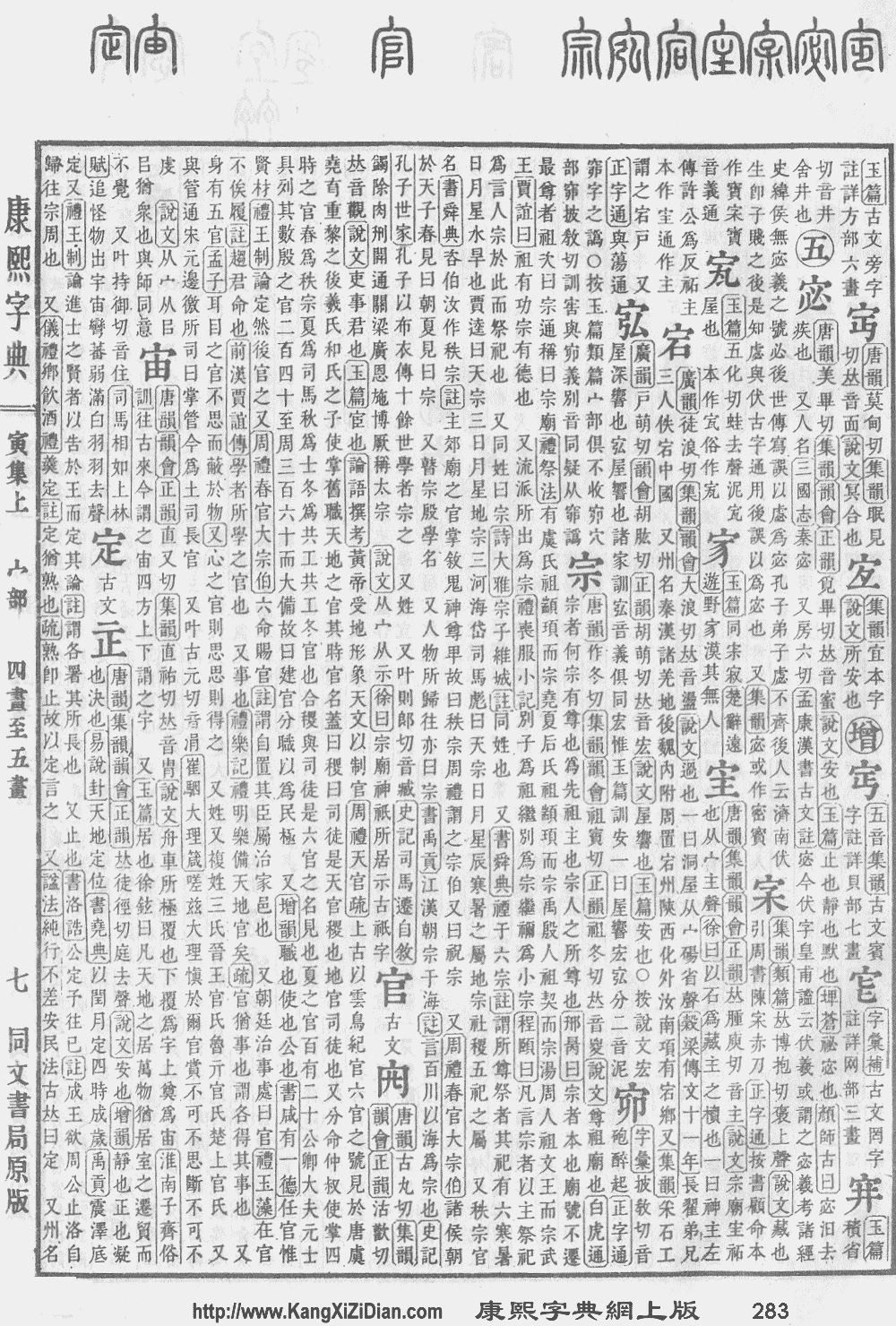
- KangXi: page 283, character 14
- Dai Kanwa Jiten: character 7106
- Dae Jaweon: page 557, character 5
- Hanyu Da Zidian (first edition): volume 2, page 917, character 11
- Unihan data for U+5B97
Chinese
| trad. | 宗 | |
|---|---|---|
| simp. # | 宗 | |
Glyph origin
| Historical forms of the character 宗 | |||
|---|---|---|---|
| Shang | Western Zhou | Shuowen Jiezi (compiled in Han) | Liushutong (compiled in Ming) |
| Oracle bone script | Bronze inscriptions | Small seal script | Transcribed ancient scripts |
 |
 |
 |
 |
Characters in the same phonetic series (宗) (Zhengzhang, 2003)
Ideogrammic compound (會意) : 宀 (“house”) + 示 (“spirit tablet”) – temple; ancestral shrine.
Etymology
Compare Proto-Sino-Tibetan *tsuk ⪤ *tsik (“to build”) (STEDT). Cognate with Tibetan རྫོང (rdzong, “castle; fortress”). Perhaps cognate with Burmese ဆောင် (hcaung, “building, mansion”).
Pronunciation
Definitions
宗
- ancestral temple
- ancestors or elders of a people
- family
- 宗法 ― zōngfǎ ― patriarcal clan system
- 宗周 ― Zōngzhōu ― Ancestral Zhou, Clan city of Zhou (Western Zhou dynasty's capital)
- having the same ancestry
- 宗兄 ― zōngxiōng ― elder brother
- school; sect
- 禪宗/禅宗 ― chánzōng ― Zen
- 真佛宗 ― zhēn fó zōng ― True Buddha School
- main purpose
- 宗旨 ― zōngzhǐ ― aim
- to revere; to respect
- to follow
- (historical) an administrative division in historical Tibet, equivalent to a county
- Classifier for legal cases.
- Classifier for cases of sickness.
- 初步診斷有41宗病例,其中一宗死亡[…]香港醫學會傳染病顧問委員會主席梁子超,在本台節目《星期六問責》說,相比同類型病毒,例如中東呼吸綜合症及沙士,今次武漢至今僅一宗死亡個案,相信此病毒性肺炎的死亡率不算高。 [MSC, trad.]
- From: 2020 January 11, RTHK, 醫學會專家相信武漢不明原因病毒性肺炎死亡率不算高
- Chūbù zhěnduàn yǒu 41 zōng bìnglì, qízhōng yī zōng sǐwáng Xiānggǎng Yīxuéhuì Chuánrǎnbìng Gùwèn Wěiyuánhuì zhǔxí Liáng Zǐchāo, zài běn tái jiémù “Xīngqīliù Wènzé” shuō, xiàngbǐ tónglèixíng bìngdú, lìrú Zhōngdōng hūxī zōnghézhèng jí Shāshì, jīncì Wǔhàn zhìjīn jǐn yī zōng sǐwáng gèàn, xiàngxìn cǐ bìngdúxìng fèiyán de sǐwánglǜ bùsuàn gāo. [Pinyin]
- 41 tentative diagnoses, with 1 death among them […] Hong Kong Medical Association Infectious Diseases Advisory Committee leader LEUNG Chi-chiu said in our program "Saturday Accountability" that compared to viruses of the same type, such as MERS and SARS, Wuhan has only had one case of death so far; he believes that the death rate of this viral pneumonia cannot be considered to be high.
初步诊断有41宗病例,其中一宗死亡[…]香港医学会传染病顾问委员会主席梁子超,在本台节目《星期六问责》说,相比同类型病毒,例如中东呼吸综合症及沙士,今次武汉至今仅一宗死亡个案,相信此病毒性肺炎的死亡率不算高。 [MSC, simp.]
- a surname
Compounds
Derived terms from 宗
|
|
|
References
- “宗”, in 漢語多功能字庫 (Multi-function Chinese Character Database), 香港中文大學 (the Chinese University of Hong Kong), 2014–
Japanese
Kanji
宗
Readings
Korean
Hanja
Vietnamese
This article is issued from Wiktionary. The text is licensed under Creative Commons - Attribution - Sharealike. Additional terms may apply for the media files.