台

See also: 臺, 檯, 颱, 枱, and 合
台 U+53F0, 台
CJK UNIFIED IDEOGRAPH-53F0
← 可
[U+53EF]
CJK Unified Ideographs 叱 →
[U+53F1]

Translingual

Stroke order
5 strokes
Japanese 台
Simplified 台
Traditional 臺/台

Han character

台 (Kangxi radical 30, 口+2, 5 strokes, cangjie input 戈口 (IR), four-corner 23600, composition ⿱厶口)

Derived characters

References

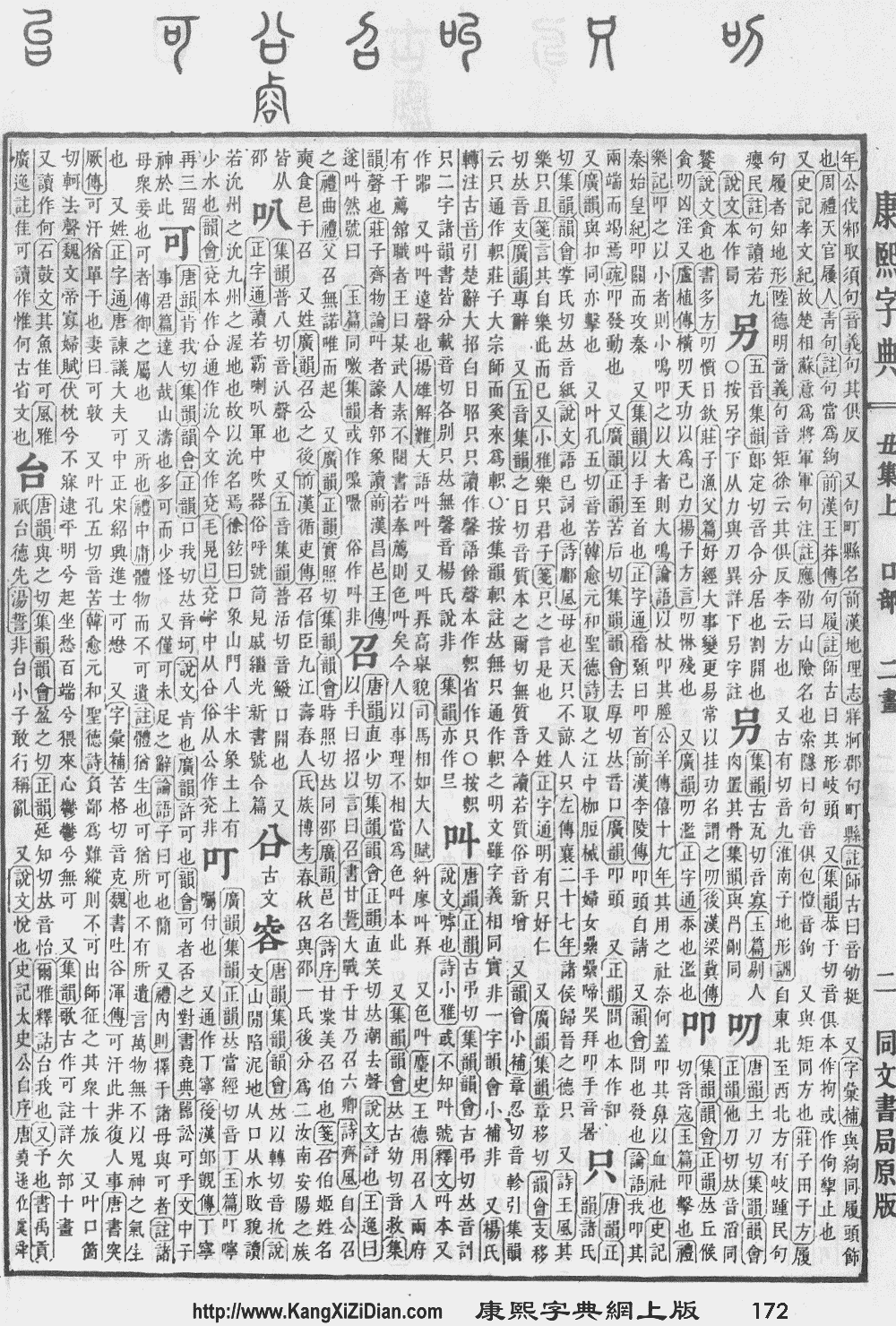
  • KangXi: page 172, character 13
  • Dai Kanwa Jiten: character 3246
  • Dae Jaweon: page 384, character 1
  • Hanyu Da Zidian (first edition): volume 1, page 575, character 2
  • Unihan data for U+53F0

Chinese

Glyph origin

Phono-semantic compound (形聲, OC *l̥ʰɯː, *l'ɯː, *l'ɯː, *lɯ) : phonetic 㠯 + semantic 口 (“mouth”).

An alternate variant of 㠯 (modern form: 以 (yǐ)) in Chinese bronze inscriptions.

Etymology 1

For pronunciation and definitions of 台 – see 臺 (“tower; lookout; stage; platform; etc.”).
(This character, 台, is the simplified and variant traditional form of 臺.)
Notes:

Etymology 2

For pronunciation and definitions of 台 – see 颱 (“typhoon”).
(This character, 台, is the simplified form of 颱.)
Notes:

Etymology 3

For pronunciation and definitions of 台 – see 檯 (“table; desk”).
(This character, 台, is the simplified and variant traditional form of 檯.)
Notes:

Etymology 4

simp. and trad.
台

Pronunciation


Rime
Character 台
Reading # 1/2
Initial (聲) 以 (36)
Final (韻) 之 (19)
Tone (調) Level (Ø)
Openness (開合) Open
Division (等) III
Fanqie 與之切
Reconstructions
Zhengzhang
Shangfang
/jɨ/
Pan
Wuyun
/jɨ/
Shao
Rongfen
/ie/
Edwin
Pulleyblank
/jɨ/
Li
Rong
/iə/
Wang
Li
/jĭə/
Bernard
Karlgren
/i/
Expected
Mandarin
Reflex
yí
Expected
Cantonese
Reflex
ji4
Baxter–Sagart system 1.1 (2014)
Character 台
Reading # 1/1
Modern
Beijing
(Pinyin)
yí
Middle
Chinese
‹ yi ›
Old
Chinese
/*lə/
English I, me

Notes for Old Chinese notations in the Baxter–Sagart system:

* Parentheses "()" indicate uncertain presence;
* Square brackets "[]" indicate uncertain identity, e.g. *[t] as coda may in fact be *-t or *-p;
* Angle brackets "<>" indicate infix;
* Hyphen "-" indicates morpheme boundary;

* Period "." indicates syllable boundary.
Zhengzhang system (2003)
Character 台
Reading # 4/4
No. 12298
Phonetic
component
台
Rime
group
之
Rime
subdivision
0
Corresponding
MC rime
飴
Old
Chinese
/*lɯ/
Notes 後作怡本從以聲

Definitions

台

  1. † Original form of 怡 (yí, “happy, pleased”).
  2. † I, me
    非台小子敢行稱亂。 [Classical Chinese, trad.]
    非台小子敢行称乱。 [Classical Chinese, simp.]
    From: The Book of Documents, circa 4th – 3rd century BCE
    Fēi yí xiǎozǐ gǎn xíng chēng luàn. [Pinyin]
    It is not I, the little child, who dare to raise a rebellion.
  3. † what
  4. a surname
Usage notes

The surname 台 (Yí) is different from the surname 臺 (Tái). Note that 臺 has been simplified to 台 in mainland China.

Synonyms

Etymology 5

simp. and trad.
台

Pronunciation


Rime
Character 台
Reading # 2/2
Initial (聲) 透 (6)
Final (韻) 咍 (41)
Tone (調) Level (Ø)
Openness (開合) Open
Division (等) I
Fanqie 土來切
Reconstructions
Zhengzhang
Shangfang
/tʰʌi/
Pan
Wuyun
/tʰəi/
Shao
Rongfen
/tʰɒi/
Edwin
Pulleyblank
/tʰəj/
Li
Rong
/tʰᴀi/
Wang
Li
/tʰɒi/
Bernard
Karlgren
/tʰɑ̆i/
Expected
Mandarin
Reflex
tāi
Expected
Cantonese
Reflex
toi1
Zhengzhang system (2003)
Character 台
Reading # 1/4
No. 12260
Phonetic
component
台
Rime
group
之
Rime
subdivision
0
Corresponding
MC rime
胎
Old
Chinese
/*l̥ʰɯː/
Notes 本從以聲

Definitions

台

  1. Used in place names.

Compounds

Etymology 6

simp. and trad.
台

Pronunciation


Rime
Character 台
Reading # 2/2
Initial (聲) 透 (6)
Final (韻) 咍 (41)
Tone (調) Level (Ø)
Openness (開合) Open
Division (等) I
Fanqie 土來切
Reconstructions
Zhengzhang
Shangfang
/tʰʌi/
Pan
Wuyun
/tʰəi/
Shao
Rongfen
/tʰɒi/
Edwin
Pulleyblank
/tʰəj/
Li
Rong
/tʰᴀi/
Wang
Li
/tʰɒi/
Bernard
Karlgren
/tʰɑ̆i/
Expected
Mandarin
Reflex
tāi
Expected
Cantonese
Reflex
toi1

Definitions

台

  1. Used in 三台 (“name of a star”).
  2. historical placename in modern Shandong
    alt. forms: 邰 (tái)
  3. † (polite, honorific) used to address another person or to describe the actions of another person

Compounds

  • 三台
  • 台端

Etymology 7

For pronunciation and definitions of 台 – see 鮐 (“mackerel; old person; etc.”).
(This character, 台, is a variant form of 鮐.)

Etymology 8

simp. and trad.
台

Pronunciation


Definitions

台

  1. Alternative form of 嗣 (sì).
  2. Alternative form of 始 (shǐ).

Japanese

Kanji

台

(grade 2 “Kyōiku” kanji)

Readings

  • Go-on: い (i)
  • Kan-on: い (i)

Kanji

Shinjitai

台

Kyūjitai

臺
台

(grade 2 “Kyōiku” kanji, shinjitai kanji, kyūjitai form 臺)

  1. pedestal
  2. a stand
  3. counter for machines and vehicles
  4. Taiwan

Compounds

Readings

As shinjitai kanji of 臺:

Kanji

台

(grade 2 “Kyōiku” kanji)

  1. (replacing 颱) typhoon

Readings

Counter

台(だい) • (-dai) 

  1. machines, especially vehicles or computers
    一(いっ)家(か)に一(いち)台(だい)!
    Ikka ni ichidai!
    A unit in every household! (stock phrase, sometimes humorously used to refer to people)

Suffix

台(だい) • (-dai) 

  1. tables, beds
  2. level, especially of price
    100点(ひゃくてん)台(だい)
    hyaku-ten-dai
    around 100 points
  3. period of time in a person's life

Korean

Hanja

台 • (tae, i, dae) (hangeul 태, 이, 대, revised tae, i, dae, McCune–Reischauer t'ae, i, dae)

  1. This term needs a translation to English. Please help out and add a translation, then remove the text {{rfdef}}.

Vietnamese

Han character

台: Hán Việt readings: thai (湯(thang)來(lai)切(thiết))[1][2][3], đài (堂(đoàng)來(lai)切(thiết))[2][3]
台: Nôm readings: thơi[1][2][3][4][5], thai[1][2][3][5], thay[1][2][4][5], hay[1][2], đài[2][4], thài[2], hai[3], đày[4]

  1. This term needs a translation to English. Please help out and add a translation, then remove the text {{rfdef}}.

References

  1. Nguyễn (2014).
  2. Nguyễn et al. (2009).
  3. Trần (2004).
  4. Hồ (1976).
  5. Taberd & Pigneau de Béhaine (1838).
This article is issued from Wiktionary. The text is licensed under Creative Commons - Attribution - Sharealike. Additional terms may apply for the media files.