本
| ||||||||
Translingual
| Stroke order | |||
|---|---|---|---|
 | |||
Han character
本 (Kangxi radical 75, 木+1, 5 strokes, cangjie input 木一 (DM), four-corner 50230, composition ⿻木一)
References
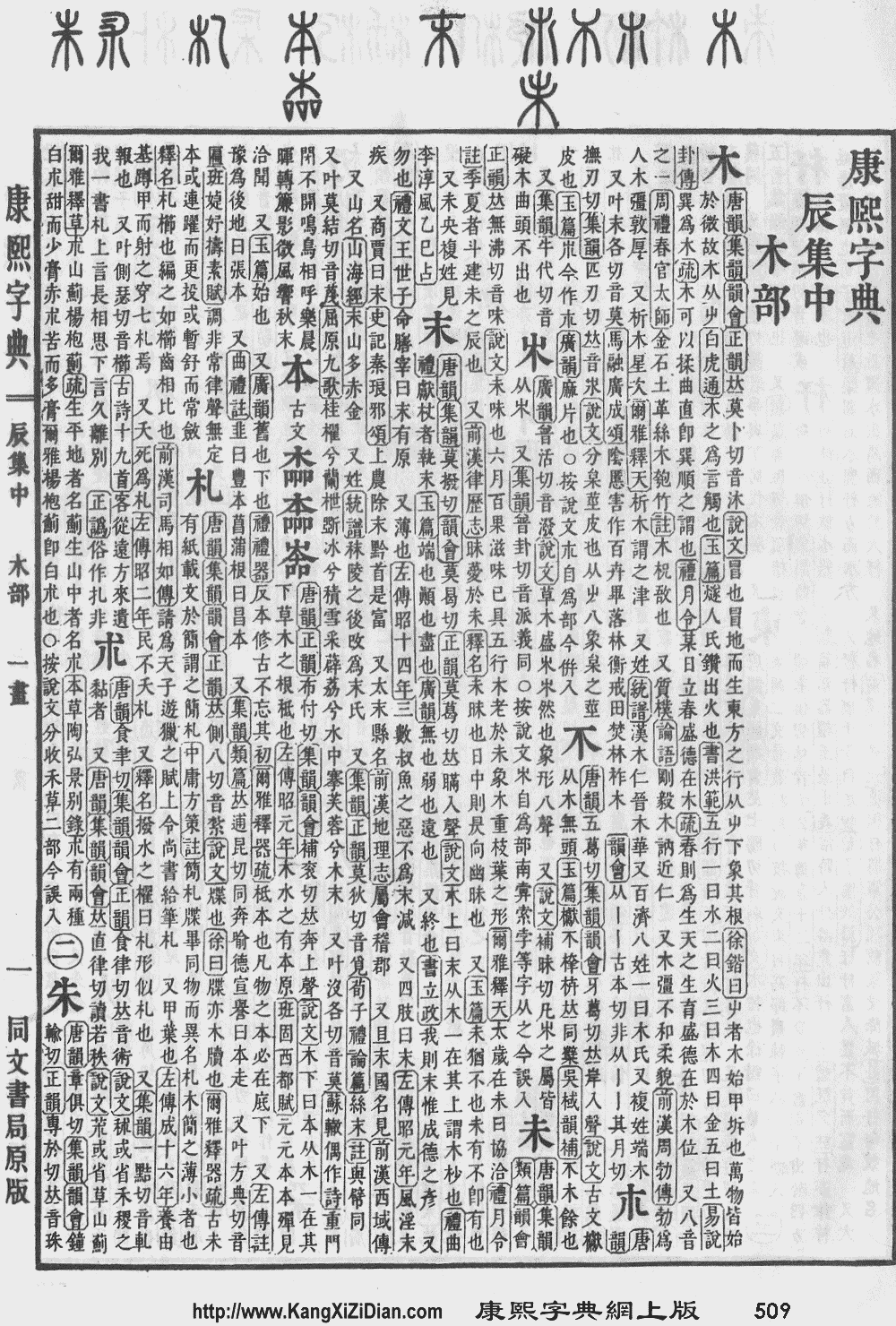
- KangXi: page 509, character 7
- Dai Kanwa Jiten: character 14421
- Dae Jaweon: page 891, character 2
- Hanyu Da Zidian (first edition): volume 2, page 1151, character 1
- Unihan data for U+672C
Chinese
| simp. and trad. |
本 | |
|---|---|---|
| alternative forms | 夲 | |
Glyph origin
| Historical forms of the character 本 | ||
|---|---|---|
| Western Zhou | Shuowen Jiezi (compiled in Han) | Liushutong (compiled in Ming) |
| Bronze inscriptions | Small seal script | Transcribed ancient scripts |
 |
 |
 |
Ideogram (指事) : a tree (木) with its bottom highlighted with an extra stroke, accentuating the roots; contrast 末, 朱.
Etymology
From Proto-Sino-Tibetan *(b/p)ul (“root; stump; tree”) (STEDT). Cognate with Mizo bul (“cause; beginning; root; stump”), Jingpho phun (“tree; bush; stalk; wood”), Garo bol (“tree”), Burmese ပင် (pang, “tree, plant”) and Burmese ပင်ရင်း (pang-rang:, “source, origin, basic”).
Pronunciation
Definitions
本
- (of plants) root; stem
- 枝大於本,脛大於股,不折必披。 [Classical Chinese, trad.]
- From: The Records of the Grand Historian, by Sima Qian, c. 91 BCE
- Zhī dà yú běn, jìng dà yú gǔ, bù zhé bì pī. [Pinyin]
- When the branch is larger than the stem, or the shin is larger than the thigh, if it does not fall off, it will surely crack.
枝大于本,胫大于股,不折必披。 [Classical Chinese, simp.]
- source; origin; root
- foundation; basis
- edition; version; copy
- originally; initially
- 我本天上鳥,常留五彩雲。今宵風雨惡,誤落野鳥群。 [Korean Literary Sinitic, trad.]
- From: 《與訪客詰拒》 by Kim Byeong'yeon (金炳淵), 1800s
- A bon cheonsang jo, sang nyu osaeg un. Geumso pung'u ak, orak yajo gun. [Sino-Korean]
- I am originally a bird of the heavens, always staying amid the five-hued clouds. Tonight the rain and gusts were harsh, and I slipped and fell into this flock of wild birds.
- current; present
- this; here; this very
- capital; principal (money used in investment)
- Classifier for books, periodicals, files. ⇒ all nouns using this classifier
- volume
- (Korean Classical Chinese) ancestral seat of a descent group
Synonyms
- (classifier for books): (Jinjiang and Yongchun Hokkien) 卷 (kńg)
Antonyms
Compounds
|
|
|
Further reading
- “Entry #1664”, in 臺灣閩南語常用詞辭典 [Dictionary of Frequently-Used Taiwan Minnan] (in Chinese and Min Nan), Ministry of Education, R.O.C., 2011.
Japanese
Readings
Compounds
- 本物 (honmono)
- 本当 (hontō)
- 本意 (hon'i)
- 本島 (hontō)
- 本家 (honke)
- 本懐 (honkai)
- 本格 (honkaku)
- 本官 (honkan)
- 本願 (hongan)
- 本義 (hongi)
- 本業 (hongyō)
- 本源 (hongen)
- 本旨 (honshi)
- 本地 (honji)
- 本地垂迹 (honjisuijaku)
- 本州 (Honshū)
- 本性 (honshō)
- 本心 (honshin)
- 本籍 (honseki)
- 本草 (honzō)
- 本草学 (honzōgaku)
- 本草綱目 (Honzō Kōmoku)
- 本体 (hontai)
- 本態 (hontai)
- 本朝 (honchō)
- 本土 (hondo)
- 本能 (honnō)
- 本分 (honbun)
- 本邦 (honpō)
- 本末 (honmatsu)
- 本務 (honmu)
- 本命 (honmei)
- 本望 (honmō)
- 本屋 (hon'ya, “bookstore”)
- 本来 (honrai)
- 本領 (honryō)
- 本論 (honron)
- 本日 (honjitsu, “today”)
- 日本 (Nihon)
- 日本 (Nippon)
- 日本人 (Nihonjin)
- 日本人 (Nipponjin)
Etymology 1
| Kanji in this term |
|---|
| 本 |
| もと Grade: 1 |
| kun’yomi |
Etymology 2
| Kanji in this term |
|---|
| 本 |
| ほん Grade: 1 |
| on’yomi |
Counter
本 • (-hon)
See also
| Japanese number-counter combinations for 本 (hon) | ||||
|---|---|---|---|---|
| 1 | 2 | 3 | 4 | 5 |
| 一本 (ippon) | 二本 (nihon) | 三本 (sanbon) | 四本 (yonhon) | 五本 (gohon) |
| 6 | 7 | 8 | 9 | 10 |
| 六本 (roppon) | 七本 (nanahon) 七本 (shichihon) |
八本 (happon) 八本 (hachihon) |
九本 (kyūhon) | 十本 (juppon) 十本 (jippon) |
| 100 | 1,000 | 10,000 | How many? | |
| 百本 (hyappon) | 千本 (senbon) | 一万本 (ichimanbon) | 何本 (nanbon) 何本 (nanhon) 何本 (nanpon) | |
Prefix
本 • (hon-)
Korean
Etymology
From Middle Chinese 本 (MC puənX). Recorded as Middle Korean 본 (pwon) (Yale: pwon) in Sinjeung Yuhap (新增類合 / 신증유합), 1576.
Hanja
Wikisource 本 (eumhun 근본 본 (geunbon bon))
- Hanja form? of 본 (“root; basis; foundation; stem”).
- Hanja form? of 본 (“source; origin”).
- Hanja form? of 본 (“main; primary; principal”).
- Hanja form? of 본 (“mind; nature; essence; true self”).
- Hanja form? of 본 (“ancestor; fatherland; hometown”).
- Hanja form? of 본 (“counter for books; book; publication”).
- Hanja form? of 본 (“model; version”).
- Hanja form? of 본 (“this; this very”).
- Hanja form? of 본 (“(finance) principal”).
Compounds
- 본격 (本格, bon'gyeok, “authenticity; genuineness”)
- 본격적 (本格的, bon'gyeokjeok, “earnest; real; genuine”)
- 본관 (本貫, bon'gwan, “family clan”)
- 본능 (本能, bonneung, “instinct”)
- 본래 (本來, bollae, “origin; originally”)
- 본루 (本壘, bollu)
- 본말 (本末, bonmal, “the fundamental and the incidental”)
- 본말전도 (本末顚倒, bonmaljeondo, “put the cart before the horse”)
- 본명 (本命, bonmyeong, “heavenly stem and earthly branch of one's birth year”)
- 본문 (本文, bonmun, “text; passage; the body of a book”)
- 본부 (本部, bonbu, “headquarters”)
- 본분 (本分, bonbun, “one's bounden duty”)
- 본사 (本社, bonsa, “headquarters; head office”)
- 본선 (本線, bonseon, “main line”)
- 본성 (本性, bonseong, “human nature; one's true colour”)
- 본심 (本心, bonsim, “real intention; true feelings”)
- 본원 (本源, bonwon, “origin; source”)
- 본위 (本位, bonwi, “monetary standard”)
- 본인 (本人, bonin)
- 본자 (本字, bonja, “original character”)
- 본전 (本錢, bonjeon, “capital; funds”)
- 본점 (本店, bonjeom, “flagship shop”)
- 본조 (本朝, bonjo, “present dynasty”)
- 본주 (本主, bonju, “original proprietor; owner”)
- 본질 (本質, bonjil, “essence”)
- 본체 (本體, bonche, “main body”)
- 본토 (本土, bonto, “mainland”)
- 각본 (脚本, gakbon, “scenario; screenplay; script”)
- 견본 (見本, gyeonbon)
- 근본 (根本, geunbon, “root; basis”)
- 기본 (基本, gibon, “basis”)
- 독본 (讀本, dokbon, “reader”)
- 부본 (副本, bubon, “copy; duplicate”)
- 사본 (寫本, sabon, “copy”)
- 원본 (原本, wonbon, “original copy”)
- 일본 (日本, ^ilbon, “Japan”)
- 자본 (資本, jabon)
- 자본주의 (資本主義, jabonjuui, “capitalism”)
- 장본 (帳本, jangbon, “account book”)
- 초본 (草本, chobon)
- 표본 (標本, pyobon, “specimen”)
- 본고사 (本考査, bon'gosa, “university admission exam”)
Okinawan
Etymology 1
| Kanji in this term |
|---|
| 本 |
| むとぅ Grade: 1 |
| kun’yomi |
Etymology 2
| Kanji in this term |
|---|
| 本 |
| ふん Grade: 1 |
| on’yomi |
Vietnamese
Han character
本: Hán Việt readings: bổn (
本: Nôm readings: vốn[1][2][5][6][3][4][7], bộn[1][5][6][3][4][7], bổn[2][5][3][7], bủn[6][3][4][7], bốn[1][2][5], vỏn[5][6][3], bỏn[5][4][7], bản[1][2], vón[1], bọn[4]
Compounds
References
- Nguyễn (2014).
- Nguyễn et al. (2009).
- Bonet (1899).
- Génibrel (1898).
- Trần (2004).
- Hồ (1976).
- Taberd & Pigneau de Béhaine (1838).