彗

See also: 篲
彗 U+5F57, 彗
CJK UNIFIED IDEOGRAPH-5F57
← 彖
[U+5F56]
CJK Unified Ideographs 彘 →
[U+5F58]

Translingual

Han character

彗 (Kangxi radical 58, 彐+8, 11 strokes, cangjie input 手十尸一 (QJSM), four-corner 55174, composition ⿱⿰丰丰𫜹 or ⿱⿰丰丰⺕)

Derived terms

References

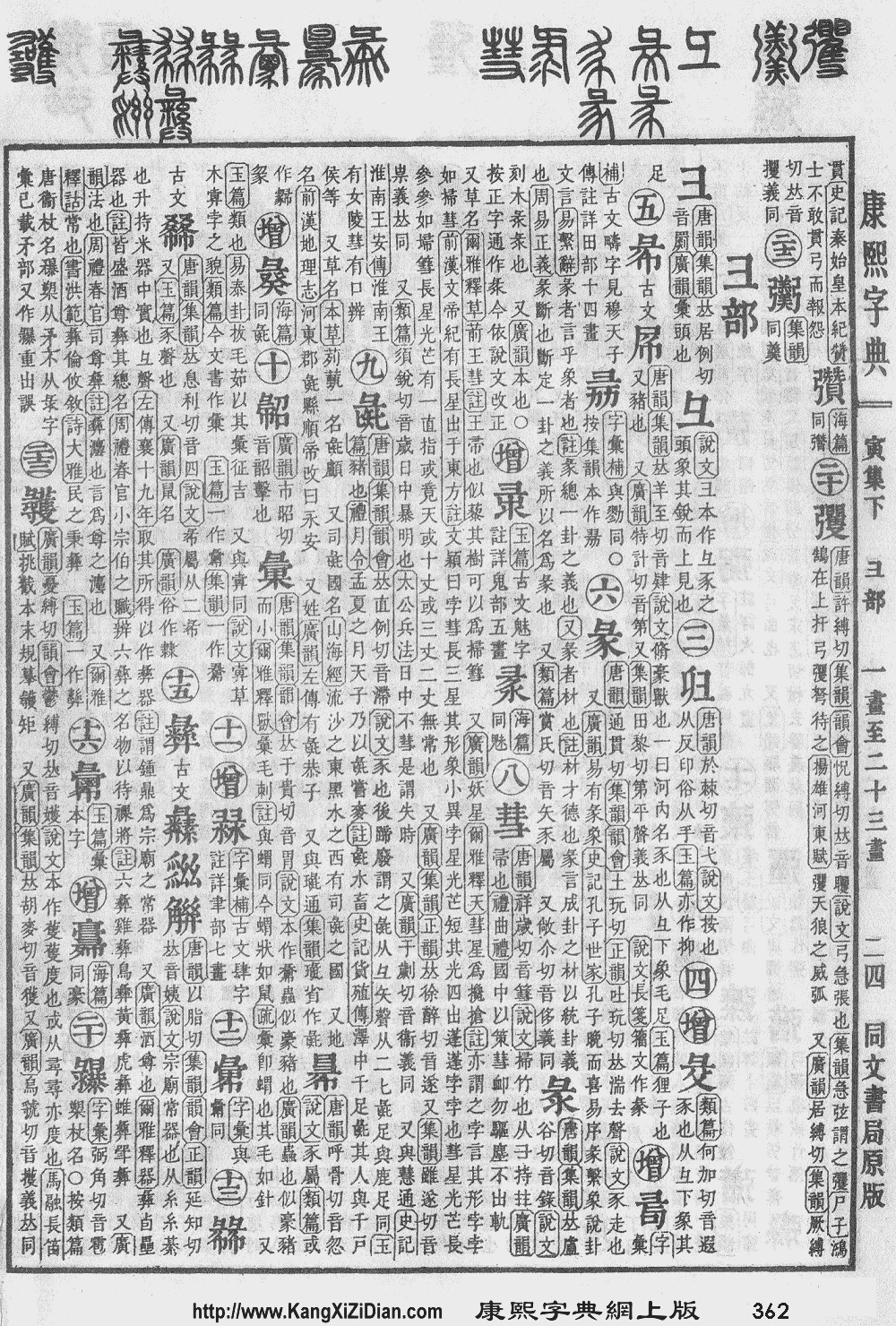
  • KangXi: page 362, character 16
  • Dai Kanwa Jiten: character 9927
  • Dae Jaweon: page 680, character 31
  • Hanyu Da Zidian (first edition): volume 2, page 961, character 10
  • Unihan data for U+5F57

Chinese

Glyph origin

Phono-semantic compound (形聲, OC *sɢʷeds, *ɢʷeds, *sɢʷids) : 甡 (“broom”) + 又 (“hand”) – to hold a broom which is made of bamboo.

Etymology 1

trad. 彗
simp. # 彗
alternative forms 篲
𥱵
𥶙

Sagart (2021) modifies Baxter and Sagart's (2014) reconstruction to *sə-m-pʰˤut-s, deriving it from a root *pʰˤut (“dust”), with the iambic form of the prefix *s-, which derives circumstantial nouns, and the prefix *m-, which derives verbs of volitional action from nouns.

Pronunciation


  • Dialectal data
Variety Location 彗
Mandarin Beijing /xuei⁵¹/
Harbin /xuei⁵³/
Tianjin /xuei⁵³/
Jinan /xuei²¹/
Qingdao /xue⁴²/
Zhengzhou /xuei³¹²/
Xi'an /xuei⁴⁴/
Xining /xuɨ²¹³/
Yinchuan /xuei¹³/
Lanzhou /xuei¹³/
Ürümqi /xuei²¹³/
Wuhan /xuei³⁵/
Chengdu /xuei¹³/
Guiyang /xuei²¹³/
Kunming /xuei²¹²/
Nanjing /xuəi⁴⁴/
Hefei /xue⁵³/
Jin Taiyuan /xuei⁴⁵/
Pingyao
Hohhot /xuei⁵⁵/
Wu Shanghai /ɦue²³/
Suzhou /ɦue̞³¹/
Hangzhou /ɦui¹³/
Wenzhou /vu²²/
Hui Shexian /xue²²/
Tunxi /xuə⁴²/
Xiang Changsha /fei⁵⁵/
Xiangtan /ɸəi⁵⁵/
Gan Nanchang
Hakka Meixian /fi⁵³/
Taoyuan /fui⁵⁵/
Cantonese Guangzhou /wɐi²²/
Nanning /wɐi²²/
Hong Kong /wɐi²²/
Min Xiamen (Min Nan) /sui²²/
/hui²²/ 俗
Fuzhou (Min Dong) /suɔi²⁴²/
Jian'ou (Min Bei) /xy⁴⁴/
Shantou (Min Nan) /hui³⁵/
Haikou (Min Nan) /hui³⁵/

Rime
Character 彗 彗
Reading # 1/3 3/3
Initial (聲) 邪 (17) 邪 (17)
Final (韻) 脂 (16) 祭 (36)
Tone (調) Departing (H) Departing (H)
Openness (開合) Closed Closed
Division (等) III III
Fanqie 徐醉切 祥歲切
Reconstructions
Zhengzhang
Shangfang
/ziuɪH/ /ziuᴇiH/
Pan
Wuyun
/zʷiH/ /zʷiɛiH/
Shao
Rongfen
/zjuɪH/ /ziuæiH/
Edwin
Pulleyblank
/zwiH/ /zwiajH/
Li
Rong
/zuiH/ /ziuɛiH/
Wang
Li
/zwiH/ /zĭwɛiH/
Bernard
Karlgren
/zwiH/ /zi̯wɛiH/
Expected
Mandarin
Reflex
suì suì
Expected
Cantonese
Reflex
seoi6 seoi6
Baxter–Sagart system 1.1 (2014)
Character 彗
Reading # 1/1
Modern
Beijing
(Pinyin)
huì
Middle
Chinese
‹ zjwejH ›
Old
Chinese
/*s-[ɢ]ʷe[t]-s/
English broom; comet

Notes for Old Chinese notations in the Baxter–Sagart system:

* Parentheses "()" indicate uncertain presence;
* Square brackets "[]" indicate uncertain identity, e.g. *[t] as coda may in fact be *-t or *-p;
* Angle brackets "<>" indicate infix;
* Hyphen "-" indicates morpheme boundary;

* Period "." indicates syllable boundary.
Zhengzhang system (2003)
Character 彗 彗
Reading # 1/3 3/3
No. 5462 5475
Phonetic
component
彗 彗
Rime
group
祭 至
Rime
subdivision
2 1
Corresponding
MC rime
篲 遂
Old
Chinese
/*sɢʷeds/ /*sɢʷids/

Definitions

彗

  1. (literary) broom
  2. † comet
  3. † to sweep; to brush
Synonyms

Compounds

  • 彗星 (huìxīng)
  • 百武彗星
  • 彗氾畫塗/彗氾画涂
  • 擁彗先驅/拥彗先驱
  • 擁彗迎門/拥彗迎门
  • 畢拉彗星/毕拉彗星

Etymology 2

trad. 彗
simp. # 彗

Pronunciation


Rime
Character 彗
Reading # 2/3
Initial (聲) 云 (35)
Final (韻) 祭 (38)
Tone (調) Departing (H)
Openness (開合) Closed
Division (等) III
Fanqie 于歲切
Reconstructions
Zhengzhang
Shangfang
/ɦˠiuᴇiH/
Pan
Wuyun
/ɦʷᵚieiH/
Shao
Rongfen
/ɣiuæiH/
Edwin
Pulleyblank
/ɦjwiajH/
Li
Rong
/ɣjuɛiH/
Wang
Li
/ɣĭwɛiH/
Bernard
Karlgren
/i̯wɛiH/
Expected
Mandarin
Reflex
wèi
Expected
Cantonese
Reflex
wai6
Zhengzhang system (2003)
Character 彗
Reading # 2/3
No. 5467
Phonetic
component
彗
Rime
group
祭
Rime
subdivision
2
Corresponding
MC rime
衞
Old
Chinese
/*ɢʷeds/

Definitions

彗

  1. Alternative form of 熭 (wèi).

Compounds

  • 日中必彗

Japanese

Kanji

彗

(“Jinmeiyō” kanji used for names)

  1. comet
  2. broom
    Synonym: 篲
  3. to sweep

Readings

From Middle Chinese 彗 (MC ziuɪH); compare Mandarin 彗 (suì, huì):

From Middle Chinese 彗 (MC ziuᴇiH):

From native Japanese roots:

Compounds

  • 彗(すい)星(せい) (suisei): comet
  • 彗(すい)掃(そう) (suisō)
  • 彗(すい)孛(はい) (suihai)
  • 王(おう)彗(すい) (ōsui)
  • 孛(はい)彗(すい) (haisui)
  • 擁(よう)彗(すい) (yōsui)
  • 妖(よう)彗(すい) (yōsui)

Korean

Etymology

From a corrupted or unorthodox reading, by analogy with 慧. The original readings are 수 (su) and 세 (se) based on Middle Chinese 彗 (MC ziuɪH, ziuᴇiH).

Historical readings

Pronunciation

  • (SK Standard/Seoul) IPA(key): [çe̞(ː)] ~ [he̞(ː)]
  • Phonetic hangul: [혜(ː)/헤(ː)]
    • Though still prescribed in Standard Korean, most speakers in both Koreas no longer distinguish vowel length.

Hanja

Wikisource 彗 (eumhun 살별 혜 (salbyeol hye))

  1. Hanja form? of 혜 (“comet”).

Compounds

References

  • 국제퇴계학회 대구경북지부 (國際退溪學會 大邱慶北支部) (2007). Digital Hanja Dictionary, 전자사전/電子字典.

Vietnamese

Han character

彗: Hán Nôm readings: tuệ

  1. This term needs a translation to English. Please help out and add a translation, then remove the text {{rfdef}}.
This article is issued from Wiktionary. The text is licensed under Creative Commons - Attribution - Sharealike. Additional terms may apply for the media files.