雪
| ||||||||
Translingual
| Stroke order | |||
|---|---|---|---|
 | |||
Han character
雪 (Kangxi radical 173, 雨+3, 11 strokes, cangjie input 一月尸一 (MBSM), four-corner 10177 or 10174, composition ⿱⻗𫜹(GJ) or ⿱⻗⺕(HTK))
References
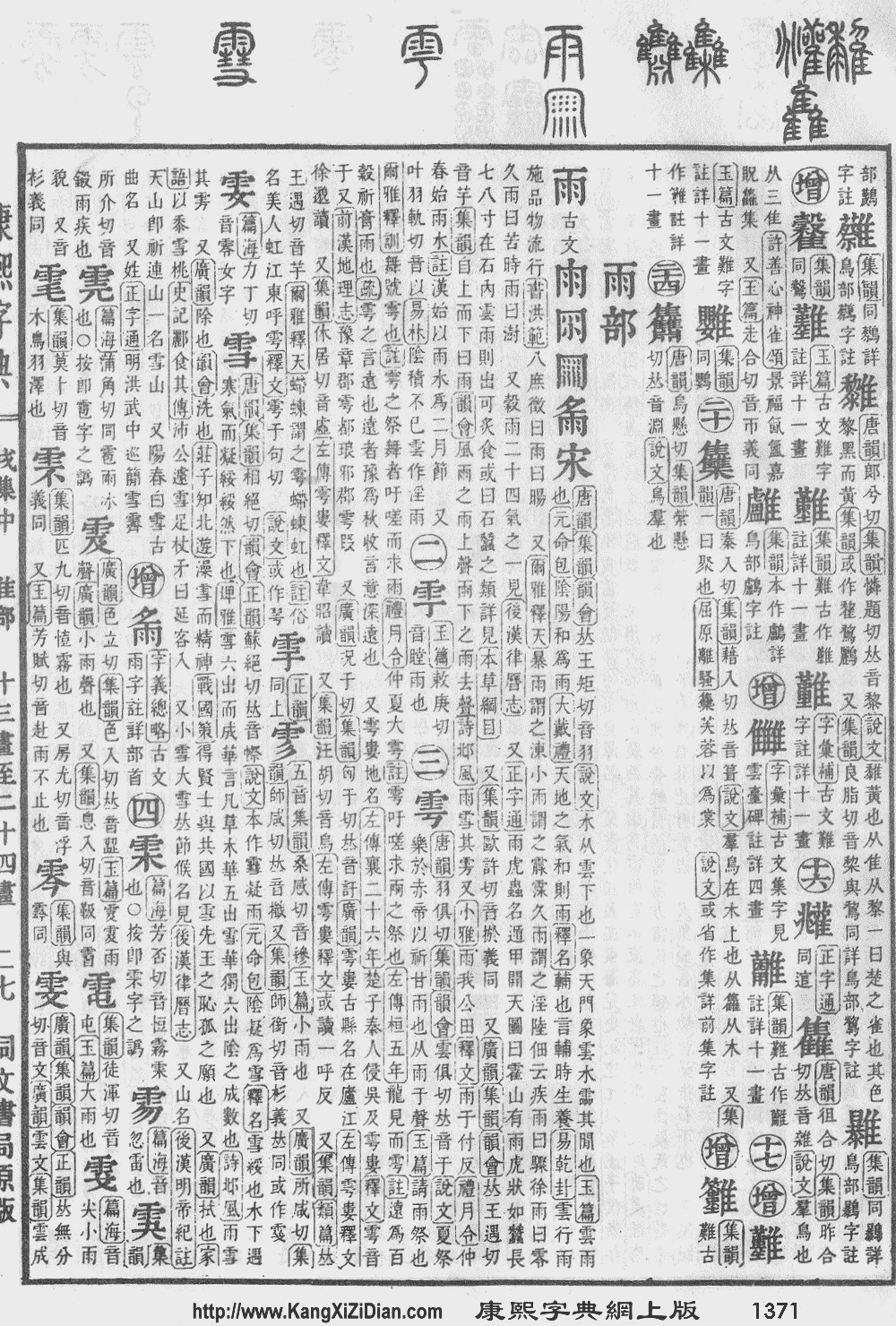
- KangXi: page 1371, character 29
- Dai Kanwa Jiten: character 42216
- Dae Jaweon: page 1878, character 7
- Hanyu Da Zidian (first edition): volume 6, page 4058, character 4
- Unihan data for U+96EA
Chinese
| trad. | 雪 | |
|---|---|---|
| simp. # | 雪 | |
| 2nd round simp. | 𫜹 | |
| alternative forms | 䨮 ancient ⿱⻗慧 | |
Glyph origin
| Historical forms of the character 雪 | ||
|---|---|---|
| Shang | Shuowen Jiezi (compiled in Han) | Liushutong (compiled in Ming) |
| Oracle bone script | Small seal script | Transcribed ancient scripts |
 |
 |
 |
Ancient simplification of 䨮, which is in turn phono-semantic compound (形聲, OC *sqʰʷed) : semantic 雨 + phonetic 彗 (OC *sɢʷeds, *ɢʷeds, *sɢʷids).
Etymology
Schuessler (2007) considers this to be related to Kra-Dai words: Proto-Tai *hnəiᴬ¹ (“snow”), Proto-Kam-Sui *ʔnuːi¹ (“snow”).
Starostin reconstructs Proto-Sino-Tibetan *suăt (“snow”), comparing this with Tibetan སད (sad, “frost, cold air, cold, coldness”), but this connection may be unlikely considering the phonetic part of this character.
Pronunciation
Definitions
雪
- snow
- 下雪 ― xiàxuě ― to snow
- † to snow
- to wipe away; to clean
- 朝食後,告辭天只前,則教「以好赴,大雪國辱。」 [Classical Chinese, trad.]
- From: 1594, 李舜臣 (Yi Sun-sin), 《亂中日記》 (War Diary of Admiral Yi)
- Zhāoshí hòu, gàocí tiānzhǐ qián, zé jiào “yǐ hǎo fù, dà xuě guórǔ.” [Pinyin]
- After the morning meal, I said my farewells to Mother. Then she instructed me: "Go well; fully cleanse [the country of this] national humiliation."
朝食后,告辞天只前,则教“以好赴,大雪国辱。” [Classical Chinese, simp.]
- (dialectal) ice; product containing ice
- (Cantonese) to refrigerate; to store in the refrigerator
- (Malaysia, Singapore) Short for 雪蘭莪/雪兰莪 (Xuělán'é, “Selangor”).
- a surname: Xue
Synonyms
- (snow):
| Variety | Location | Words |
|---|---|---|
| Classical Chinese | 雪 | |
| Formal (Written Standard Chinese) | 雪 | |
| Mandarin | Beijing | 雪 |
| Taiwan | 雪 | |
| Jinan | 雪 | |
| Xi'an | 雪 | |
| Wuhan | 雪 | |
| Chengdu | 雪 | |
| Guilin | 雪 | |
| Yangzhou | 雪 | |
| Hefei | 雪 | |
| Cantonese | Guangzhou | 雪 |
| Hong Kong | 雪 | |
| Yangjiang | 雪 | |
| Sanya (Yanglan Maihua) | 雪 | |
| Gan | Nanchang | 雪 |
| Hakka | Meixian | 雪 |
| Miaoli (N. Sixian) | 雪 | |
| Pingtung (Neipu; S. Sixian) | 雪 | |
| Hsinchu County (Zhudong; Hailu) | 雪 | |
| Taichung (Dongshi; Dabu) | 雪 | |
| Hsinchu County (Qionglin; Raoping) | 雪 | |
| Yunlin (Lunbei; Zhao'an) | 雪 | |
| Jin | Taiyuan | 雪 |
| Min Bei | Jian'ou | 雪 |
| Min Dong | Fuzhou | 雪 |
| Min Nan | Xiamen | 雪 |
| Guilin (Biyange) | 雪 | |
| Chaozhou | 雪 | |
| Shantou | 雪 | |
| Jieyang | 雪 | |
| Pontianak (Teochew) | 雪 | |
| Xiang | Changsha | 雪 |
| Shuangfeng | 雪 | |
- (to snow):
- (to wipe away): 洗刷 (xǐshuā)
- (ice):
Compounds
|
|
References
- Dictionary of Chinese Character Variants (教育部異體字字典), A04469
- “雪”, in 漢語多功能字庫 (Multi-function Chinese Character Database), 香港中文大學 (the Chinese University of Hong Kong), 2014–
Japanese
| Shinjitai | 雪 | |
| Kyūjitai [1] |
雪󠄁 雪+ 󠄁?(Adobe-Japan1) |
 |
| 雪󠄃 雪+ 󠄃?(Hanyo-Denshi) (Moji_Joho) | ||
| The displayed kanji may be different from the image due to your environment. See here for details. | ||
Readings
Compounds
- 雪冤 (setsuen)
- 雪花菜 (sekkasai)
- 雪渓 (sekkei)
- 雪月花 (setsugekka)
- 雪原 (setsugen, “snow field”)
- 雪辱 (setsujoku, “vindication, revenge”)
- 雪駄, 雪踏 (setta)
- 雪隠 (setchin)
- 雪洞 (settō)
- 雪洞 (setsudō)
- 雪膚 (seppu)
- 雪片 (seppen)
- 回雪 (kaisetsu)
- 蛍雪 (keisetsu)
- 降雪 (kōsetsu)
- 豪雪 (gōsetsu)
- 残雪 (zansetsu)
- 春雪 (shunsetsu)
- 除雪 (josetsu)
- 小雪 (shōsetsu)
- 新雪 (shinsetsu)
- 積雪 (sekisetsu)
- 早雪 (sōsetsu)
- 霜雪 (sōsetsu)
- 大雪 (taisetsu)
- 眉雪 (bisetsu)
- 氷雪 (hyōsetsu)
- 風雪 (fūsetsu)
- 雪花菜 (okara), 雪花菜 (kirazu)
- 雪崩 (nadare, “avalanche”)
- 雪洞 (bonbori, “paper lamp”)
- 吹雪 (fubuki)
Etymology
| Kanji in this term |
|---|
| 雪 |
| ゆき Grade: 2 |
| kun’yomi |
| For pronunciation and definitions of 雪 – see the following entry. | ||
| ||
| (This term, 雪, is an alternative spelling of the above term.) |
Korean
Etymology
From Middle Chinese 雪 (MC siuᴇt̚).
| Historical Readings | ||
|---|---|---|
| Dongguk Jeongun Reading | ||
| Dongguk Jeongun, 1448 | ᄉᆑᇙ〮 (Yale: syyélq) | |
| Middle Korean | ||
| Text | Eumhun | |
| Gloss (hun) | Reading | |
| Hunmong Jahoe, 1527 | 눈〯 (Yale: nwǔn) | 셜〮 (Yale: syél) |
Pronunciation
- (SK Standard/Seoul) IPA(key): [sʰʌ̹ɭ]
- Phonetic hangul: [설]
Compounds
Okinawan
Pronunciation
- IPA(key): [jut͡ɕi]
References
- “ゆち【雪】” in JLect - Japonic Languages and Dialects Database Dictionary, 2019.
Old Japanese
Etymology 1
Found in the Man'yōshū, completed some time after 759 CE.
Reconstructed by some as deriving from Proto-Japonic *yoki.
Noun
雪 (yuki1) (kana ゆき)
Derived terms
- 雪解, 雪消 (yuki1ge2)
- 雪じもの (yuki1zimono2)
- 泡雪, 沫雪 (awayuki1)
- 大雪 (opoyuki1)
- 霜雪 (simoyuki1)
- 白雪 (sirayuki1)
- 降る雪の (puru yuki1 no2, pillow word)
- 御雪 (mi1-yuki1)
Descendants
- Japanese: 雪 (yuki)
See also
- 白妙の, 白栲の (siro1tape2 no2, pillow word that can allude to yuki1)
Etymology 2
Found once in the Man'yōshū in a so-called 東歌 (Azuma uta, literally “eastern song”) in the eastern dialect of Old Japanese.
Probably a misspelling of original ⟨yo1ki1⟩, given the Western and modern reflexes. Compare 夜 (yo1 → yu, “night”).
Vietnamese
References
- Nguyễn (2014).
- Trần (2004).
- Trần (1999).
- Vũ (1998).
- Nguyễn (1974).
- Thiều Chửu (1942).