歲
| ||||||||
| ||||||||
Translingual
| Traditional | 歲 |
|---|---|
| Shinjitai | 歳 |
| Simplified | 岁 |
Han character
歲 (Kangxi radical 77, 止+9, 13 strokes, cangjie input 卜一戈竹竹 (YMIHH), four-corner 21253, composition ⿱止⿵戌𣥂)
References
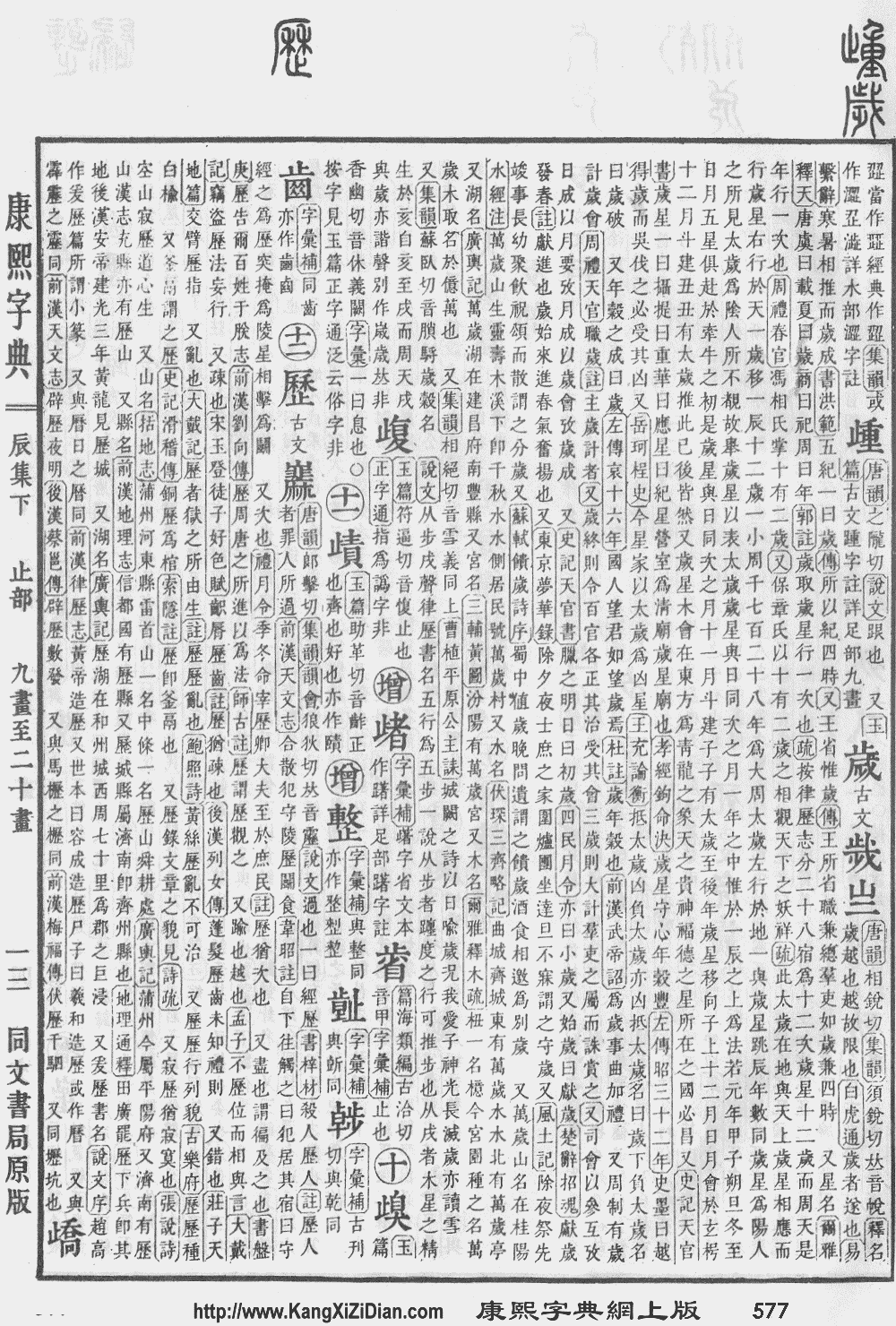
- KangXi: page 577, character 2
- Dai Kanwa Jiten: character 16326
- Dae Jaweon: page 967, character 17
- Hanyu Da Zidian (first edition): volume 2, page 1443, character 20
- Unihan data for U+6B72
- Unihan data for U+2F8F3
Chinese
| trad. | 歲 | |
|---|---|---|
| simp. | 岁 | |
| alternative forms | ||
Glyph origin
| Historical forms of the character 歲 | ||||||
|---|---|---|---|---|---|---|
| Shang | Western Zhou | Spring and Autumn | Warring States | Shuowen Jiezi (compiled in Han) | Liushutong (compiled in Ming) | |
| Oracle bone script | Bronze inscriptions | Bronze inscriptions | Chu slip and silk script | Qin slip script | Small seal script | Transcribed ancient scripts |
 |
 |
 |
 |
 |
 |
 |

Phono-semantic compound (形聲, OC *sqʰʷads, *sqʰʷad) : semantic 步 + phonetic 戉 (OC *ɢʷad). In addition to 戉, various components such as 月 (“moon; month”) used to be present, sometimes as simple as two dots. The current form derives from the Qin-style handwriting of the late Warring States (with a full-width 止 on the top and a bottom-left 撇 stroke extending outward as in 戊 or 戌 instead of bending inward as in 戉), which was also inherited by the clerical script.
Etymology
A derivative of 越 (OC *ɢʷad, “to pass over”) (Mei, 1979, 1992). Ultimately probably from Proto-Sino-Tibetan *grwat (“to travel; to go through”); compare Tibetan སྐྱོད (skyod, “to go”) (Mei, 1979, 1992; Gong Hwang-cherng, 2002; STEDT).
The functions of the *s- prefix and the *-s suffix are not clear. Possible explanations include:
- *s- as a directive prefix and *-s as a nominalizer (Mei, 1992);
- *s- is an iterative prefix, literally "to pass on again" (Schuessler, 2007);
- *s- (possibly with *-s) as a nominalizer (Smith, 2012).
Alternatively, it may be derived from a word like 圓 (OC *ɢon, “round; circle”) (< Proto-Sino-Tibetan *wal (“round; circular”)), literally "to start the circle/cycle again" (Schuessler, 2007).
Outside of Sino-Tibetan, this word has been compared to Thai ขวบ (kùuap, “year”), which Bodman (1980) considers to be a loan from Chinese, as well as Proto-Austronesian *kawaS (“year; season; sky”) (Sagart, 2005).
Also see Schuessler (2007) and Smith (2012) for a discussion on the semantic development of this word, especially the connection between "Jupiter" and "year".
Pronunciation
Definitions
歲
- (literary) Jupiter (planet)
- 昔武王伐殷,歲在鶉火,……歲之所在,則我有周之分野也,…… [Classical Chinese, trad.]
- From: Guoyu, circa 4th century BCE
- Xī Wǔwáng fá Yīn, Suì zài Chúnhuǒ,...... Suì zhī suǒzài, zé wǒ Yǒuzhōu zhī fēnyě yě,...... [Pinyin]
- Formerly when King Wu attacked Yin, the Year Star / Jupiter was in Quail Fire, [...] The Year Star / Jupiter was in the [heavenly] region allotted to us, the Youzhou, [...]
昔武王伐殷,岁在鹑火,……岁之所在,则我有周之分野也,…… [Classical Chinese, simp.]
- year
- 子曰:「歲寒,然後知松柏之後彫也。」 [Classical Chinese, trad.]
- From: The Analects of Confucius, c. 475 – 221 BCE, translated based on James Legge's version
- Zǐ yuē: “Suì hán, rán hòu zhī sōngbǎi zhī hòu diāo yě.” [Pinyin]
- The Master said, "When the year becomes cold, then we know how the pine and the cypress are the last to lose their leaves."
子曰:“岁寒,然后知松柏之后凋也。” [Classical Chinese, simp.]
- Tai Sui, the god representing each of these years
- (literary) age
- (literary) time; period
- (literary) crop harvests of the year
- Classifier for time: year
- Classifier for age (of a person or animal): year old
Usage notes
Ages in 歲/岁 (suì) are traditionally reckoned using the Chinese lunar calendar, considered as 1 year old at the moment of birth and increasing not during birthdays, but at the Chinese New Year.
Compounds
|
|
|
Descendants
References
- “歲”, in 漢語多功能字庫 (Multi-function Chinese Character Database), 香港中文大學 (the Chinese University of Hong Kong), 2014–
- “Entry #9664”, in 臺灣閩南語常用詞辭典 [Dictionary of Frequently-Used Taiwan Minnan] (in Chinese and Min Nan), Ministry of Education, R.O.C., 2011.
Japanese
Kanji
Usage notes
This character lacks JIS support and is not used in Japan. The character 歳 (U+6B73) is used instead.
Korean
Etymology
From Middle Chinese 歲 (MC siuᴇiH). Recorded as Middle Korean 셰 (syey) (Yale: syey) in Hunmong Jahoe (訓蒙字會 / 훈몽자회), 1527.