您
| ||||||||
Translingual
| Stroke order | |||
|---|---|---|---|
 | |||
Han character
您 (Kangxi radical 61, 心+7, 11 strokes, cangjie input 人火心 (OFP), four-corner 27339, composition ⿱你心)
References
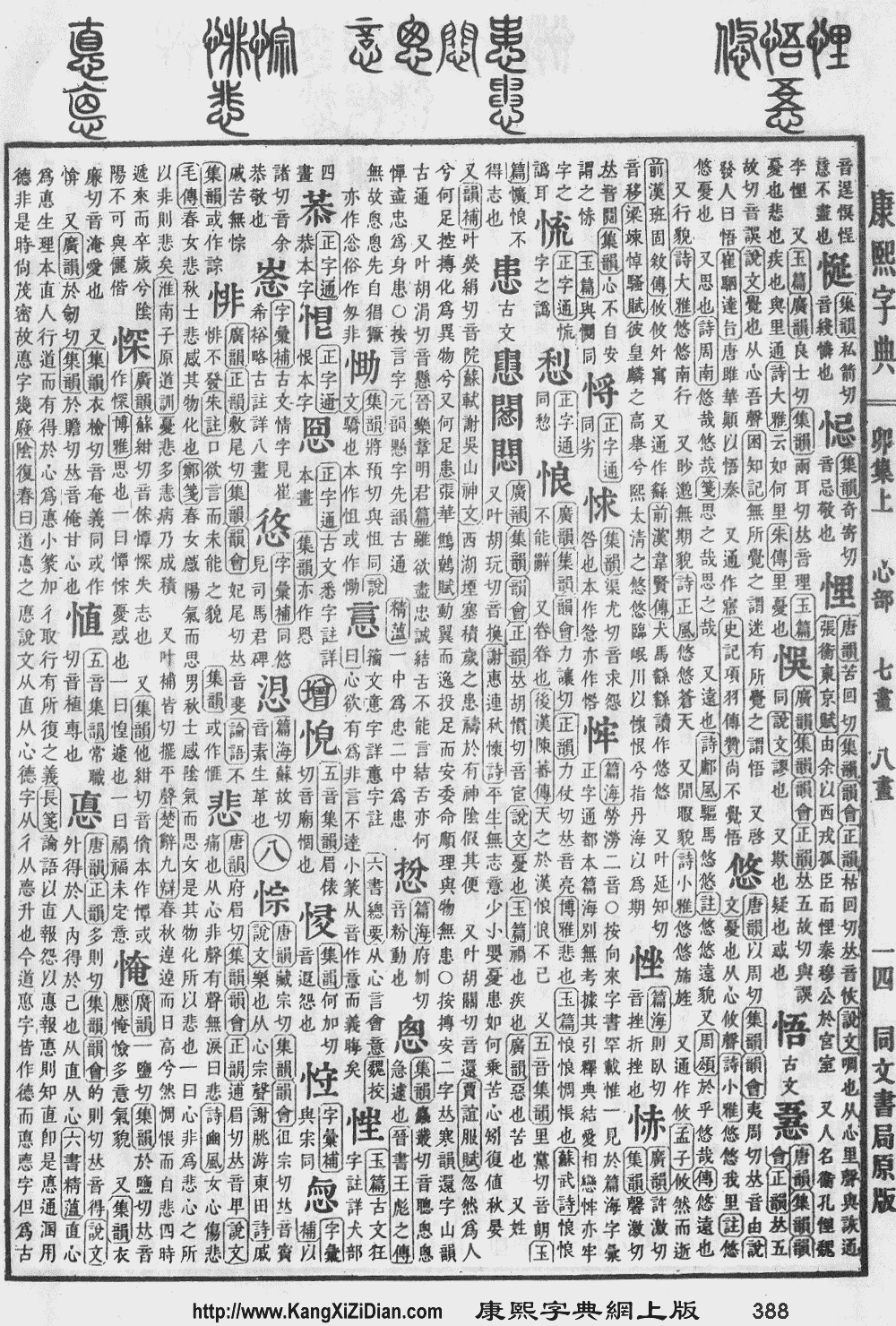
- KangXi: not present, would follow page 388, character 34
- Dai Kanwa Jiten: character 10712
- Dae Jaweon: page 721, character 23
- Hanyu Da Zidian (first edition): volume 4, page 2301, character 2
- Unihan data for U+60A8
Chinese
| trad. | 您 | |
|---|---|---|
| simp. # | 您 | |
| alternative forms | 恁 儜/佇 honorific | |
Glyph origin
Ideogrammic compound (會意) : 你 (“you”) + 心 (“heart”). 心 (MC siɪm) may also phonetically signify the original -m ending (Yuan et al., 1996).
Etymology
This character was not listed in Sui/Tang rhyme books. First attested in Jin/Yuan-era literature, when it was also written as 恁 and probably pronounced as *nim at the time (Lü, 1940; Norman, 1988). The pronoun was used both in the singular and the plural.
The pronoun used in Jin/Yuan-era literature is generally thought to be a fusion of 你們/你们 (nǐmen, “you (plural)”) or 你每 (nǐměi, “you (plural)”) (Lü, 1940; Norman, 1988). Compare 怹 (tān, “he, she (polite)”) ( < 他們/他们 (tāmen, “they”)).
The honorific usage may simply be a development of the plural usage (Norman, 1988); compare English you, French vous. However, others have argued for a different etymology for the honorific pronoun. Wang (1984) and Lü (1985) argue that it is a contraction of 你老 (“you (honorific for seniors)”): /ni lau/ → /nil/ → /nin/. Alternatively, Zhang (2001) suggests that it comes from 仁 (MC ȵiɪn), an honorific used in Buddhist texts from the Han dynasty.
In Cantonese and Hakka, this character is simply read as 你; in Teochew, it is read as 汝.
Pronunciation
Definitions
您
Usage notes
Synonyms
Compounds
|
|
|
See also
| Standard Mandarin Chinese personal pronouns | |||
|---|---|---|---|
| Person | Singular | Plural | |
| 1st | — | 我 (wǒ) | 我們/我们 (wǒmen) |
| inclusive | 咱們/咱们 (zánmen) | ||
| 2nd | male/indefinite | 你 (nǐ) | 你們/你们 (nǐmen) |
| female | 妳/你 (nǐ) | 妳們/你们 (nǐmen) | |
| deity | 祢 (nǐ) | 祢們/祢们 (nǐmen) | |
| polite | 您 (nín) | 你們/你们 (nǐmen) 您們/您们 (nínmen) | |
| 3rd | male/indefinite | 他 (tā) | 他們/他们 (tāmen) |
| female | 她 (tā) | 她們/她们 (tāmen) | |
| deity | 祂 (tā) | 祂們/祂们 (tāmen) | |
| animal | 牠/它 (tā) | 牠們/它们 (tāmen) | |
| inanimate | 它 (tā) | 它們/它们 (tāmen) | |
Japanese
Vietnamese
Han character
您: Hán Nôm readings: nâm
- This term needs a translation to English. Please help out and add a translation, then remove the text
{{rfdef}}.