曾
| ||||||||
Translingual
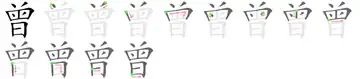
| Stroke order | |||
|---|---|---|---|
 | |||
| Traditional | 曾 |
|---|---|
| Simplified | 曾 |
| Japanese | 曽 |
| Korean | 曾 |
Alternative forms
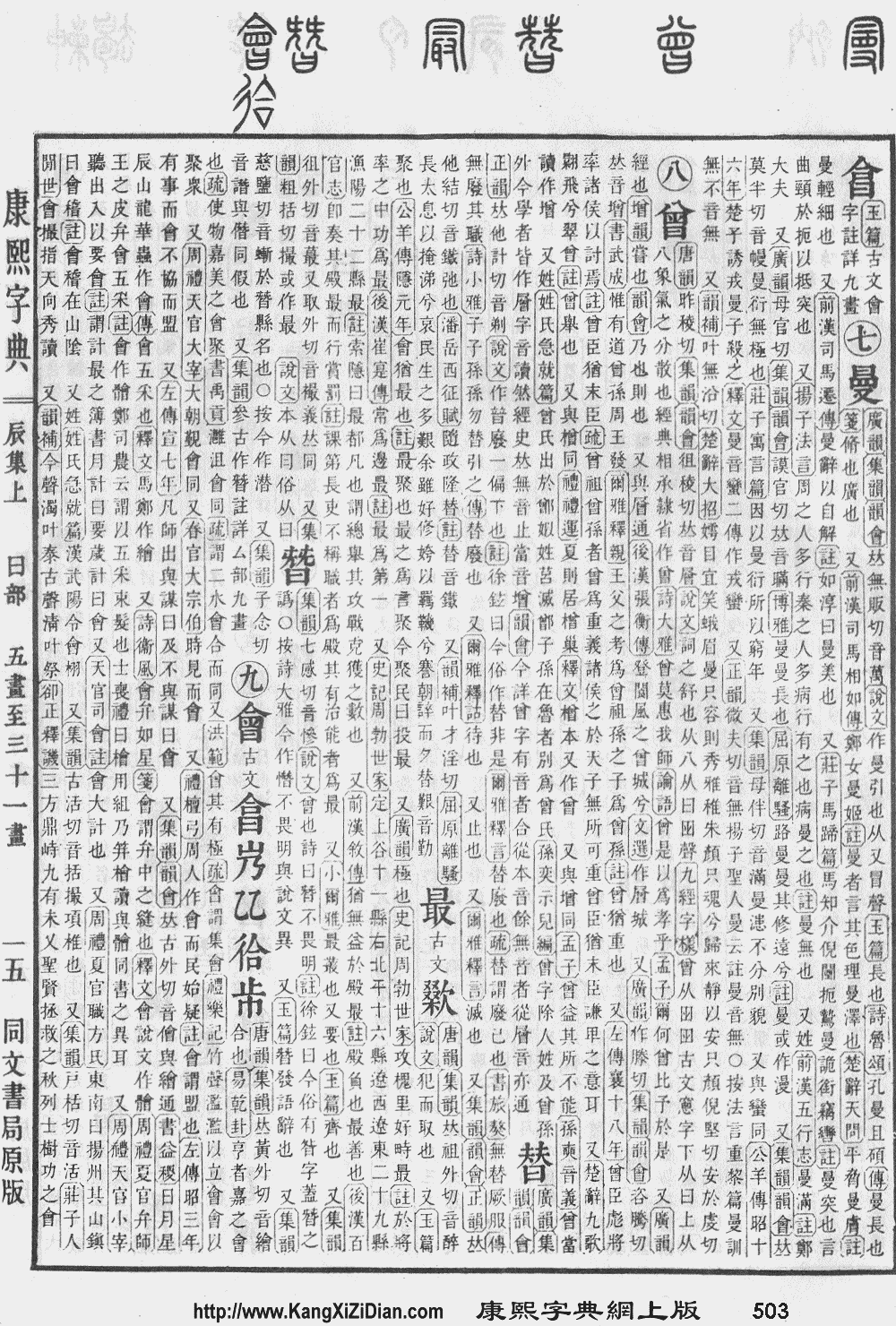
When used in Korea or as a Japanese kyūjitai character, the upper component is 八 instead of 丷, which is also the historical form found in the Kangxi dictionary.
Han character
曾 (Kangxi radical 73, 曰+8, 12 strokes, cangjie input 金田日 (CWA), four-corner 80606, composition ⿱丷𭥴(GHT) or ⿱八𭥴(JKV))
References
- KangXi: page 503, character 3
- Dai Kanwa Jiten: character 14299
- Dae Jaweon: page 877, character 2
- Hanyu Da Zidian (first edition): volume 2, page 1521, character 3
- Unihan data for U+66FE
Chinese
| simp. and trad. |
曾 | |
|---|---|---|
| alternative forms | 曽 | |
Glyph origin
| Historical forms of the character 曾 | |||
|---|---|---|---|
| Shang | Western Zhou | Shuowen Jiezi (compiled in Han) | Liushutong (compiled in Ming) |
| Oracle bone script | Bronze inscriptions | Small seal script | Transcribed ancient scripts |
 |
 |
 |
 |
Characters in the same phonetic series (曾) (Zhengzhang, 2003)
Pictogram (象形) – a cooker for steaming food. The derivative 甑 (OC *ʔsɯŋs) refers to the original word.
Pronunciation 1
Synonyms
- (already):
Synonyms of 曾
Compounds
Pronunciation 2
Definitions
曾
- (prefix) great-
- (literary) unexpectedly
- 誰謂河廣?曾不容刀。
- From: The Classic of Poetry, c. 11th – 7th centuries BCE, translated based on James Legge's version
- Shéi wèi Hé guǎng? Zēng bù róng dāo.
Shéi wèi Sòng yuǎn? Zēng bù chóngzhāo. [Pinyin] - Who says that the He is wide?
It will not admit a little boat.
Who says that Song is distant?
It would not take a whole morning to reach it.
誰謂宋遠?曾不崇朝。 [Pre-Classical Chinese, trad.]
谁谓河广?曾不容刀。
谁谓宋远?曾不崇朝。 [Pre-Classical Chinese, simp.]
- (literary) Alternative form of 增 (zēng, “to increase”).
- a surname: Zeng
Compounds
References
- “曾”, in 漢語多功能字庫 (Multi-function Chinese Character Database), 香港中文大學 (the Chinese University of Hong Kong), 2014–
Japanese
| 曽 | |
| 曾 |
Korean
Hanja
曾 • (jeung) (hangeul 증, revised jeung, McCune–Reischauer chŭng, Yale cung)
- This term needs a translation to English. Please help out and add a translation, then remove the text
{{rfdef}}.
Vietnamese
Han character
曾: Hán Việt readings: tằng[1][2][3][4], tăng[1][5][4][6][3][7]
曾: Nôm readings: tâng[1][6], tơn[6], tưng[1][6], từng[5][6][7]
References
- Génibrel (1898).
- Thiều Chửu (1942).
- Trần (1999).
- Nguyễn (1974).
- Bonet (1899).
- Hồ (1976).
- Nguyễn et al. (2009).
This article is issued from Wiktionary. The text is licensed under Creative Commons - Attribution - Sharealike. Additional terms may apply for the media files.