仁
| ||||||||
Translingual
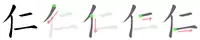
| Stroke order | |||
|---|---|---|---|
 | |||
Han character
仁 (Kangxi radical 9, 人+2, 4 strokes, cangjie input 人一一 (OMM), four-corner 21210, composition ⿰亻二)
Descendants
- に (Hiragana character derived from Man'yōgana)
- ニ (Katakana character derived from Man'yōgana)
References
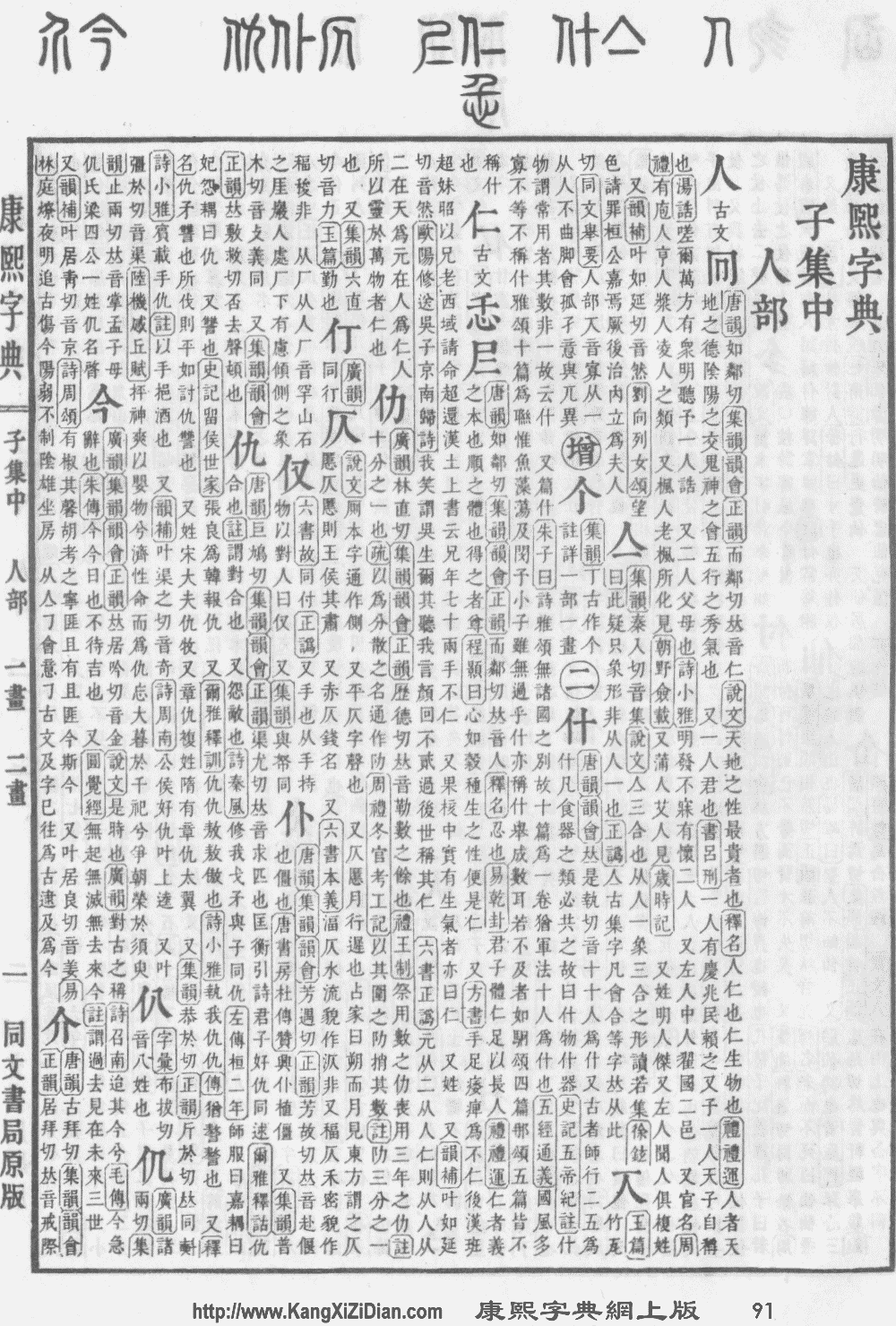
- KangXi: page 91, character 7
- Dai Kanwa Jiten: character 349
- Dae Jaweon: page 193, character 1
- Hanyu Da Zidian (first edition): volume 1, page 107, character 1
- Unihan data for U+4EC1
Chinese
| simp. and trad. |
仁 | |
|---|---|---|
| alternative forms | 𡰥 忎 忈 | |
Glyph origin
| Historical forms of the character 仁 | ||||||||||||||||||||
|---|---|---|---|---|---|---|---|---|---|---|---|---|---|---|---|---|---|---|---|---|
| Warring States | Shuowen Jiezi (compiled in Han) | Liushutong (compiled in Ming) | ||||||||||||||||||
| Bronze inscriptions | Chu slip and silk script | Qin slip script | Ancient script | Small seal script | Transcribed ancient scripts | |||||||||||||||
 |
 |
 |
 |
 |
 | |||||||||||||||
|||||
|
References: Mostly from Richard Sears' Chinese Etymology site (authorisation),
| ||||||||||||||||||||


Phono-semantic compound (形聲, OC *njin) : phonetic 人 (OC *njin) + semantic 二.
Etymology
From Proto-Sino-Tibetan *s/k-niŋ (“heart; brain; mind”) (Schuessler, 2007; STEDT). Cognate with Tangkhul Naga ning (“mind”), Manipuri ꯄꯨꯛꯅꯤꯡ (pukning, “heart; mind”), Kinnauri [script needed] (stiŋ, “heart”), Garo taning (“brain”), Ngochang Achang nhaiqlom (“heart”), Bisu นืงบา (nɨŋba, “heart”). Possibly related to Tibetan ཉིང (nying, “pith, essence”) (Schuessler, 2007).
For a parallel semantic development, compare Tibetan སྙིང་རྗེ (snying rje, “compassion; kindness; mercy”), from Tibetan སྙིང (snying, “heart; mind”).
Pronunciation
Definitions
仁
- compassionate; humane
- 仁慈 ― réncí ― benevolent
- 子曰:「唯仁者能好人,能惡人。」 [Classical Chinese, trad.]
- From: The Analects of Confucius, c. 475 – 221 BCE, translated based on James Legge's version
- Zǐyuē: “Wéi rénzhě néng hào rén, néng wù rén.” [Pinyin]
- The Master said, "It is only the (truly) virtuous man, who can love, or who can hate, others."
子曰:“唯仁者能好人,能恶人。” [Classical Chinese, simp.]- 無傷也,是乃仁術也,見牛未見羊也。 [Classical Chinese, trad.]
- From: Mencius, c. 4th century BCE
- Wúshāng yě, shì nǎi rénshù yě, jiàn niú wèi jiàn yáng yě. [Pinyin]
- 'There is no harm in their saying so,' said Mencius. 'Your conduct was an artifice of benevolence. You saw the ox, and had not seen the sheep.
无伤也,是乃仁术也,见牛未见羊也。 [Classical Chinese, simp.]
- humaneness; benevolence; kindness
- (literary) person of virtue
- 弟子入則孝,出則弟,謹而信,汎愛眾,而親仁。 [Classical Chinese, trad.]
- From: The Analects of Confucius, c. 475 – 221 BCE, translated based on James Legge's version
- Dìzǐ rù zé xiào, chū zé tì, jǐn ér xìn, fàn ài zhòng, ér qīn rén. [Pinyin]
- A youth, when at home, should be filial, and, abroad, respectful to his elders. He should be earnest and truthful. He should overflow in love to all, and cultivate the friendship of the good.
弟子入则孝,出则弟,谨而信,泛爱众,而亲仁。 [Classical Chinese, simp.]
- kernel
Compounds
|
|
|
References
- “仁”, in 漢語多功能字庫 (Multi-function Chinese Character Database), 香港中文大學 (the Chinese University of Hong Kong), 2014–
Japanese
Readings
Compounds
Korean
Etymology
From Middle Chinese 仁 (MC ȵiɪn).
| Historical Readings | ||
|---|---|---|
| Dongguk Jeongun Reading | ||
| Dongguk Jeongun, 1448 | ᅀᅵᆫ (Yale: zìn) | |
| Middle Korean | ||
| Text | Eumhun | |
| Gloss (hun) | Reading | |
| Hunmong Jahoe, 1527 | 클〮 (Yale: khúl) | ᅀᅵᆫ (Yale: zìn) |
Pronunciation
- (SK Standard/Seoul) IPA(key): [in]
- Phonetic hangul: [인]