扇
| ||||||||
Translingual
Han character
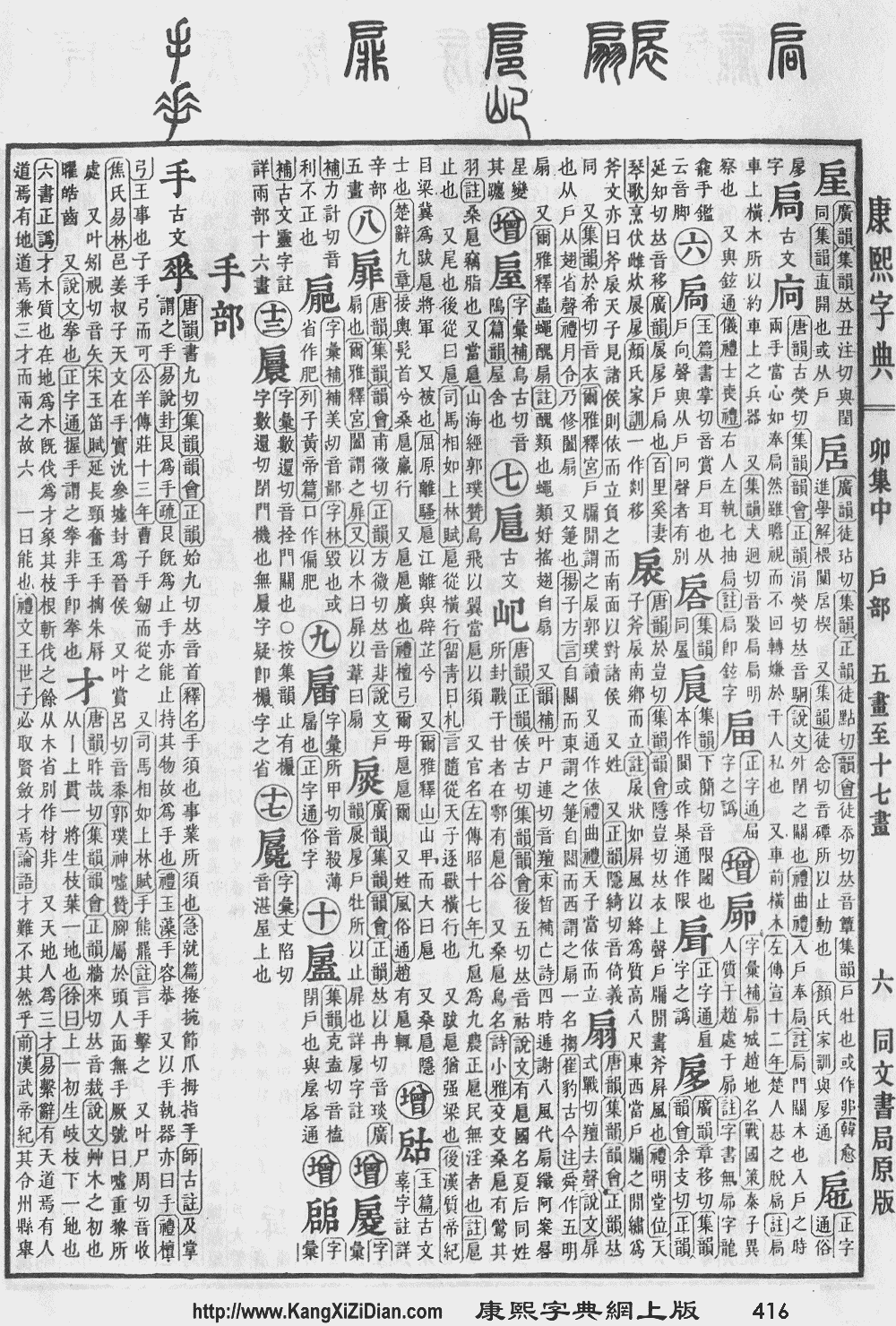
扇 (Kangxi radical 63, 戶+6, 10 strokes, cangjie input 竹尸尸一一 (HSSMM) or 戈尸尸一一 (ISSMM), four-corner 30227, composition ⿸戶羽 or ⿸户羽 or ⿸戸羽)
References
- KangXi: page 416, character 14
- Dai Kanwa Jiten: character 11743
- Dae Jaweon: page 761, character 16
- Hanyu Da Zidian (first edition): volume 3, page 2263, character 6
- Unihan data for U+6247
Chinese
| trad. | 扇 | |
|---|---|---|
| simp. # | 扇 | |
| alternative forms | 搧 煽 | |
Pronunciation 1
Synonyms
Dialectal synonyms of 扇子 (“fan”) [map]
Dialectal synonyms of 扇 (“(classifier for doors)”) [map]
| Variety | Location | Words |
|---|---|---|
| Formal (Written Standard Chinese) | 扇, 道 | |
| Mandarin | Beijing | 扇兒 |
| Taiwan | 扇 | |
| Yantai (Muping) | 扇, 道 | |
| Jinan | 扇 | |
| Luoyang | 扇 | |
| Xi'an | 扇兒, 扇, 道 | |
| Yinchuan | 扇 | |
| Xining | 扇, 道 | |
| Ürümqi | 道 | |
| Wuhan | 扇, 道 | |
| Chengdu | 扇, 道 | |
| Guiyang | 扇 | |
| Guilin | 扇 | |
| Liuzhou | 扇, 道 | |
| Xuzhou | 扇兒, 扇, 道 | |
| Yangzhou | 扇 | |
| Nanjing | 扇 | |
| Hefei | 扇 | |
| Singapore | 扇 | |
| Cantonese | Guangzhou | 度 |
| Hong Kong | 度 | |
| Hong Kong (San Tin Weitou) | 隻 | |
| Hong Kong (Ting Kok) | 度 | |
| Hong Kong (Tung Ping Chau) | 隻 | |
| Taishan | 度 | |
| Dongguan | 度 | |
| Yangjiang | 扇 | |
| Kuala Lumpur (Guangfu) | 扇 | |
| Gan | Nanchang | 扇 |
| Pingxiang | 扇 | |
| Hakka | Meixian | 扇, 皮 |
| Yudu | 扇 | |
| Hong Kong | 隻 | |
| Senai (Huiyang) | 扇 | |
| Jin | Taiyuan | 扇, 道 |
| Xinzhou | 扇 | |
| Min Bei | Jian'ou | 扇 |
| Min Dong | Fuzhou | 扇 |
| Min Nan | Xiamen | 扇 |
| Quanzhou | 扇 | |
| Zhangzhou | 扇 | |
| Taipei (Wanhua) | 扇 | |
| Kaohsiung | 片 | |
| Yilan | 扇 | |
| Changhua (Lukang) | 扇 | |
| Taichung | 片 | |
| Taichung (Wuqi) | 扇 | |
| Tainan | 片, 扇 | |
| Taitung | 片 | |
| Hsinchu | 片 | |
| Penghu (Magong) | 扇 | |
| Chaozhou | 片 | |
| Jieyang | 片 | |
| Bangkok (Teochew) | 片 | |
| Johor Bahru (Teochew) | 扇 | |
| Singapore (Teochew) | 片 | |
| Haikou | 片 | |
| Southern Pinghua | Nanning (Tingzi) | 扇 |
| Wu | Shanghai | 扇 |
| Suzhou | 扇 | |
| Ningbo | 扇 | |
| Wenzhou | 爿 | |
| Xiang | Changsha | 扇, 張, 隻 |
| Shuangfeng | 扇 | |
Compounds
Derived terms from 扇
|
Pronunciation 2
Definitions
扇
Compounds
Etymology 2
| For pronunciation and definitions of 扇 – see 煽 (“to fan; to invigorate fire; to incite; to instigate; to provoke”). (This character, 扇, is the second-round simplified form of 煽.) |
Notes:
|
Etymology 3
| For pronunciation and definitions of 扇 – see 搧 (“to fan; to slap”). (This character, 扇, is the second-round simplified form of 搧.) |
Notes:
|
Japanese
| Shinjitai | 扇 | |
| Kyūjitai [1][2] |
扇󠄁 扇+ 󠄁?(Adobe-Japan1) |
 |
| 扇󠄃 扇+ 󠄃?(Hanyo-Denshi) (Moji_Joho) | ||
| The displayed kanji may be different from the image due to your environment. See here for details. | ||
Readings
From Middle Chinese 扇 (MC ɕiᴇnH); compare Mandarin 扇 (shàn):
From Middle Chinese 扇 (MC ɕiᴇn); compare Mandarin 扇 (shān):
From native Japanese roots:
Etymology
| Kanji in this term |
|---|
| 扇 |
| おうぎ Grade: S |
| kun’yomi |
/afuɡi/ → */awuɡi/ → /auɡi/ → /ɔːɡi/ → /oːɡi/
Originally the continuative or noun stem form of verb 扇ぐ (aogu, “to fan, to wave something to create a breeze”).[3][4][5] The change in vowels represents a regular historical sound shift.
First cited to the late 900s.[3]
Related terms
- 扇ぐ (aogu, “to fan”)
References
- “扇”, in 漢字ぺディア (Kanjipedia) (in Japanese), 日本漢字能力検定協会, 2015—2023
- 1914, 漢和大辭書 (Kanwa Dai Jisho, “The Great Kanji-Japanese Dictionary”) (in Japanese), page 922 (paper), page 511 (digital), Tōkyō: 興文社 (Kōbunsha)
- “扇”, in 日本国語大辞典 (Nihon Kokugo Daijiten, “Nihon Kokugo Daijiten”) (in Japanese), 2nd edition, Tōkyō: Shogakukan, 2000, →ISBN
- “扇”, in デジタル大辞泉 (Dejitaru Daijisen) (in Japanese), Tōkyō: Shogakukan, updated roughly every four months
- 2006, 大辞林 (Daijirin), Third Edition (in Japanese), Tōkyō: Sanseidō, →ISBN
Korean
Vietnamese
This article is issued from Wiktionary. The text is licensed under Creative Commons - Attribution - Sharealike. Additional terms may apply for the media files.