隻
| ||||||||
Translingual
Han character
隻 (Kangxi radical 172, 隹+2, 10 strokes, cangjie input 人土水 (OGE) or X人土水 (XOGE), four-corner 20407, composition ⿱隹又)
Derived characters
References
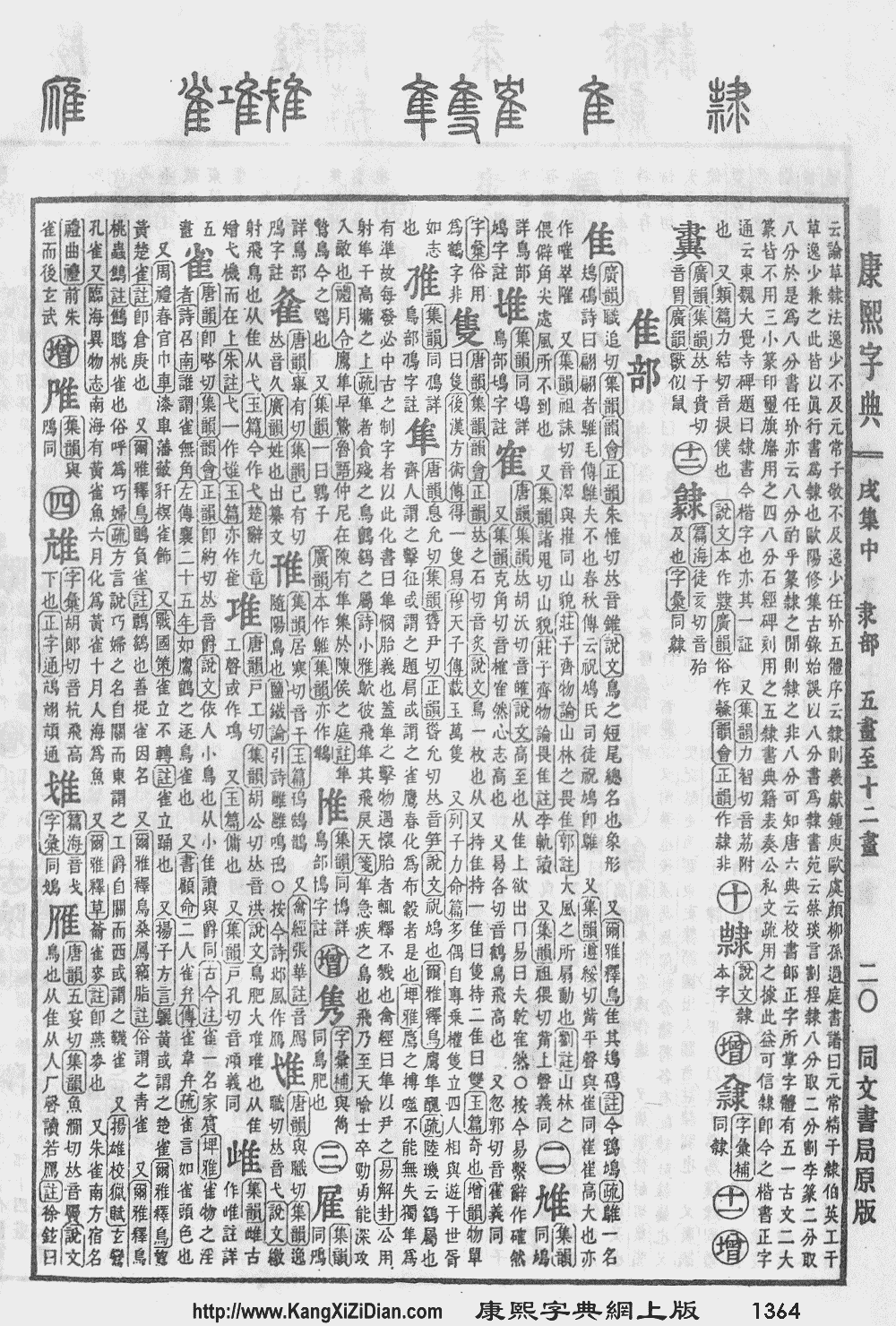
- KangXi: page 1364, character 9
- Dai Kanwa Jiten: character 41941
- Dae Jaweon: page 1867, character 26
- Hanyu Da Zidian (first edition): volume 6, page 4090, character 10
- Unihan data for U+96BB
Chinese
| trad. | 隻/只* | |
|---|---|---|
| simp. | 只* | |
Glyph origin
Ideogrammic compound (會意) : 隹 (“bird”) + 又 (“hand”).
To hold one bird is 隻; to hold two birds is 雙.
Etymology 1
From Proto-Sino-Tibetan *tjak ~ g-t(j)ik (“one”).
Pronunciation
Definitions
隻
- † one bird
- single
- † (mathematics) odd
- † alone
- † unique
- Classifier for one of a pair. ⇒ all nouns using this classifier
- Classifier for certain animals.
- Classifier for body parts.
- Classifier for boats and certain vessels.
- (dialectal or humorous) Classifier for people. ⇒ all nouns using this classifier
- (Cantonese) Classifier for kinds or varieties.
- This term needs a translation to English. Please help out and add a translation, then remove the text
{{rfdef}}.
Synonyms
Dialectal synonyms of 隻 (“(classifier for chickens)”) [map]
Dialectal synonyms of 頭 (“(classifier for cows)”) [map]
Dialectal synonyms of 口 (“(classifier for pigs)”) [map]
Dialectal synonyms of 條 (“(classifier for fish)”) [map]
Dialectal synonyms of 條 (“(classifier for dogs)”) [map]
| Variety | Location | Words |
|---|---|---|
| Formal (Written Standard Chinese) | 條, 隻 | |
| Mandarin | Taiwan | 隻, 條 |
| Guilin | 條 | |
| Malaysia | 隻 | |
| Singapore | 隻 | |
| Cantonese | Guangzhou | 隻 |
| Hong Kong | 隻 | |
| Singapore (Guangfu) | 隻 | |
| Hakka | Meixian | 條, 隻 |
| Dongguan (Qingxi) | 隻 | |
| Heyuan (Bendihua) | 條 | |
| Wengyuan | 條 | |
| Liannan | 條 | |
| Jiexi | 條 | |
| Zhao'an (Xiuzhuan) | 隻 | |
| Changting | 隻 | |
| Wuping (Yanqian) | 隻 | |
| Ninghua | 條 | |
| Ningdu | 隻 | |
| Tonggu (Sandu) | 隻 | |
| Ganzhou (Panlong) | 隻 | |
| Dayu | 隻 | |
| Hong Kong | 條 | |
| Mengshan (Xihe) | 條 | |
| Luchuan | 條 | |
| Min Nan | Xiamen | 隻 |
| Quanzhou | 隻 | |
| Jinjiang | 隻 | |
| Penang (Hokkien) | 隻 | |
| Singapore (Hokkien) | 隻 | |
| Manila (Hokkien) | 隻 | |
| Chaozhou | 隻 | |
| Shantou | 隻 | |
| Jieyang | 隻 | |
| Singapore (Teochew) | 隻 | |
| Pontianak (Teochew) | 條 | |
Dialectal synonyms of 個 (“generic classifier for people”) [map]
Dialectal synonyms of 輛 (“(classifier for vehicles)”) [map]
Dialectal synonyms of 艘 (“(classifier for boats/ships)”) [map]
| Variety | Location | Words |
|---|---|---|
| Formal (Written Standard Chinese) | 艘, 隻, 條 | |
| Mandarin | Beijing | 條, 隻 |
| Taiwan | 條, 隻 | |
| Jinan | 條, 隻 | |
| Xi'an | 個, 隻 | |
| Wuhan | 隻, 條 | |
| Chengdu | 隻, 條 | |
| Guilin | 條 | |
| Yangzhou | 條 | |
| Hefei | 隻 | |
| Cantonese | Guangzhou | 隻 |
| Hong Kong | 隻, 架, 部 | |
| Yangjiang | 隻 | |
| Gan | Nanchang | 隻 |
| Hakka | Meixian | 條 |
| Dongguan (Qingxi) | 條 | |
| Heyuan (Bendihua) | 條 | |
| Wengyuan | 條, 隻 | |
| Liannan | 條 | |
| Jiexi | 條 | |
| Zhao'an (Xiuzhuan) | 條 | |
| Changting | 隻 | |
| Wuping (Yanqian) | 隻 | |
| Ninghua | 條 | |
| Ningdu | 隻 | |
| Tonggu (Sandu) | 條 | |
| Ganzhou (Panlong) | 條 | |
| Dayu | 隻 | |
| Hong Kong | 條 | |
| Mengshan (Xihe) | 條 | |
| Luchuan | 條 | |
| Jin | Taiyuan | 隻 |
| Min Bei | Jian'ou | 條 |
| Min Dong | Fuzhou | 條 |
| Min Nan | Xiamen | 隻 |
| Jinjiang | 隻 | |
| Manila (Hokkien) | 隻 | |
| Chaozhou | 隻 | |
| Shantou | 隻 | |
| Jieyang | 隻 | |
| Pontianak (Teochew) | 條 | |
| Wu | Suzhou | 隻 |
| Wenzhou | 隻 | |
| Xiang | Changsha | 隻, 條 |
| Shuangfeng | 隻, 條 | |
Dialectal synonyms of 匹 (“(classifier for horses)”) [map]
Compounds
Derived terms from 隻
Etymology 2
| For pronunciation and definitions of 隻 – see 獲 (“to catch; to obtain; to get; to receive; to win; etc.”). (This character, 隻, is a variant form of 獲.) |
Etymology 3
| For pronunciation and definitions of 隻 – see 雙 (“two; double; twin; even; etc.”). (This character, 隻, is a variant form of 雙.) |
References
- “隻”, in 漢語多功能字庫 (Multi-function Chinese Character Database), 香港中文大學 (the Chinese University of Hong Kong), 2014–
Japanese
Counter
隻 • (-seki)
- boats or ships
- 一隻
- isseki
- one ship
- 一隻
- one of two, one of a pair
- birds, fish, or arrows
Korean
Hanja
隻 • (cheok) (hangeul 척, McCune–Reischauer ch'ŏk, Yale chek)
- This term needs a translation to English. Please help out and add a translation, then remove the text
{{rfdef}}.
Vietnamese
This article is issued from Wiktionary. The text is licensed under Creative Commons - Attribution - Sharealike. Additional terms may apply for the media files.