登

登 U+767B, 登
CJK UNIFIED IDEOGRAPH-767B
← 発
[U+767A]
CJK Unified Ideographs 發 →
[U+767C]

Translingual

Han character

登 (Kangxi radical 105, 癶+7, 12 strokes, cangjie input 弓人一口廿 (NOMRT), four-corner 12108, composition ⿱癶豆)

Derived characters

References

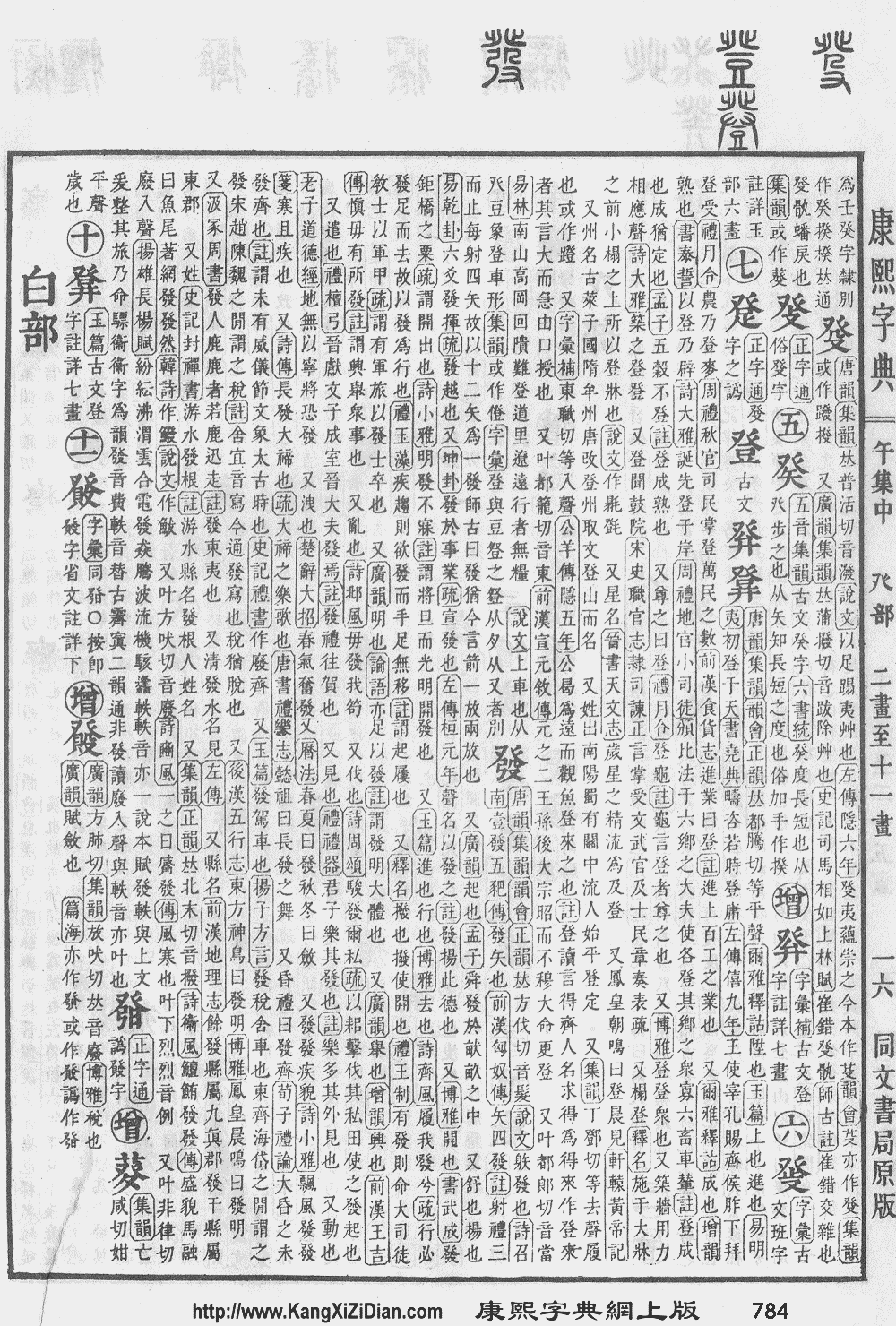
  • KangXi: page 784, character 7
  • Dai Kanwa Jiten: character 22668
  • Dae Jaweon: page 1193, character 16
  • Hanyu Da Zidian (first edition): volume 4, page 2760, character 11
  • Unihan data for U+767B

Chinese

simp. and trad.
登

Glyph origin

Ideogrammic compound (會意) : 癶 (“left and right feet”) + 豆 (“pictogrammic of raised object; stepping stone”).

Etymology 1

From Proto-Sino-Tibetan *s-tjaŋ (“top; to rise; to raise”) (STEDT). Cf. 陟 (OC *tɯɡ) (Wang, 1923) < *l-t(j)ak (“to ascend”).

Pronunciation


Rime
Character 登
Reading # 1/1
Initial (聲) 端 (5)
Final (韻) 登 (129)
Tone (調) Level (Ø)
Openness (開合) Open
Division (等) I
Fanqie 都滕切
Reconstructions
Zhengzhang
Shangfang
/təŋ/
Pan
Wuyun
/təŋ/
Shao
Rongfen
/təŋ/
Edwin
Pulleyblank
/təŋ/
Li
Rong
/təŋ/
Wang
Li
/təŋ/
Bernard
Karlgren
/təŋ/
Expected
Mandarin
Reflex
dēng
Expected
Cantonese
Reflex
dang1
Baxter–Sagart system 1.1 (2014)
Character 登 登
Reading # 1/2 2/2
Modern
Beijing
(Pinyin)
dēng dēng
Middle
Chinese
‹ tong › ‹ tong ›
Old
Chinese
/*k-tˁəŋ/ /*tˁəŋ/
English a kind of sacrificial vessel ascend

Notes for Old Chinese notations in the Baxter–Sagart system:

* Parentheses "()" indicate uncertain presence;
* Square brackets "[]" indicate uncertain identity, e.g. *[t] as coda may in fact be *-t or *-p;
* Angle brackets "<>" indicate infix;
* Hyphen "-" indicates morpheme boundary;

* Period "." indicates syllable boundary.
Zhengzhang system (2003)
Character 登
Reading # 1/1
No. 2169
Phonetic
component
登
Rime
group
蒸
Rime
subdivision
0
Corresponding
MC rime
Old
Chinese
/*tɯːŋ/

Definitions

登

  1. to go up; to climb; to mount; to rise
  2. to publish; to run (a story, an ad, etc.)
  3. (historical) to succeed in imperial examinations
  4. to ripen; to ripe
  5. a surname
Synonyms
  • (to go up):
  • (to publish):
  • (to ripen): 成熟 (chéngshú)
Compounds

Etymology 2

For pronunciation and definitions of 登 – see 得 (“to get; to obtain”).
(This character, 登, is an obsolete form of 得.)

References

Japanese

Kanji

登

(grade 3 “Kyōiku” kanji)

Readings

Proper noun

登(のぼる) • (Noboru) 

  1. a male given name

Korean

Hanja

登 (eumhun 오를 등 (oreul deung))

  1. Hanja form? of 등 (“to go up; to climb”).

Vietnamese

Han character

登: Hán Nôm readings: đăng, đắng

  1. This term needs a translation to English. Please help out and add a translation, then remove the text {{rfdef}}.
This article is issued from Wiktionary. The text is licensed under Creative Commons - Attribution - Sharealike. Additional terms may apply for the media files.