級
See also: 级
| ||||||||
Translingual
| Traditional | 級 |
|---|---|
| Simplified | 级 |
| Japanese | 級 |
| Korean | 級 |
Alternative forms
- In modern Chinese scripts, the radical component on the left is written 糹 (three dots below 幺).
- In Japanese kanji and Korean hanja, the radical component on the left is written 糸 (小 below 幺 but the middle stroke of 小 is written with a 丨 vertical stroke without bottom hook), which is the historical form found in the Kangxi dictionary.
- In traditional Chinese and Korean hanja, the 及 component on the right contains 又, which is the historical form found in the Kangxi dictionary.
- In mainland China (for the traditional form based on Xin Zixing (新字形)), Japanese kanji and Vietnamese Nôm, the 及 component on the right does not contain 又 and is written in 3 strokes (丿 followed by ⿱乛乛 and ㇏).
Han character
級 (Kangxi radical 120, 糸+4 in traditional Chinese and Korean, 糸+3 in mainland China and Japanese, 10 strokes in traditional Chinese and Korean, 9 strokes in mainland China and Japanese, cangjie input 女火弓竹水 (VFNHE), four-corner 27947, composition ⿰糹及)
Related characters
References
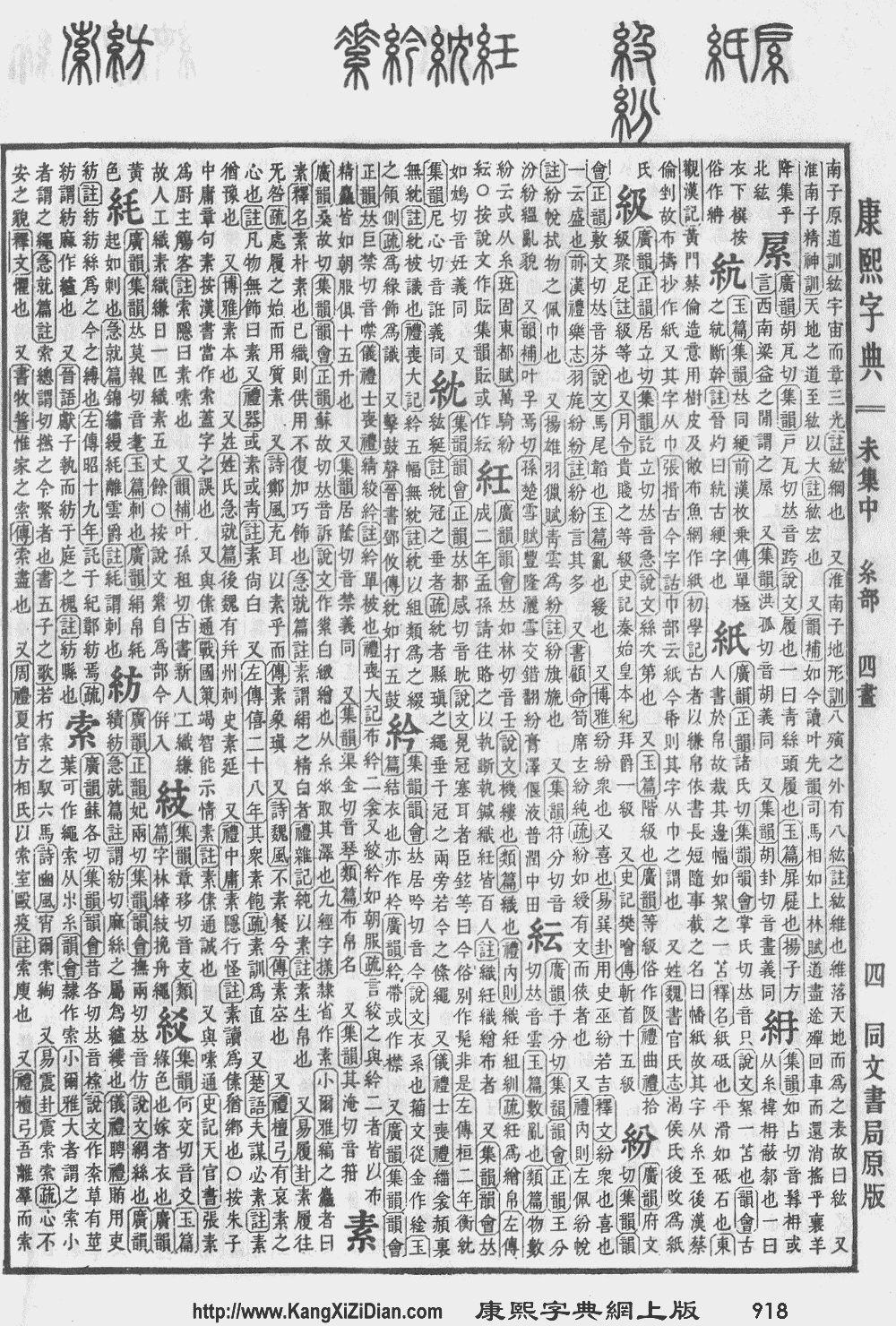
- KangXi: page 918, character 5
- Dai Kanwa Jiten: character 27294
- Dae Jaweon: page 1348, character 1
- Hanyu Da Zidian (first edition): volume 5, page 3366, character 2
- Unihan data for U+7D1A
Chinese
| trad. | 級 | |
|---|---|---|
| simp. | 级 | |
Glyph origin
| Historical forms of the character 級 | |
|---|---|
| Shuowen Jiezi (compiled in Han) | Liushutong (compiled in Ming) |
| Small seal script | Transcribed ancient scripts |
 |
 |
Characters in the same phonetic series (及) (Zhengzhang, 2003)
Phono-semantic compound (形聲, OC *krɯb) : semantic 糹/纟 (“thread”) + phonetic 及 (OC *ɡrɯb).
Pronunciation
Definitions
級
Synonyms
- (grade; form):
Dialectal synonyms of 年級 (“grade; year (in school)”) [map]
| Variety | Location | Words |
|---|---|---|
| Formal (Written Standard Chinese) | 年級, 級 | |
| Mandarin | Taiwan | 年級 |
| Singapore | 年級 | |
| Sokuluk (Gansu Dungan) | 號 | |
| Cantonese | Hong Kong | 年班, 年級 |
| Hakka | Miaoli (N. Sixian) | 年生, 年級 |
| Pingtung (Neipu; S. Sixian) | 年生, 年級 | |
| Hsinchu County (Zhudong; Hailu) | 年生, 年級 | |
| Taichung (Dongshi; Dabu) | 年生, 年級 | |
| Hsinchu County (Qionglin; Raoping) | 年生, 年級 | |
| Yunlin (Lunbei; Zhao'an) | 年生, 年級 | |
| Min Nan | Xiamen | 年級 |
| Quanzhou | 年級 | |
| Zhangzhou | 年級 | |
Compounds
Derived terms from 級
|
|
|
References
- “級”, in 漢語多功能字庫 (Multi-function Chinese Character Database), 香港中文大學 (the Chinese University of Hong Kong), 2014–
Japanese
| Shinjitai | 級 | |
| Kyūjitai [1] |
級󠄁 級+ 󠄁?(Adobe-Japan1) |
 |
| 級󠄃 級+ 󠄃?(Hanyo-Denshi) (Moji_Joho) | ||
| The displayed kanji may be different from the image due to your environment. See here for details. | ||
Readings
Etymology
| Kanji in this term |
|---|
| 級 |
| きゅう Grade: 3 |
| on’yomi |
| Alternative spelling |
|---|
| Q |
kipu → kiɸu → *kiwu → kiu → kyuː.
Pronunciation
- IPA(key): [kjuː]
Noun
Derived terms
References
- “級”, in 漢字ぺディア (Kanjipedia) (in Japanese), 日本漢字能力検定協会, 2015—2023
Korean
Etymology
(This etymology is missing or incomplete. Please add to it, or discuss it at the Etymology scriptorium. Particularly: “Middle Korean readings, if any”)
Pronunciation
- (SK Standard/Seoul) IPA(key): [kɯp̚]
- Phonetic hangul: [급]
Vietnamese
Han character
級: Hán Nôm readings: cấp, cóp, khớp, cụp
- This term needs a translation to English. Please help out and add a translation, then remove the text
{{rfdef}}.
References
This article is issued from Wiktionary. The text is licensed under Creative Commons - Attribution - Sharealike. Additional terms may apply for the media files.