苟
See also: 茍
| ||||||||
Translingual
Han character
苟 (Kangxi radical 140, 艸+5, 8 strokes, cangjie input 廿心口 (TPR), four-corner 44627, composition ⿱艹句)
Derived characters
References
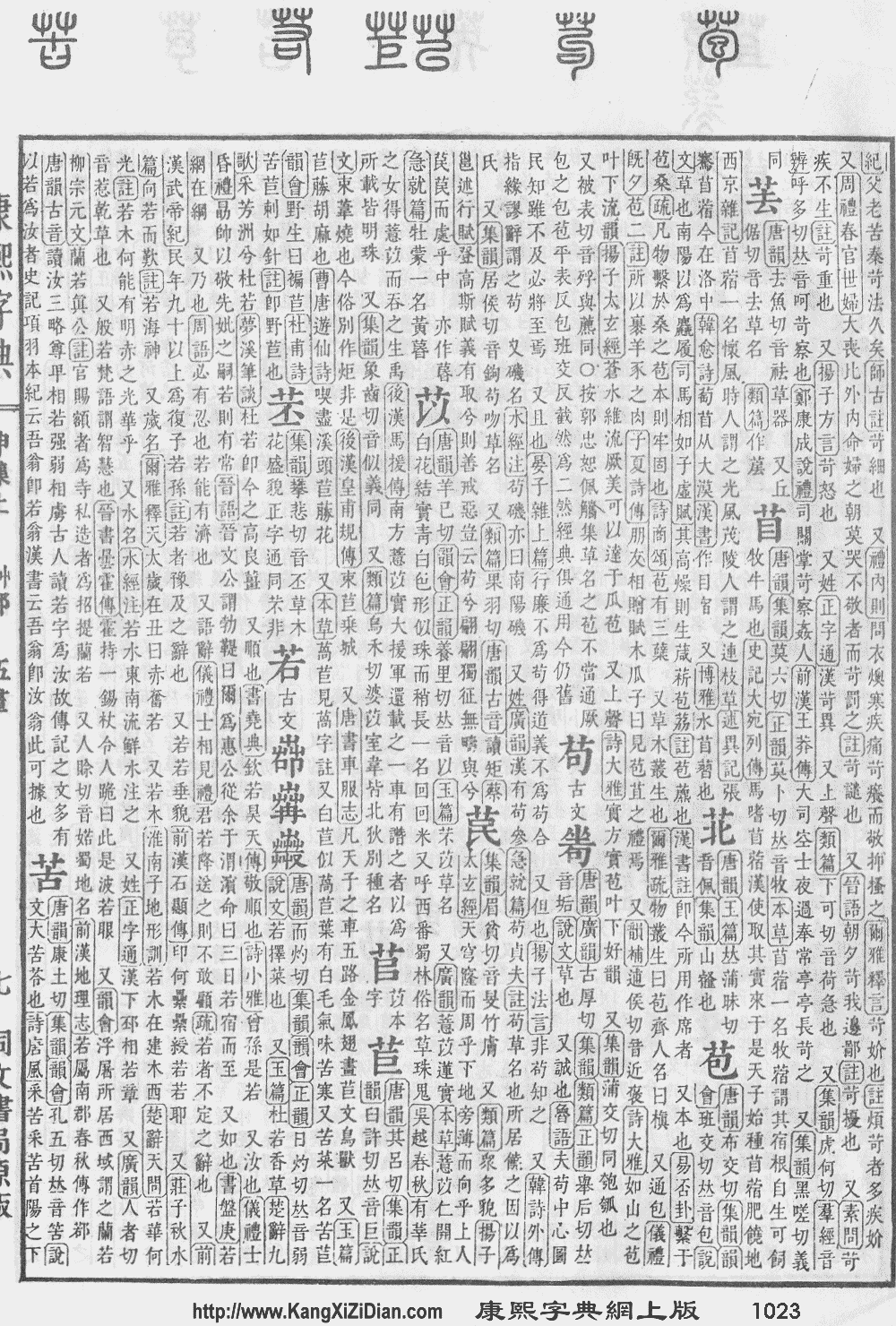
- KangXi: page 1023, character 5
- Dai Kanwa Jiten: character 30790
- Dae Jaweon: page 1482, character 5
- Hanyu Da Zidian (first edition): volume 5, page 3194, character 12
- Unihan data for U+82DF
Chinese
| trad. | 苟 | |
|---|---|---|
| simp. # | 苟 | |
| alternative forms | 芶 𠷜 𦯗 𦴆 𦴳 | |
Glyph origin
| Historical forms of the character 苟 | ||
|---|---|---|
| Western Zhou | Shuowen Jiezi (compiled in Han) | Liushutong (compiled in Ming) |
| Bronze inscriptions | Small seal script | Transcribed ancient scripts |
 |
 |
 |
Characters in the same phonetic series (句) (Zhengzhang, 2003)
| Old Chinese | |
|---|---|
| 勾 | *koː, *koːs |
| 鉤 | *koː |
| 鴝 | *koː, *ɡo |
| 句 | *koː, *koːs, *kos, *ɡo |
| 夠 | *koː, *koːs, *kʰoː |
| 枸 | *koː, *koːʔ, *koʔ |
| 軥 | *koː, *koːs, *ɡo |
| 狗 | *koːʔ |
| 苟 | *koːʔ |
| 岣 | *koːʔ, *ko |
| 笱 | *koːʔ |
| 玽 | *koːʔ |
| 耇 | *koːʔ |
| 豿 | *koːʔ, *qʰroːɡ |
| 敂 | *koːʔ |
| 怐 | *koːs, *kʰoːs, *qʰoːs, *kos |
| 雊 | *koːs |
| 竘 | *kʰoːʔ, *kʰoʔ |
| 齁 | *qʰoː |
| 呴 | *qʰoːʔ, *qʰos |
| 蚼 | *qʰoːʔ, *ɡo |
| 豞 | *qʰoːs |
| 訽 | *qʰoːs, *ɡoːs |
| 佝 | *qʰoːs |
| 拘 | *ko |
| 駒 | *ko |
| 眗 | *ko |
| 跔 | *ko |
| 鮈 | *ko |
| 痀 | *ko |
| 蒟 | *koʔ, *kos |
| 絇 | *kos, *ɡo |
| 邭 | *kos |
| 劬 | *ɡo |
| 朐 | *ɡo |
| 鼩 | *ɡo |
| 斪 | *ɡo |
| 翑 | *ɡo |
| 葋 | *ɡo |
| 姁 | *ɡo, *qʰo, *qʰoʔ, *qʰos |
| 欨 | *qʰo, *qʰoʔ |
| 喣 | *qʰoʔ |
| 煦 | *qʰoʔ, *qʰos |
| 昫 | *qʰos |
Phono-semantic compound (形聲, OC *koːʔ) : semantic 艹 + phonetic 句 (OC *koː, *koːs, *kos, *ɡo) – a kind of grass, in original sense.
Pronunciation
Definitions
苟
- careless; casual; indifferent
- casually; carelessly
- 苟同 ― gǒutóng ― to readily agree
- tentatively; for the time being
- 苟全性命於亂世,不求聞達於諸侯。 [Classical Chinese, trad.]
- From: 227, 諸葛亮 (Zhūgě Liàng) (Zhuge Liang), 出師表
- Gǒuquán xìngmìng yú luànshì, bù qiú wèndá yú zhūhóu. [Pinyin]
- For the time being, I did what I could to survive the chaotic times, and never wished to become eminent among the nobles.
苟全性命于乱世,不求闻达于诸侯。 [Classical Chinese, simp.]
- (literary) if only; if
- 苟能充之,足以保四海;苟不充之,不足以事父母。 [Classical Chinese, trad. and simp.]
- From: Mencius, c. 4th century BCE
- Gǒu néng chōng zhī, zúyǐ bǎo sìhǎi; gǒu bù chōng zhī, bù zúyǐ shì fùmǔ. [Pinyin]
- If the four principles can be developed, men will be capable of living and protecting all within the four seas; if the four principles are not developed, men will not be capable of serving their parents.
- † a type of grass
- a surname
Synonyms
Dialectal synonyms of 如果 (“if”) [map]
Compounds
Etymology 2
| For pronunciation and definitions of 苟 – see 茍 (“to be circumspect or cautious in one's behaviour ”). (This character, 苟, is recorded in one or more historical dictionaries as a variant form of 茍.) |
References
- “苟”, in 漢語多功能字庫 (Multi-function Chinese Character Database), 香港中文大學 (the Chinese University of Hong Kong), 2014–
Japanese
Korean
Vietnamese
Han character
1. (Tính) Cẩu thả, ẩu, bừa. ◎Như: "nhất bút bất cẩu" 一筆不苟 một nét không cẩu thả.
2. (Phó) Tạm, tạm bợ. ◎Như: "cẩu an đán tịch" 苟安旦夕 tạm yên sớm tối, "cẩu toàn tính mệnh" 苟全性命 tạm cầu cho còn tính mạng, "cẩu hợp" 苟合 lấy vợ lấy chồng không có đủ lễ chính đáng (không tính chuyện lâu dài).
This article is issued from Wiktionary. The text is licensed under Creative Commons - Attribution - Sharealike. Additional terms may apply for the media files.